
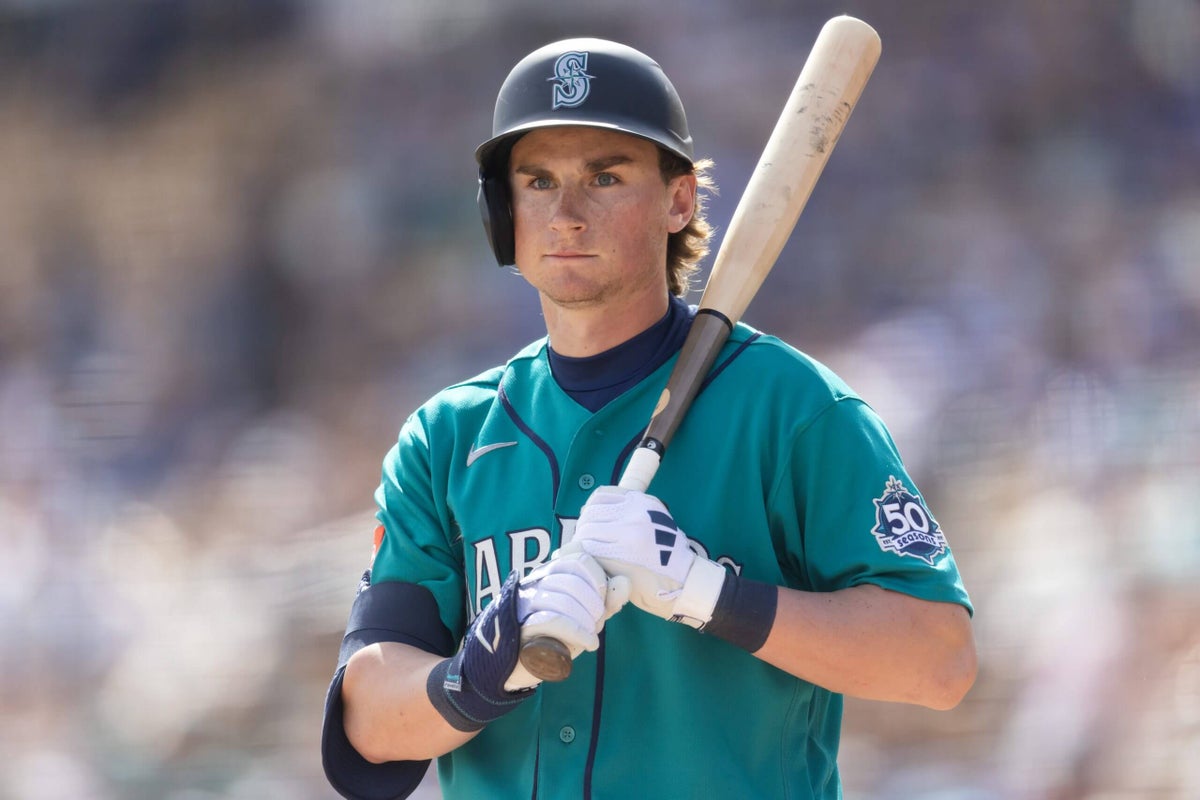
If baseball is broken, perhaps someone can explain how the team in the sport’s smallest television market is about to guarantee $50.75 million to a former sixth-round pick who has yet to play in the majors and last season had only a .691 OPS at Double A.
Actually, the explanation is simple.
The Milwaukee Brewers believe they will get more than their money’s worth out of shortstop Cooper Pratt, with whom they are finalizing an eight-year contract that includes two club options, according to major-league sources.
Teams only award extensions to players they project will outperform the contracts, producing surplus value. Owners crave cost certainty, especially near the end of a collective-bargaining agreement. And the expiration of the current CBA on Dec. 1 provides even more incentive for MLB franchises to lock up young talent.
Among many possibilities, the owners might try to tempt the players into accepting a salary cap by offering free agency earlier than the current six-year mark. The Seattle Mariners, in the eight-year, $95 million deal they awarded infielder Colt Emerson on Tuesday, bought out a minimum of two free-agent years, and as many as three if they exercise a club option. The additional control will be even more valuable if players in the next CBA can hit the open market sooner.
Even if the CBA remains unchanged, the Mariners will come out ahead if Emerson’s extension proves a bargain, as these deals often do. For every Scott Kingery or Evan White who underperforms his contract — both those players signed six-year, $24 million extensions with three club options in the late 2010s — there are numerous others whose below-market deals save their teams countless millions.
Thus, more extensions are likely in the coming days and months, particularly with so many rookies already making significant impacts in the new season.
The Pittsburgh Pirates have been negotiating with shortstop Konnor Griffin, who is currently at Triple A. St. Louis Cardinals shortstop JJ Wetherholt, Cincinnati Reds first baseman Sal Stewart, Detroit Tigers shortstop Kevin McGonigle and Cleveland Guardians outfielder Chase DeLauter are among the other logical candidates for long-term deals.
Not every team, though, is sold on the risk. Buster Posey, in his second season as San Francisco Giants president of baseball operations, told The Athletic’s Andrew Baggarly he has no immediate plans to pursue an extension with the team’s top prospect, first baseman Bryce Eldridge.
“Personally, I’m probably more in the cautious bucket,” Posey said, citing the difference between performing in the major and minor leagues that he experienced during his decorated 12-year playing career.
“I’m actually curious to talk to some of the executives that have done this and understand the rationale. I can somewhat see it on the surface. It’s a gamble, for sure. But I think it can go one way or the other, or it can be somewhat neutral, and I suppose that holds true for any contract.”
Other executives, relying on projection models, are more enthusiastic about securing top prospects for the long term. Here’s the counterintuitive part: As revenue-sharing recipients such as the Brewers and Mariners sign young players to extensions, they water down future free-agent markets, seemingly weakening the argument for a cap.
The Kansas City Royals’ Bobby Witt Jr., Mariners’ Julío Rodríguez and Arizona Diamondbacks’ Corbin Carroll are among the other players from revenue-sharing recipients to agree to long-term extensions. And while Detroit Tigers left-hander Tarik Skubal could land a record contract for a pitcher next offseason, no free-agent position player is likely to approach Juan Soto’s record 15-year, $765 million deal on the open market anytime soon.
For young players, the chance to secure life-changing money often outweighs the upside of going year to year in arbitration and hitting free agency at a younger age. Carroll, who in March 2023 signed an eight-year, $111 million extension with a club option, recalls advice he received from then-Diamondbacks teammate Evan Longoria, who 15 years earlier had signed an extension six days into his career.
Longoria told Carroll he could now “play free.”
“I don’t regret that decision for a day,” said Carroll, who had only 40 days of service when he agreed to his contract. “This is a hard game for young players, a lot of ups and downs. Just the stability … that has provided for me has made those waters easier to navigate.”
Pratt’s agent, Scott Boras, generally prefers clients to establish their values in free agency. He rarely advises players to accept deals with multiple club options. But Pratt, whose extension is pending a physical, agreed to the fifth-largest contract in Brewers history, and more than twice what Kingery and White received in their pre-debut deals. Not too shabby, considering he has yet to prove he can hit even minor-league pitching.
So, what were the Brewers thinking?
Again, it’s simple. The three-time defending NL Central champions are not about to match the spending of the division rival Chicago Cubs, who in the past three months have signed third baseman Alex Bregman, center fielder Pete Crow-Armstrong and second baseman Nico Hoerner for a combined $431 million. The Brewers prefer to make smaller bets. The eight-year, $82 million contract they awarded outfielder Jackson Chourio prior to his debut was one. The Pratt deal is another.
Pratt, who turns 22 in August, has played only three games at Triple A. Some club officials, however, compare his defense at shortstop to that of their former All-Star at the position, J.J. Hardy. Citing Pratt’s speed, athleticism and aptitude, they figure his offense will come. And even if Pratt proves only a defense-first type, his floor could be $50.75 million. In that sense, he is similar to Crow-Armstrong, an elite defender and developing hitter whose new Cubs deal is worth $115 million.
This isn’t the Brewers’ first commitment to Pratt. They signed him for $1.35 million, more than $1 million above slot, after making him the 182nd overall pick in 2023. The new contract obviously demonstrates even greater faith in him, particularly at a time when another Brewers minor-league shortstop, Jesús Made, 18, is the game’s No. 3 prospect, according to The Athletic’s Keith Law. Made eventually could end up at second base, third or left field.
Pratt is No. 99 in Law’s top 100. Emerson, a year younger and drafted much higher as the No. 22 pick in 2023, is No. 4. His $95 million guarantee is only $4.4 million less than the amount of new money the Mariners awarded catcher Cal Raleigh last March, when he was three years from free agency and not yet a 60-homer man. Again, hardly the sign of a sport that is broken.
The Mariners were willing to invest in Emerson in part because they expect him to reach the majors at some point this season, making it likely under the current rules that he would become a free agent entering his age-27 campaign. His eventual position figures to be shortstop, and up-the-middle defenders who are above-average hitters command huge dollars on the open market. Like the Brewers with Pratt, the Mariners are also betting on the person. Emerson’s makeup is considered impeccable.
The best part for the Mariners is that Emerson, according to MLB.com, will earn an average of $15 million per season in the final five years of the deal. If teams continue to sign free agents to shorter contracts with high average annual values — see Kyle Tucker for four years at $60 million per season and Bo Bichette at three years at $42 million per — Emerson’s contract might look better and better.
One negative: By signing Emerson before his debut, the Mariners forfeited their right to earn a Prospect Promotion Incentive (PPI) draft pick if he won Rookie of the Year. But Emerson was something of a tweener, unlikely to reach the majors in time to qualify the team for the PPI selection, but likely to play enough to lose his rookie eligibility for 2027. In the end, the Mariners valued the extension over the possibility of a pick. The Brewers made the same call on Pratt, who appears less likely to win Rookie of the Year.
Both the Mariners and Brewers are open to cutting similar deals with other prospects, according to sources briefed on their strategies. Some of those players will resist, and perhaps they’ll regret their decisions if their careers go awry. Others will accept, willing to sacrifice tens of potential millions for long-term security. If the next CBA includes a salary floor as well as a cap, such extensions are likely to become even more common.
Clubs do not offer such deals haphazardly. In trying to buy low, they know exactly what they are doing.