
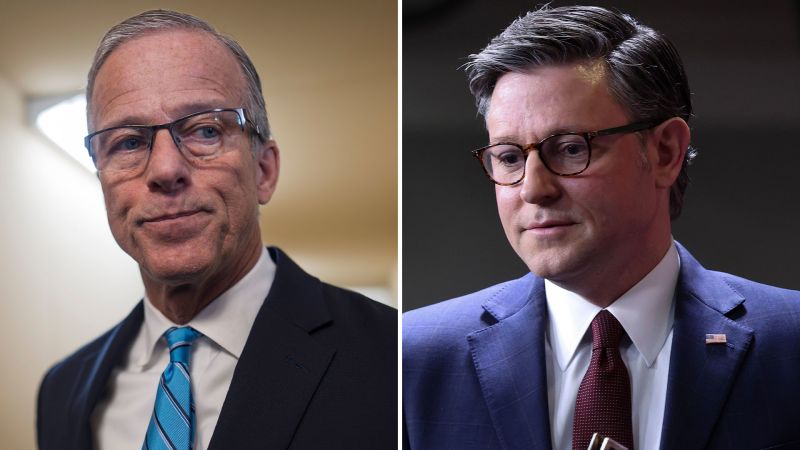
What started as a shutdown face-off between Republicans and Democrats has morphed into a full display of disunity between GOP leaders just months ahead of the midterm elections
Senate Majority Leader John Thune’s decision to leave immigration enforcement funding out of a deal with Democrats to reopen the Department of Homeland Security and the House GOP’s revolt over that deal has shattered the fragile party unity that had been crucial to President Donald Trump’s second term.
Now, Republicans are running Washington during the longest-ever shutdown of DHS with no path out, while their unifier, Trump, is consumed by a Middle East war that threatens even more problems for Congress this year.
Thune, knowing he had to contend with Democrats, cut the only deal he believed was possible to end the shutdown. The Senate GOP leader’s allies insist that he didn’t make the decision unilaterally and that his members agreed by virtue of not stopping the measure. They also point out that Republicans can use a party-line maneuver later on to secure the rest of the funding.
Thune and Johnson have spoken several times since Friday, when the Senate plan to end the shutdown was blocked in humiliating fashion by House Republicans, according to two people familiar with the discussions, though both declined to offer specifics about what was discussed or their plans going forward.
But there are still deep divisions between the two GOP leaders and their conferences, with fulsome bipartisan negotiations virtually nonexistent — raising real questions about whether Republicans can end the shutdown.
Now in a two-week recess, the two Republican-led chambers are deadlocked with both hesitant to cut short their time away from Washington without a clear solution that can make it to Trump’s desk. And Republicans are keenly aware that Democrats — whose votes will be needed for the final deal — see no reason to bargain amid the GOP dysfunction.
It also reveals a deepening schism between the two men, who have until this point navigated occasional tactical differences behind the scenes. Now, Johnson — buoyed by Trump — is leading a public campaign to pressure the Senate back to Washington to push a hardline shutdown strategy, while Thune becomes a target of seething conservative backlash.
“We have got a dilemma. … The Senate has to do their job and help us on this heavy lift,” Johnson said Tuesday on Fox News, in a rare missive directed at his fellow Republicans across the Capitol. “We have to get the government funded, and they are playing games with real people’s lives.”
Johnson, a devout Southern Baptist who mostly avoids disparaging fellow Republicans, has been careful not to criticize Thune directly in public. But privately, he and his fellow House GOP leaders believe Thune botched the negotiations and triggered an intraparty clash that could last through the midterms.
Asked about Thune’s leadership, Rep. Lisa McClain, a member of House leadership, told CNN: “I’d rather not comment on that, but I would suggest the Senate does come back and at least take a vote. That is what they were elected to do.”
Rep. Mike Simpson, a mild-mannered Mormon and 27-year veteran of the House, added to CNN: “I don’t have principled words I can say about it.”
But when pressed about Thune’s push ahead on shutdown talks without consent from House GOP leaders, he added: “It’s never a good idea. I keep telling myself, well, that’s the Senate. I try not to interfere with their business. But it’s questionable, let’s put it that way.”
It’s not just House Republicans who have at times broken with Thune amid the shutdown: Even centrist Sen. Susan Collins declined to put her name on the amendment that Thune introduced last week to eliminate the contentious immigration funding, according to one person familiar with those internal discussions. One of Thune’s most hardline members, Sen. Mike Lee of Utah, has been calling for the Senate to come back into session for days.
Some of Thune’s fellow Senate Republicans, however, have previously acknowledged their leader has been dealing with difficult decisions for months.
“He’s doing good considering the team he’s got,” Republican Sen. Tommy Tuberville said of Thune before the Senate passed the bipartisan DHS deal. “We’re so divided on how to handle certain things and he just got dealt a hand that is very, very tough to control.”
“The thing I would say about John Thune is he’s an honest man, he’s an honest broker and I think that really counts for a lot,” Sen. Josh Hawley said in a recent interview before Thune put the DHS spending bill on the floor. “That is a quality in short supply in this town. I have never had John Thune tell me something that wasn’t true and I never had him make a promise he didn’t keep.”
It’s not just the shutdown. Thune and Johnson — as well as much of the GOP — are on different planets when it comes to what else Congress should tackle in 2026. Johnson has been adamant that Congress should pursue another massive partisan policy bill that could involve major Trump priorities such as a voter ID law before the midterms using a procedure known as reconciliation.
For Johnson, satisfying his right flank is essential for his own survival in leadership. (And he has a lot more GOP hardliners on his side of the Capitol than Thune does.)
But some Senate Republicans have been frustrated that Johnson and hardline conservatives are pushing a sweeping reconciliation plan when the lower chamber barely has a functioning majority. They believe it sets up failure and will only alienate the Trump base come November.
Some Trump officials are aware that jamming another major party-line bill through Congress could end in failure, especially with only months left until the midterms and no clear consensus on what should go into the legislation.
But many around Trump believe they need to give it a shot, eager to show the MAGA base that they’re still fighting for key priorities — and of the belief that Trump’s outsize influence could still be enough to convince lawmakers to line up behind another big bill.
“I was told we couldn’t do the ‘One Big, Beautiful Bill’ from some really smart inside baseball Hill people,” said one Trump adviser. “And they obviously did it.”
Senior Republican lawmakers and aides acknowledge that much of the fury at Thune comes from an insatiable push from conservatives to nuke the Senate’s filibuster and allow the chamber to pass anything they please without Democratic votes. Thune — while far from the only GOP senator who wants to preserve the filibuster — has become the public face of the battle.
Online, Thune has become the latest target for MAGA influencers already upset with him over his refusal to kill the Senate’s filibuster (which he has said repeatedly he doesn’t have the votes to do) to pass the president’s “SAVE America Act” voter ID bill. Some House conservatives have even called on Thune to be replaced, which has virtually no chance of happening given support for the South Dakota lawmaker within his ranks. Senate GOP sources, including conservatives, told CNN that is highly unlikely in the coming months.
Still, Thune is hammered every time he has to negotiate with Democratic colleagues, who are crucial to the 60-vote threshold to end debate and move to a final vote on legislation.
The latest tension between the two GOP leaders indicates trouble ahead as the party stares down a tumultuous few months in which they still have to pass a clean reauthorization of the intelligence community’s spy powers, find a way out of the shutdown, and face pressure to pass another party-line policy bill that will once again force both GOP leaders to operate with almost no defections.
Then there’s a potentially massive funding request from the Pentagon that has already revealed deep divisions among Republicans — and even a rare split with Trump.
While the recent disagreement over funding has been on full display, the president himself has been careful not to target Thune directly.
“I understand John Thune and I understand Mike Johnson,” Trump said Friday. “They want to be sure that people aren’t coming into our country like they have for the last four years. I don’t want to say they’ve ruined it. They made my job a lot harder and now we have it good.”
People inside the White House also still view Thune as a straight shooter and key ally of the president in the Senate, adept at navigating sometimes-conflicting viewpoints even within his own conference.
“It’s hard being the leader because you’ve got to deal with a lot of people and they all have their own egos and they all have their own constituencies,” the Trump adviser said. “No matter what happens, Mike Johnson will still be speaker and even John Thune will probably still leader. Maybe not, but who knows.”