
Christian faith has always played a significant part in American public life. Today nearly two-thirds of Americans identify as Christian, even if many don’t regularly attend church. The story of the United States is intertwined with the religion despite being a nation with a secular Constitution.
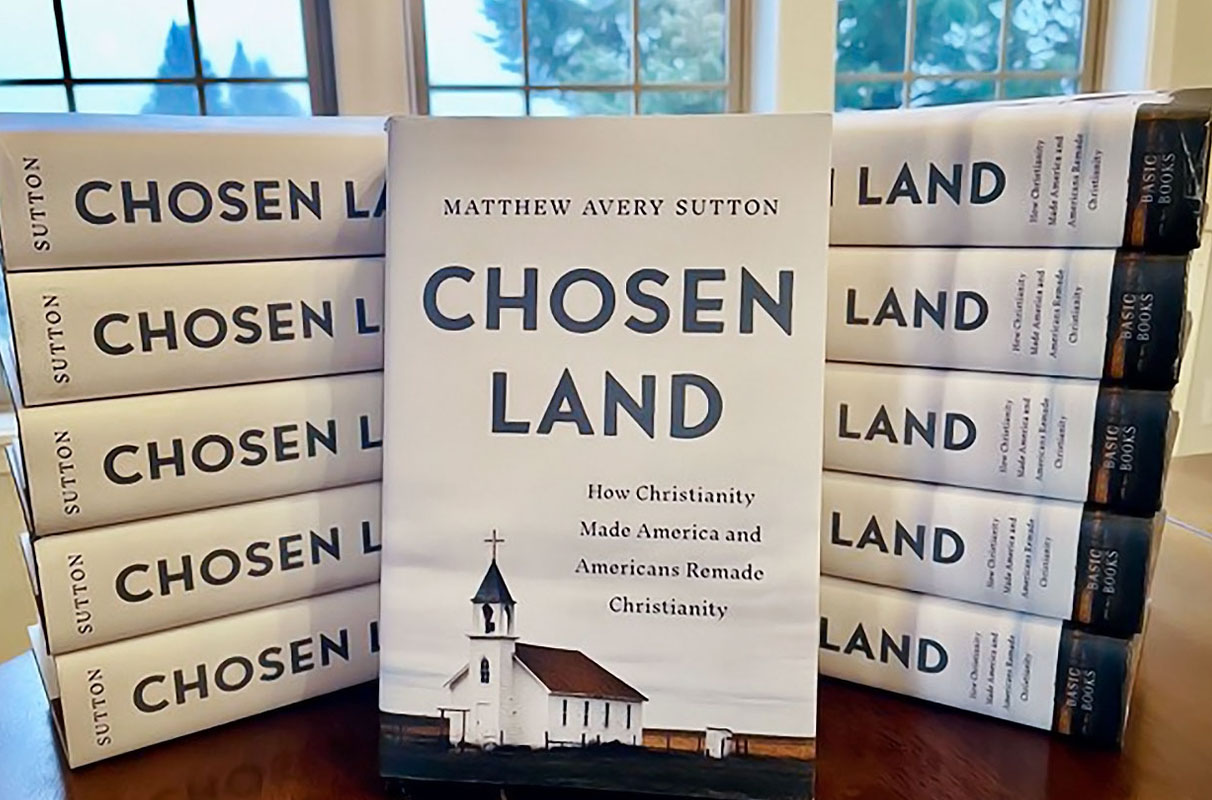
Matthew Avery Sutton, Claudius O. and Mary Johnson Distinguished Professor and chair of the Department of History at Washington State University, explores that story in his book Chosen Land: How Christianity Made America and Americans Remade Christianity (Basic Books, 2026). His expansive history of Christianity in America shows the prominent role of Christian faith and practice in politics, education, popular culture, and law through many examples from all eras of U.S. history.
 Matthew Sutton
A sweeping history of the effort to transform North America into a new holy land, Chosen Land chronicles the rise of American Christianity and its continuing influence. A crucial part of that growth came from evolving strains of Christianity battling for potential adherents, because the nation’s lack of a state religion “was not a barrier to religious influence, but stimulated religious innovation, expansion, and integration in every part of American life,” Sutton writes.
Sutton talked about the book and its ideas with Washington State Magazine editor Larry Clark.
How is Christianity ingrained in America and America’s consciousness?
As a historian who specializes in religion, I’ve always been struck by how much more religious we are than our competitor nations, like Canada and much of western Europe. To understand this story, we have to go back to the First Amendment and what the founders were trying to do in intentionally creating a godless, secular Constitution. They looked at European models with their established, official churches, and they realized there’s no consensus in the colonies around a single denomination, but you need to organize together to fight the revolution. So, you can’t choose Presbyterians over Anglicans over Baptists.
An unintended consequence is that not choosing a single winner opened the doors for those who already had power: mainstream Protestant leaders. But they had a problem — there’s not a state mechanism providing financial support to underwrite their work, so they have to be relevant.
They became more effective than Christians in many other parts of the world because they tapped into Americans’ needs, desires, interests, and entertainments. That set the stage for Christian leaders to influence culture, laws, foreign policy, education — because all those things were going to help ensure their longevity.
What are some key events and figures that helped keep Christianity infused in society?
I open the book with this revivalist, Peter Cartwright, because he’s campaigning for a seat in Congress against Abraham Lincoln. The challenge for Lincoln was that he was pretty unorthodox and Cartwright knew it. Lincoln didn’t attend church regularly and was kind of skeptical about the Bible. So, Cartwright made religion central to the Congressional campaign and essentially forced Lincoln to affirm that he was pro-church, pro-Christian, pro-God, and that he would never do anything as a political leader to undermine the power of establishment Christianity.
But Cartwright wasn’t just working through politics. He was also very entertaining. He would tell these fabulous stories to get attention from journalists to make sure he got good newspaper coverage. So, we see all these themes coming together, of media and innovation and entrepreneurship and politics and religion, then we fast forward and see Billy Graham and Martin Luther King Jr. doing the same thing.
What are some key points for someone who reads Chosen Land?
I hope to convince those who are more secular to take American Christianity more seriously. For those who are more Christian, I want to help them see that their history is complicated, and that there have been many competing versions of Christianity vying to shape the trajectory of the nation.
Christianity remains central to all of the things that both unite and divide us. And if we don’t recognize or understand that, then I think we won’t be as effective at building the kind of future we want, regardless of what that future might look like.