
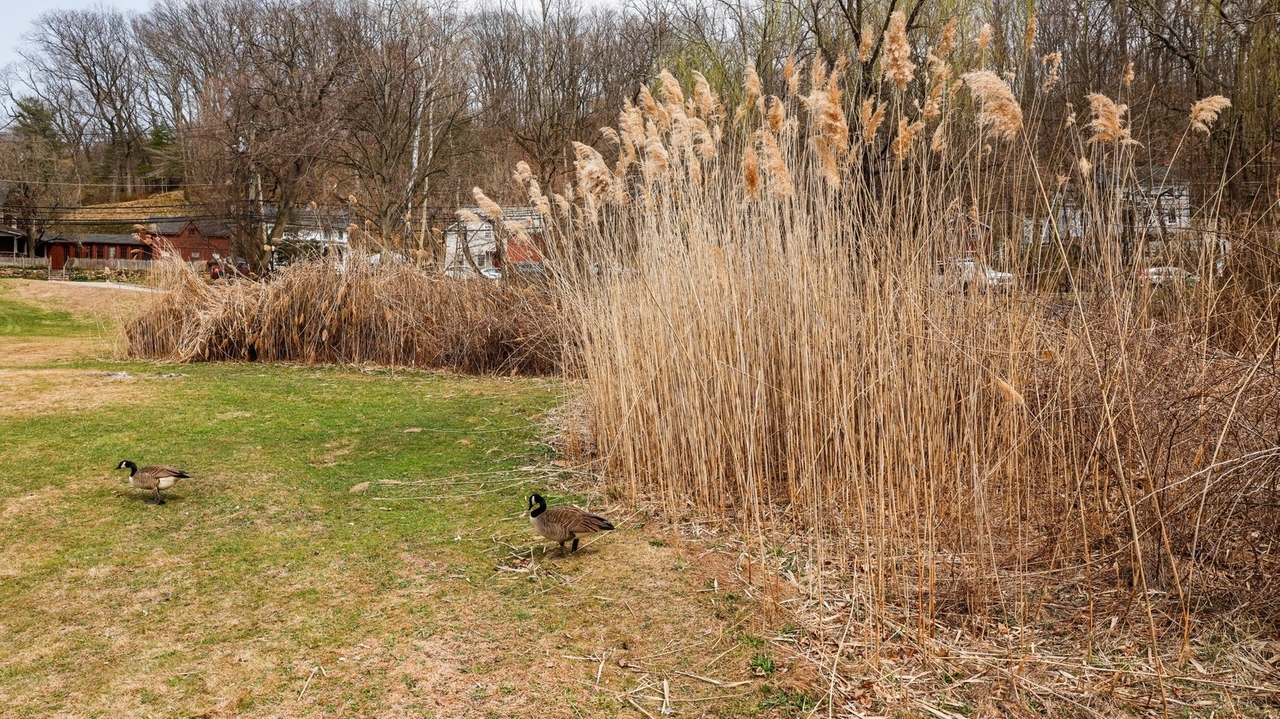
Gerry Pond Park, a quiet oasis in a historic part of Roslyn where geese like to swim, is being attacked by a seemingly innocuous offender: flowering plants.
The plants, known as common reed grass (Phragmites australis), are an invasive species. They are popular on Long Island, but do not filter stormwater or help prevent erosion.
The Nassau County Soil and Water Conservation District has a plan, and, as of Monday, the funds to execute it. The district received a $248,372 grant from the state Department of Environmental Conservation to combat invasive species at the Roslyn park, as well as at Muttontown Preserve, Lido West Town Park and the Hempstead Plains Preserve.
It was among more than $900,000 in grants awarded to Nassau and Suffolk counties to tackle invasive species and restore damaged habitats. The funds also went to removing an invasive species that developed after Superstorm Sandy, and to repair damage from pine beetles at the Quogue Wildlife Refuge.
Derek Betts, district manager for the Nassau agency, said in an interview that invasive species such as common reed grass can thrive on Long Island but don’t provide “ecological services” to the environment.
“They’re not able to withstand storm surges much, erosion as much,” Betts said. “And they don’t offer that filtration benefit that a lot of our deep-rooted species have.”
The Roslyn park, which was built in 1930, has become overrun with the flowering plants in the upper pond and wetland areas, Betts said. Other invasive plants that could be removed as part of the effort include multiflora rose, common ivy, Japanese knotweed, Japanese honeysuckle, tree of heaven and bittersweet nightshade.
The district will then plant native wetland trees and shrubs, Betts said, such as red maple and silver maple trees and arrowwood viburnum.
Muttontown, Hempstead projects
A project at Muttontown Preserve will see the removal of burning bush, with potential collateral invasives including Oriental bittersweet, multiflora rose, Norway maple and border privet.
The agency will plant an array of ground cover, forest trees and shrubs to “revegetate the understory and outcompete invasive species,” Betts said.
In the Town of Hempstead, Asiatic sand sedge, which formed after Superstorm Sandy, will be removed from Lido West Town Park. “Deep-rooted vegetation,” such as little bluestem, seaside goldenrod and American beachgrass will be installed in its place.
Invasives such as multiflora rose and autumn olive will also be removed from Hempstead Plains Preserve. A pilot re-seeding project using ecotypic Long Island seed will “further strengthen seed bank resilience,” Betts said.
Boat inspections
The state also awarded more than $600,000 to efforts in Suffolk, such as a $224,869 award to the Southampton Township Wildfowl Association to “correct ecological damage caused by the invasive southern pine beetle at the Quogue Wildlife Refuge,” according to a DEC news release.
The nonprofit Save the Great South Bay received a $65,750 DEC grant.
Robyn Silvestri, executive director of Save the Great South Bay, said the money will help fund free inspections of boats for invasive species like red seaweed, feather weed, green crabs and devil’s tongue weed.
The invasive species have been found to spread throughout the Great South Bay by latching onto watercraft and then drifting onto beaches, Silvestri said in a phone interview.
She added that one species of red seaweed “stinks to high heaven.” The algae have become “a big problem the last couple of years,” she said.
“We’re looking to see if boats are spreading invasive species from water body to water body,” Silvestri said.
The grant will fund two workers who will staff public boat launches on the South Shore between Memorial Day and Labor Day, Silvestri said. The nonprofit hopes to start the program in May, she said.
Newsday’s Carl MacGowan contributed to this story.
The fight against invasivesThe Nassau County Soil and Water District received $248,372 to remove invasive species and restore native habitats at three locations.A project at Lido West Town Park will see the removal of Asiatic sand sedge, which largely formed after Superstorm Sandy destabilized the dunes.Save the Great South Bay received $65,750 to help fund free inspections of boats for invasive species. 
Joshua Needelman covers the Town of North Hempstead for Newsday. A Long Island native and University of Maryland graduate, his work has appeared in publications including The New York Times and The Washington Post.