
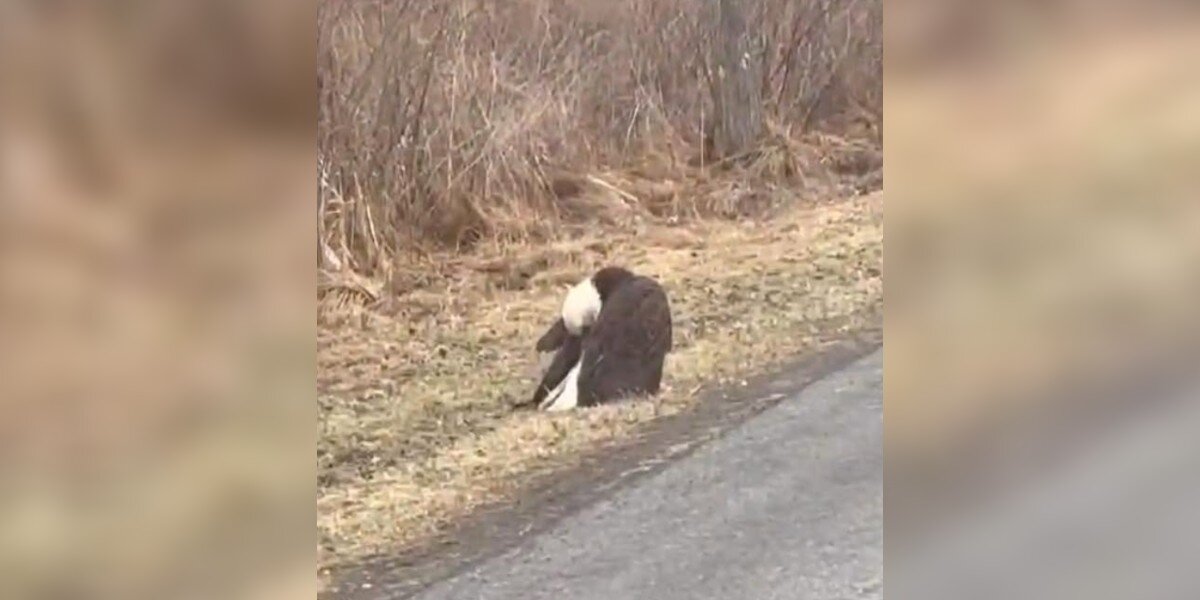
Normally, seeing a bald eagle in the wild is an awe-inspiring experience. But the other day in Wallkill, New York, a man spotted one of the majestic birds curled up on the ground on the side of the road and knew immediately that something was wrong.
The man called Dave Loverde, owner of Friends of the Feathered and Furry Wildlife Center (FFF Wildlife Center), for help. When the rescuer arrived, he found the eagle fast asleep right next to the busy street.
 FFF Wildlife Center
“It’s extremely unusual for an eagle that big to be on the ground and sleeping right next to a road,” Loverde told The Dodo. “As soon as I saw that, I knew she was in trouble.”
Loverde instantly suspected that the lethargic animal was suffering from lead and rodenticide poisoning. Eagles typically sleep in the safety of tall trees, but the toxin had compromised the bird’s nervous system, leaving her disoriented.
“With lead poisoning … the first thing that goes is their peripheral vision,” Loverde said. “So that’s why she was on the ground, because she was afraid to fly and really couldn’t see what she was flying into.”
 FFF Wildlife Center
The eagle was so out of it that she didn’t even protest as Loverde trapped her in his net. Back at the FFF Wildlife Center facility, a test confirmed that the eagle had elevated lead levels in her blood, the result of her eating an animal with a bullet in their body.
“She was dangerously close to dying,” Loverde said.
The care team at FFF Wildlife Center got the eagle started on a treatment that helped reduce the level of poisons in her bloodstream. It’s now been 10 days since the eagle arrived at the rescue center, and she’s already doing much better.
 FFF Wildlife Center
“She’s doing really well,” Loverde said. “I put her in a cage outside and she’s flying around like crazy.”
Unfortunately, FFF Wildlife Center sees dozens of cases of wildlife poisoned by rodenticide every year. The good news is that saving these animals’ lives is as simple as avoiding the use of these substances.
“You can help protect wildlife by ditching the rat poison,” FFF Wildlife Center wrote on Instagram. “These toxins cause internal bleeding in rodents, but they also harm eagles, owls, hawks, and other animals that eat the poisoned rodents.”
 FFF Wildlife Center
Once the eagle is feeling a bit better, she will be transferred to a flight cage so she can get her strength up. Before long, she will be released back into the wild, where she’ll get to spread her wings and fly free.
If you’d like to support FFF Wildlife Center, you can make a donation here. Flightless Eagle ‘Stumbles’ Through The Woods Until A Pair Of Heroes Arrive“Our rehabilitator feared the worst …”