
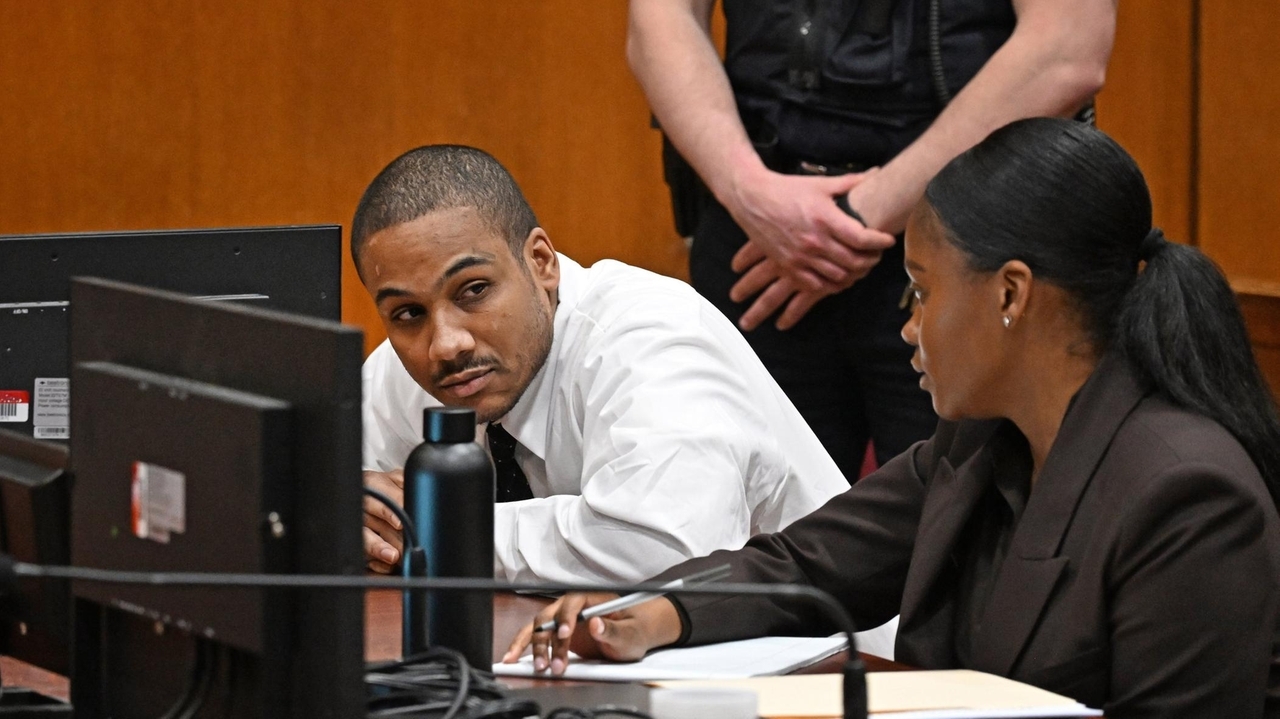
A jury convicted a 36-year-old Queens man of aggravated manslaughter but acquitted him of the top count of first-degree murder Wednesday evening in the 2024 killing of NYPD Det. Jonathan Diller, of Massapequa Park.
Chaos ensued immediately after the verdict was first announced. While jurors were being polled individually on whether they supported the verdict, one juror told the judge he didn’t agree with the jury’s decision on one charge.
The judge then asked the jury to resume deliberations to reach a unanimous verdict. The panel returned and affirmed the original verdict by 7:20 p.m.
Queens Supreme Court Justice Michael Aloise Tuesday had allowed for the possibility the jury might find defendant Guy Rivera lacked the intent to kill Diller, including for the panel’s consideration a lesser charge of aggravated manslaughter in the first degree. That lesser charge means a person intends to cause serious physical injury to a police officer and death results.
WHAT NEWSDAY FOUNDA Queens man was convicted of aggravated manslaughter in the killing of NYPD Det. Jonathan Diller during a 2024 encounter.Guy Rivera was acquitted of the top charge of first-degree murder but was convicted of first-degree attempted murder of a police officer and two weapons charges.Stephanie Diller, the detective’s widow, left the courthouse after the verdict without making any comments.
“We present the evidence. The jury decides the case,” said Queens District Attorney Melinda Katz. But she said Rivera is still facing a maximum of 90 years to life behind bars.
Stephanie Diller, the officer’s widow, put both hands to her face when Rivera was acquitted of first-degree murder. She and her family left the courthouse without comment after the jurors affirmed the original verdict.
Jurors also found Rivera guilty of first-degree attempted murder of a police sergeant and two charges of criminal possession of a weapon.
Afterward, NYPD PBA President Patrick Hendry expressed outrage over the jury’s acquittal of Rivera on the first-degree murder count. Flanked by a crowd of officers on the courthouse steps, he said: “The police officers behind me know it was murder one, no doubt about it.”
Hendry said of the Diller family: “The decision gives them some justice but it is not full justice, it isn’t the full closure, the pain will never go away.”
During the three-week trial, jurors heard emotional testimony from the fallen officer’s widow and police officers who witnessed the fatal encounter.
Rivera went on trial in Queens State Supreme Court on March 10 in front of a jury that included 16 members and alternates. He was charged with first-degree murder, attempted first-degree murder of a police officer as well as various weapons counts.
The panel began deliberations Wednesday morning after receiving instructions from the judge.
The prosecution’s case centered on the testimony of Diller’s fellow police officers at the crime scene. Police body camera videos were also key pieces of evidence used by both the prosecution and defense. The defense rested without calling any witnesses.
Rivera was represented by attorneys for the Legal Aid Society. Rivera had a previous criminal record which sent him to state prison.
The 31-year-old Diller was part of a special community response team and was on a dinner break around 5:30 p.m. the afternoon of March 25, 2024, on Mott Avenue in Queens.
NYPD Det. Jonathan Diller was shot and killed in the line of duty in Far Rocakaway, Queens, on March 25, 2024. Credit: NYPD
Trial evidence showed Diller and other officers surrounded a Kia Soul car parked by 19-19 Mott Ave. in which Rivera was a passenger. Moments before Rivera entered the vehicle, NYPD Sgt. Sasha Rosen testified he saw the outlines of a firearm in Rivera’s hoodie.
With Rosen suspicious that Rivera was armed, he, Diller and other officers approached the car and Diller — who was standing by the passenger-side door — asked Rivera to exit the Kia. All of the officers were dressed in distinctive khaki pants and had on police raid jackets emblazoned with the letters “NYPD.”
Police videos showed Rivera initially refused to roll down the driver’s side window and wouldn’t exit the car despite being repeatedly ordered to do so by Diller. The door finally opened when another officer on the driver’s side reached where co-defendant Lindy Jones was seated and opened the door locks.
“Yo, don’t go into your pocket!” one officer yelled to Rivera as the passenger door opened.
Rivera was seen on body camera videos leaning toward Diller, reaching into his jacket pocket and pulling out a .380-caliber handgun, later determined to be unlicensed, which fired, fatally wounding Diller.
Diller fell to the ground, saying he was shot in the leg when in fact he suffered a gunshot wound to his abdomen.
Another officer fired at Rivera, who suffered back and arm wounds that sent him to a hospital.
Diller was rushed in a police car to Jamaica Hospital Medical Center where doctors worked feverishly to revive him. When he arrived in the emergency room Diller was dead, but doctors were able to revive his heart a number of times. But having lost about 75% of his blood, Diller died at about 8 that night.
Defense attorneys had argued in their opening statement and summation that the events captured on the videos indicated the shooting was unintentional and the result of Rosen, who was standing with Diller by the passenger door, reaching in and grabbing Rivera’s arm holding the gun.
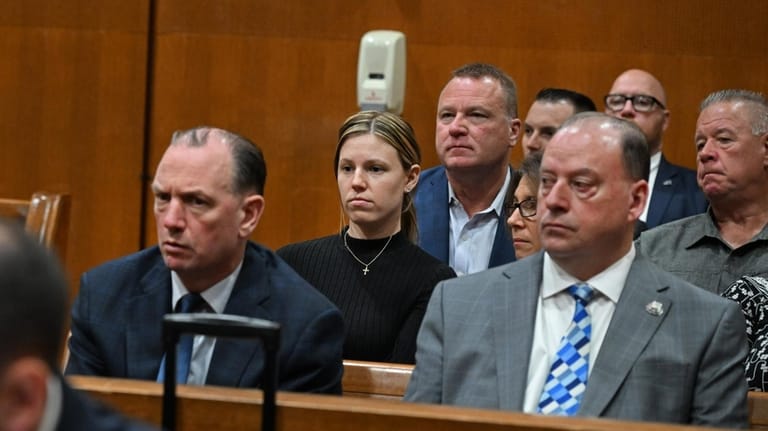
Widow Stephanie Diller, center, in Queens Criminal Court on Wednesday as the jury begins deliberations against a man charged in her husband’s killing. Credit: Gregory P. Mango/New York Post/Gregory P. Mango/New York Post
Diller’s wife and other family member attended each day of the trial, leaving the courtroom only when the graphic videos of Diller being shot were shown to the jury.
Stephanie Diller testified briefly and emotionally that her husband had called to say he would be home for dinner. About 15 minutes later, he was mortally wounded.
“I love you,” Diller had told his wife before leaving for work, Stephanie Diller recalled.
“I love you too,” she replied.
The Diller case doesn’t end with the Rivera verdict. Jones, 43, the driver of the Kia Soul, wasn’t charged with Diller’s death but instead faces trial for weapons possession in connection with a defaced handgun found in the car’s glove compartment.

Anthony M. DeStefano has been a reporter for Newsday since 1986 and covers law enforcement, criminal justice and legal affairs from its New York City offices.