
Since his first day back in the Oval Office, President Donald Trump has made the Arctic one of his highest priorities for national and economic security. On Jan. 20 2025, he signed an executive order titled “Unleashing Alaska’s Extraordinary Resource Potential.” In March 2025, he ordered agencies to expedite critical mineral production as a national security imperative, specifically approving the Ambler Road Project to unlock mineral deposits in remote Arctic Alaska, all in turn part of the administration’s critical minerals agenda.
The president’s focus on the Arctic goes beyond the state of Alaska, of which one third lies within the Arctic Circle. In October 2025, Trump signed a presidential memorandum authorizing the construction of Arctic Security Cutters, declaring the United States would restore its status as “a great Arctic power.” The cutters will supplement the Coast Guard’s fleet of icebreakers and other Arctic-capable vessels. A month later, the administration touted its “ICE Pact” with Finland and Canada to revive their respective shipbuilding industries as “the largest and most transformative Arctic and maritime investment in U.S. history.”
Trump’s interest in acquiring Greenland, whatever one thinks of that idea and his ham-handed method for pressing the case, reflected an underlying recognition that the Arctic has become a zone of serious strategic competition. Russia maintains the world’s largest icebreaker fleet and has been militarizing its northern approaches for years. China has declared itself a “near-Arctic state” and is expanding its polar footprint. Climate change, whether the administration wants to acknowledge it or not, will soon remake global navigation and chokepoints, as the Arctic becomes ice-free year-round.
So the administration has correctly identified the strategic direction in making the case for an enhanced American Arctic posture. The problem is that the administration’s own policies are systematically destroying the operational means necessary to execute this strategy. In doing so, it is not enhancing America’s security posture but, rather, eroding the strategic position of the United States in the Arctic more effectively than any adversary could hope.
Backfire Risks in DEI Erasure
In addition to the rhetorical pyrotechnics with European allies over Greenland, a recent example of this malpractice is Defense Secretary Pete Hegseth’s announcement that he was “taking a sledgehammer” to what he described as “the oldest DEI program in the federal government”: the Small Business Administration’s 8(a) Business Development Program. He ordered a line-by-line review of every sole-source 8(a) contract over $20 million, declaring that “if a contract doesn’t make us more lethal, it’s gone.” (Though Hegseth acknowledged in the same announcement that he had never previously heard of the 8(a) program.)
Strong oversight of federal contracting is appropriate and necessary, and no program should be insulated from scrutiny. But a broad suspension or prolonged disruption of 8(a) contracting — especially in mission-critical categories — creates second-order operational risk in the very theaters the administration says it wants to prioritize. In Alaska in particular, a meaningful share of base operations, logistics, construction, and sustainment work flows through local and regional contractors structured to operate under programs including 8(a). Alaska Native Corporations (ANCs) are a prominent part of that ecosystem.
ANC subsidiaries provide base operating services at Fort Greely — home to the Ground-Based Midcourse Defense system, the nation’s only homeland missile defense installation — including infrastructure maintenance for airfield, power generation, and distribution systems at that remote location. Under Hegseth’s own stated criterion, that is precisely the kind of contract that “makes us more lethal.” Yet, it exists within the very program he has promised to demolish. These contracting channels support day-to-day functions tied to strategic systems. Disrupting them without a sequenced transition plan — or even with one — risks delaying work, driving up costs, and reducing readiness in the near term — outcomes difficult to reconcile with an Arctic strategy premised on speed and resilience.
Another ANC, NANA Regional Corporation, owns the land beneath the Red Dog Mine, the world’s largest zinc producer and the largest critical-mineral mine in the United States. Located in Alaska’s Northwest Arctic Borough, it’s a mine that Trump’s Department of the Interior has designated a national security priority.
Aligning Strategy
Any serious strategist understands that strategy is the alignment of ends, ways and means. The idea is to identify objectives and desired end states, develop approaches to achieve them, and marshal the resources required. When policy initiatives driven by one set of priorities undercut the operational requirements of another, the result is strategic incoherence. This is precisely what is happening in the Arctic. The administration’s stated ends include enhanced homeland defense, Arctic power projection, and critical-mineral “dominance.” But the means required to achieve those ends depend substantially on the contracting ecosystem — including ANCs — that provides base operations, logistics, construction, and maintenance services across Alaska’s defense infrastructure. The “way” the administration has chosen to pursue a different goal — categorizing 8(a) as a DEI program and attacking it across the board — directly degrades the means on which its own strategic ends depend.
This misalignment is not an isolated case. The Greenland episode followed the same logic, though slightly differently: the administration correctly identified strategic concerns with China’s growing investment in Greenland’s critical minerals, gaps in North Atlantic defense coverage for the United States and its allies, and Russia’s expanding Arctic military posture. The objective was sound. But the execution involved public threats against Denmark, talk of military options, and tariff threats against NATO allies. The result was European allies questioning American reliability and pursing their own enhanced Arctic posture absent America, and the administration ultimately backing down with damaged relationships and nothing gained. It was the right strategic instinct, pursued through means that produced the opposite of the intended effect.
The 8(a) episode follows the same pattern, at smaller scale, though as a slightly different case of two administration objectives clashing — and with more direct consequences for operational readiness. There is also a legal dimension the administration has yet to resolve. The administration’s own SBA General Counsel had concluded already in May 2025 that the executive order on DEI programs that likely spurred Hegseth’s knee-jerk “sledgehammer” command “by its plain terms, does not apply” to programs serving Alaska Natives and American Indians, given their status as sovereign political entities under long-settled Supreme Court precedent. That conclusion, however, clearly didn’t stop the disruption. It has simply added legal incoherence to the strategic incoherence.
In an era of heightened strategic competition, the administration has articulated a defensible set of Arctic objectives. But when the policies actively destroy the means to achieve the stated ends, there is no credit for the ambition. The contractors that maintain Fort Greely’s missile defense infrastructure are an operational asset, not a political ornament for virtue signaling. A secretary of defense who understood that would reach for a scalpel. To use Hegseth’s own metaphor back at him: taking a sledgehammer to this contracting is the operational equivalent of breaking off the branch you are sitting on.
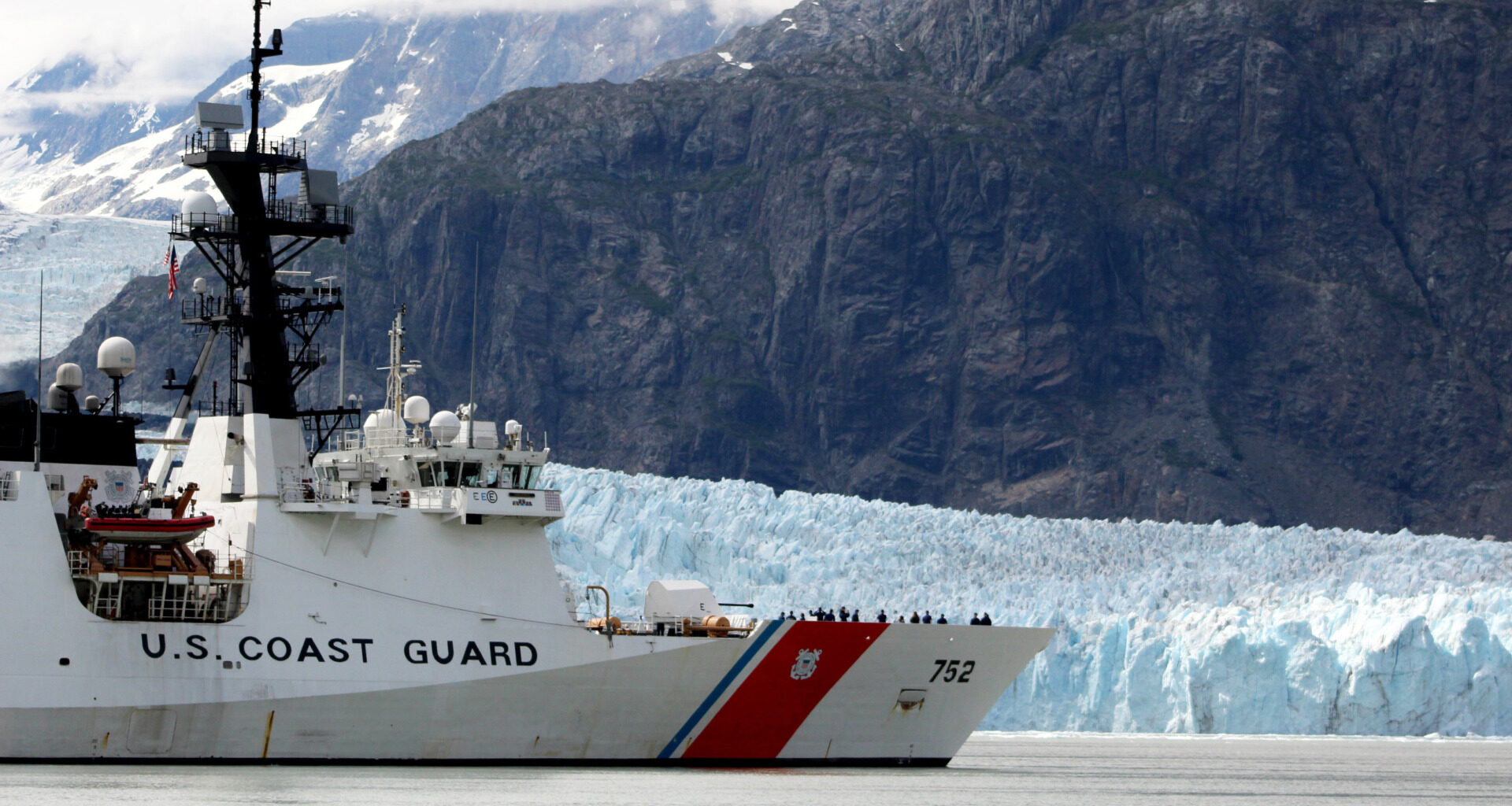
FEATURED IMAGE: The U.S. Coast Guard Cutter Stratton (WMSL 752) transits Glacier Bay, Alaska, on Aug. 1, 2024, while patrolling the region. (Photo courtesy of the U.S. Coast Guard)