
The transfer portal dust has settled, the NCAA Tournament is almost wrapped up and spring practices are winding down. We’re about to enter the bleak part of the year with no actual football on the college calendar.
To help bridge the gap until the pads start popping again in August, we’re taking a look back at January’s eventful transfer portal window and ranking the top transfers at each position. Today, we begin with the quarterbacks.
Although there are some similarities, this ranking is a bit different from our winter portal top 30, where we ranked quarterbacks primarily on their ability, resume and interest in the market. In this ranking, those things still matter, but projection takes precedence after watching the players more, gathering more data, speaking with more coaches and personnel staffers and better understanding the quarterbacks’ fits with their new teams.
Given that, some big names who were on January’s list, like Dylan Raiola, Husan Longstreet and Deuce Knight, will be absent since they aren’t expected to be the starters at their respective schools in 2026.
Without further ado, let’s dive into our top 20 transfer quarterbacks going into the 2026 season.
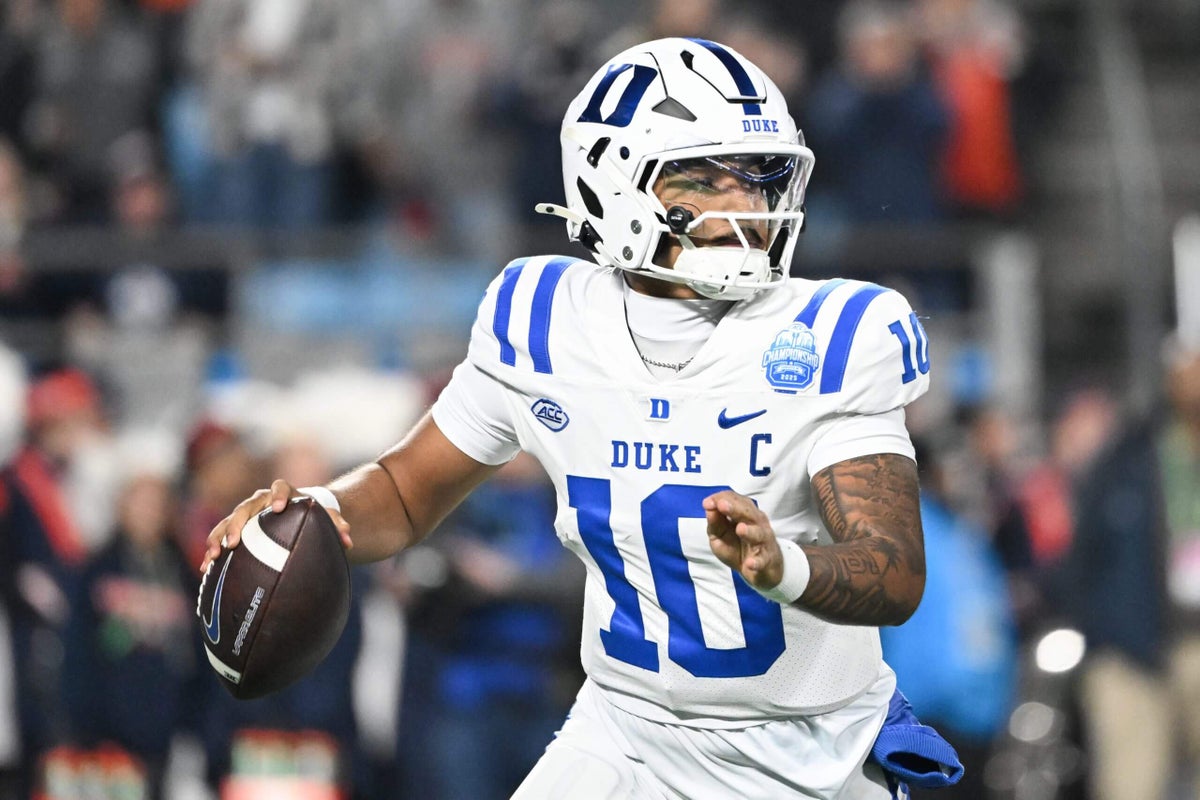
1. Darian Mensah, Duke → Miami
Height/weight: 6-3/205
Years remaining: 2
Key 2025 stats: 66.8 percent, 3,973 passing yards, 34 TD, 6 INT
What’s to like: He has good size and a good arm. He is athletic and accurate. His off-target percentage (10.8 percent in 2025, per Pro Football Focus) was fourth-best among Power 4 transfer quarterbacks with at least 250 pass attempts. He can make NFL-caliber throws. He’s not a pure runner but throws well on the run. And he doesn’t turn the ball over much: His 4.4 touchdown responsible-to-turnover ratio was second-best among transfer QBs, per TruMedia.
Lingering questions: Yes, there was a lot of drama around Mensah’s 11th-hour transfer portal departure from Duke, which included a lawsuit that was eventually settled. But aside from that, there aren’t many concerns about Mensah. As long as the transition is smooth, the upside for this offense with Mensah at the controls is immense.
Potential 2026 impact: In 2024, Cam Ward took Miami to College Football Playoff contention, but the Canes fell just short. In 2025, Carson Beck had Miami on the verge of a national title. Could Mensah take the Hurricanes to that final step? He has less mileage and a cleaner injury history than Beck did, and he’s more physically gifted. Fitting into coordinator Shannon Dawson’s offense should be no problem. And with another year of Mark Fletcher and Malachi Toney, plus the addition of Mensah’s Duke teammate Cooper Barkate, the potential for Miami’s offense seems limitless.
🎯 @DarianMensah x @camvaughn4_ pic.twitter.com/8sZzJGqbaY
— Miami Hurricanes Football (@CanesFootball) March 24, 2026
2. Sam Leavitt, Arizona State → LSU
Height/weight: 6-2/216
Years remaining: 2
Key 2025 stats: 60.7 percent, 1,628 passing yards, 10 TD, 3 INT; 73 rushing attempts, 306 yards, 5 TD
What’s to like: Leavitt is fearless. Turn on the tape from his 2024 CFP quarterfinal performance against a top-flight Texas defense. Or look at the way he stared down Texas Tech, one of the best defenses in the country, and engineered a game-winning 10-play, 75-yard touchdown drive. In crunch time, Leavitt finds ways to make plays. He keeps defenses honest with his running ability, and he’s terrific at evading pressure and making accurate throws on the move, which makes him a headache to scheme for. When a play breaks down, Leavitt can make something special out of it.
Lingering questions: His health was the biggest question mark coming out of the 2025 season. He missed the final month-plus of the season because of a nagging foot injury that eventually required surgery. Seeing him work out as LSU kicked off spring practice was encouraging, even if it was non-contact drills without pads.
Lane Kiffin gets his first LSU spring practice underway in beautiful weather.
QB Sam Leavitt looking much healthier than I expected, already taking part in non-contact throwing drills this spring. #LSU pic.twitter.com/B0bcW8aHQu
— Michael Cauble (@Cauble) March 24, 2026
Potential 2026 impact: Assuming he’s healthy, Leavitt fits like a glove in Lane Kiffin’s offense, and with the considerable talent LSU brought in around him, there’s reason to believe that the Tigers should make a massive improvement from the 2025 offense that averaged 22.8 points per game (third-worst in the SEC) and a meager 5.2 yards per play (second-worst).
3. Drew Mestemaker, North Texas → Oklahoma State
Height/weight: 6-3/215
Years remaining: 3
Key 2025 stats: 68.9 percent, 4,379 passing yards, 34 TD, 9 INT
What’s to like: Mestemaker, who never was the full-time starter for his varsity high school team, walked on at North Texas in 2024, won the starting job in 2025 and guided the Mean Green to a school-record 12 wins. But he’s not just a feel-good tale — his talent is legitimate. Some of the descriptors given to Mestemaker by college football personnel staffers this winter included “elite processor” and “best arm of the guys in the portal.” His production was elite: He led the Football Bowl Subdivision in passing yards in 2025 and was the only FBS quarterback to surpass 4,000 yards.
Lingering questions: How will Mestemaker handle a higher level of competition? For as eye-popping as his numbers were, he hit some bumps against UNT’s best opponents, turning the ball over four times each in losses to USF and Tulane. Big 12 defenses will be a step up from what he saw in the American.
Potential 2026 impact: The fit here is ideal, as Mestemaker will have the same head coach and play caller (Eric Morris) that he did a year ago, as well as much of his supporting cast, led by running back Caleb Hawkins and receiver Wyatt Young, to ease the transition. Honestly, there’s really nowhere to go but up for Oklahoma State, which went 1-11 last season.
4. Brendan Sorsby, Cincinnati → Texas Tech
Height/weight: 6-3/235
Years remaining: 1
Key 2025 stats: 61.6 percent, 2,800 passing yards, 27 TD, 5 INT; 100 rushing attempts, 580 yards, 9 TD
What’s to like: Sorsby is a true dual-threat with considerable arm talent and good size and athleticism. His 580 rushing yards in 2025 were the most among Power 4 QBs who transferred this offseason. He mulled a jump to the NFL Draft and was well-liked by pro scouts before opting to return to college and transfer to Texas Tech.
Lingering questions: Sorsby needs to be more consistent, evidenced by his up and down November as Cincinnati went 0-4 and fell out of conference title contention. He can attack any part of the field with his arm, but his accuracy needs improvement; he ranked in the bottom half of the Big 12 in completion percentage.
Potential 2026 impact: If he can raise his completion rate, there’s no reason to believe Sorsby can’t have the Red Raiders back in the Big 12 title game and CFP race. His running ability adds an element to Tech’s offense that wasn’t really there under his predecessor Behren Morton, who was more of a pocket passer. With Tech’s collection of returning skill position players and offensive linemen, Sorsby’s supporting cast should be plenty capable.
5. Josh Hoover, TCU → Indiana
Height/weight: 6-2/200
Years remaining: 1
Key 2025 stats: 65.9 percent, 3,472 passing yards, 29 TD, 13 INT
What’s to like: He consistently places the ball well (he had the second-highest completion rate in the Big 12) and has a quick release and enough arm talent to put it wherever necessary. Hoover has a natural feel for the position, moving well within and outside the pocket.
Lingering questions: Turnovers have been an issue. Hoover’s interception total has risen each of the last two years (from nine in 2023 to 11 in 2024 to 13 in 2025), and his 3.1 percent interception rate last year ranked 104th out of the 133 FBS quarterbacks who averaged at least 14 attempts per game, per TruMedia. Hoover’s predecessor, Fernando Mendoza, ranked 24th with a 1.6 percent interception rate. When you add in Hoover’s fumbles, he turned the ball over 41 times in 31 career starts.
Potential 2026 impact: Hoover is moving from one RPO-heavy offense to another, so the fit should be solid. If he can trim the turnovers, he should excel in Bloomington. After the success the Hoosiers had with Kurtis Rourke and Mendoza, it’s reasonable to expect Hoover to play his best football at IU, though reaching a Heisman Trophy level may be unrealistic.
6. Byrum Brown, USF → Auburn
Height/weight: 6-3/232
Years remaining: 1
Key 2025 stats: 66.3 percent, 3,158 passing yards, 28 TD, 7 INT; 175 rushing attempts, 1,008 yards, 14 TD
What’s to like: When healthy, Brown has produced. In 35 games (32 starts) since 2022, he is responsible for 93 touchdowns and has accounted for nearly 10,000 yards of total offense. He’s big, he’s a huge threat in the running game and he is a more than capable passer coming off a career-high completion rate last season.
Lingering questions: College personnel staffers do not love Brown’s elongated throwing motion, but it didn’t stop Brown from garnering a ton of Power 4 attention when he hit the portal. One Power 4 GM whose team did not sign Brown rated him as one of the three best QBs in the portal.
Potential 2026 impact: Following head coach Alex Golesh to the Plains smooths the transition for Brown. Like Mestemaker, Brown has some members of his supporting cast who made the move with him. That will allow the Tigers to hit the ground running offensively and should give them a chance at better quarterback play than they got a year ago with Jackson Arnold and Ashton Daniels.
Let it fly 🎯🦅@byrumbrown17 ➡️ @KeshaunX21 pic.twitter.com/G1rkCGGDXG
— Auburn Football (@AuburnFootball) March 19, 2026
7. Rocco Becht, Iowa State → Penn State
Height/weight: 6-1/209
Years remaining: 1
Key 2025 stats: 60.5 percent, 2,584 passing yards, 16 TD, 9 INT
What’s to like: He’s a leader, a good decision maker with great anticipation. He manages the game and the offense well and has been lauded by opposing coaches for his toughness and competitive spirit. He’s also a running threat (eight rushing touchdowns in 2025) and has the ability to create when a play breaks down.
Lingering questions: His arm strength doesn’t jump off the page compared to those above him on this list. His accuracy isn’t what you’d expect from someone as experienced as he is. His completion rate has been under 61 percent each of the last two seasons, and his off-target percentage (14.2 percent in 2025, according to PFF) ranked in the bottom half of the Big 12. He’s also recovering from offseason shoulder surgery but is throwing during drill work this spring.
Potential 2026 impact: Becht followed coach Matt Campbell to Penn State and will work with the same offensive coordinator (Taylor Mouser) and quarterbacks coach (Jake Waters) that he did at Iowa State. Plus, 13 of the 22 former Cyclones who also made the trek are on offense. Becht is set up for immediate success.
8. DJ Lagway, Florida → Baylor
Height/weight: 6-3/239
Years remaining: 2
Key 2025 stats: 63.2 percent, 2,264 passing yards, 16 TD, 14 INT
What’s to like: The physical gifts are all there. He’s built like a tank with tight end-like size, he has tremendous arm strength and good mobility. He can make jaw-dropping, highlight-worthy plays and has the kind of confidence you want in your quarterback.
Lingering questions: He was banged up for a good portion of his Florida career. Even when healthy, he’s been inconsistent. One Power 4 offensive coordinator said Lagway appears to be a slow processor. His interception total (23 in 24 games) is not ideal.
Potential 2026 impact: Going back to his home state of Texas for a fresh start was a good idea for Lagway. Playing in familiar surroundings (his dad played for Baylor) and working with offensive coordinator Jake Spavital could help him recapture the magic that made him a five-star recruit. Since 2011, every Power 4 quarterback who has started at least 11 games with Spavital as his offensive coordinator or quarterbacks coach has thrown for at least 3,000 yards and 28 touchdowns. Baylor would take that stat line in a heartbeat.
Could DJ Lagway be a 3,000-yard passer at Baylor in 2026?
Since 2011, every Power 4 QB who started at least 11 games in a season w/Jake Spavital as their OC and/or QB coach has posted at least 3,000 yards and 28+ TDs.
More on Lagway-Baylor @TheAthletic: https://t.co/nPfnqeWHK1 pic.twitter.com/SJ4PxuLFmL
— Sam Khan Jr. (@skhanjr) January 9, 2026
9. Colton Joseph, Old Dominion → Wisconsin
Height/weight: 6-2/212
Years remaining: 2
Key 2025 stats: 59.7 percent, 2,624 passing yards, 21 TD, 10 INT; 158 rushing att., 1,007 yards, 13 TD
What’s to like: He’s a playmaker. If you need proof, just turn on the first game of his 2025 season, when he ran for 179 yards and two scores — including a 75-yard touchdown on the first play — against eventual national champion Indiana. Joseph was one of just three non-service academy quarterbacks to rush for more than 1,000 yards last season. His ability to extend plays can be a headache for defenses.
Lingering questions: As a passer, there’s still a lot of work to be done. His completion rate has yet to hit 60 percent in a season, and his interception rate jumped from 2.3 percent in 2024 to 3.4 in 2025. He can make some impressive throws on the run, but he’ll need to be more consistent.
Potential 2026 impact: Going from the Sun Belt to the Big Ten is a significant step up, and how Joseph handles that transition will be telling. The system fit here is intriguing, though. Joseph will be in an offense that’s heavy on bootlegs and misdirection, which should fit his skill set well.
10. Austin Simmons, Ole Miss → Missouri
Height/weight: 6-4/215
Years remaining: 2
Key 2025 stats: 60 percent, 744 passing yards, 4 TD, 5 INT
What’s to like about Simmons: He processes quickly, drives the ball with plenty of velocity and places it well, particularly across the middle of the field. Simmons generally checks a lot of boxes coaches look for in a quarterback prospect: smart, mature, prototypical size and mobile enough to be factor in the run game.
Lingering questions: His lack of experience is the biggest question mark. In his three-year career, he’s taken just 262 snaps. Simmons was set to be Ole Miss’ starter in 2025, but an early-season ankle injury derailed that, and Trinidad Chambliss took over and never relinquished the job. He also doesn’t have quite as many reps as a typical college junior, given that he reclassified up two years at the end of his high school career.
Potential 2026 impact: Simmons has clearly won over the staff at Mizzou, as the Tigers named him the starting quarterback coming out of spring practice. His physical tools could give Missouri’s offense a higher ceiling than what it had with its 2025 quarterback, Beau Pribula, who didn’t quite possess the arm strength that Simmons has.
The best of the rest11. Kenny Minchey, Notre Dame → Kentucky
Height/weight: 6-2/211
Years remaining: 2
Key 2025 stats: 76.9 percent, 196 passing yards, 0 TD, 0 INT; 7 rushing attempts, 84 yards, 1 TD
What you should know: Minchey brings loads of intrigue to Lexington. He’s light on game experience after three years at Notre Dame, but he pushed CJ Carr in the team’s QB competition last offseason and has enticing talent. Minchey is accurate, possesses a quick release, can create outside the pocket and has plenty of arm strength. The pairing with new head coach Will Stein, who has worked with Dante Moore, Bo Nix, Dillon Gabriel and Frank Harris, is an attractive one.
12. Jaden Craig, Harvard → TCU
Height/weight: 6-3/230
Years remaining: 1
Key 2025 stats: 61.5 percent, 2,869 passing yards, 25 TD, 7 INT
What you should know: Craig led the Crimson to the Football Championship Subdivision playoffs and was considered a draftable prospect when he finished up at Harvard but opted for another year of college to prove himself against Power 4 competition. How he transitions to the speed of the game is key, but he doesn’t lack tools. He should fit well with new TCU offensive coordinator Gordon Sammis.
13. Cutter Boley, Kentucky → Arizona State
Height/weight: 6-5/213
Years remaining: 3
Key 2025 stats: 65.8 percent, 2,160 passing yards, 15 TD, 12 INT
What you should know: Boley’s numbers in his first season as a starter weren’t eye-catching, but his traits were. He’s big and mobile and can make big-time throws, navigate the pocket and manage the offense. That Kenny Dillingham — who has tutored Sam Leavitt, Bo Nix and Jordan Travis — targeted Boley speaks volumes. Boley will need to cut down on the turnovers; he has 17 in 15 career games.
14. Katin Houser, East Carolina → Illinois
Height/weight: 6-3/225
Years remaining: 1
Key 2025 stats: 65.9 percent, 3,300 passing yards, 19 TD, 6 INT; 85 rushing attempts, 193 yards, 9 TD
What you should know: Houser, who began his career at Michigan State, returns to the Big Ten. He was one of the more experienced quarterbacks in the portal and has gradually improved each of the last two seasons. His completion rate ticked up in both 2024 and ’25, and his off-target rate, per PFF, was in the top 20 nationally last season. His yardage and touchdown production also improved in each of the last two seasons, and his interception rate in 2025 (1.5 percent) was third-lowest among 2025 starting QBs who transferred.
15. Aaron Philo, Georgia Tech → Florida
Height/weight: 6-1/208
Years remaining: 3
Key 2025 stats: 75 percent, 373 passing yards, 1 TD, 1 INT
What you should know: Philo didn’t earn much playing time behind starter Haynes King, taking 63 snaps in 2025 and 180 over the last two seasons. But in the little time he has seen, he’s shown that he’s a capable passer — within and outside the offensive structure — and a good runner. His 3.4 percent explosive play rate over the last two seasons would be top 30 nationally if he had enough snaps to qualify, according to TruMedia. Teaming Philo with running back Jadan Baugh and former Georgia Tech and Auburn receiver Eric Singleton has loads of potential. And Philo arrives in Gainesville with plenty of familiarity with the offense after spending the last two years working in new offensive coordinator Buster Faulkner’s scheme at Georgia Tech.
16. Anthony Colandrea, UNLV → Nebraska
Height/weight: 6-0/205
Years remaining: 1
Key 2025 stats: 65.9 percent, 3,459 passing yards, 23 TD, 9 INT; 127 rushing attempts, 649 yards, 10 TD
What you should know: The Cornhuskers landed on Colandrea after their attempted signing of Kenny Minchey fell through, but there’s plenty of reasons to be excited about the outcome. Colandrea, who had a career year with Dan Mullen and the Rebels in 2025, is a highlight reel waiting to happen and plays with infectious confidence. That cuts both ways, though, and can lead to turnovers, though he has improved his interception rate each of the last two seasons to a career-best 2.2 percent in 2025. Regardless, the pairing of Colandrea with coordinator Dana Holgorsen’s offense should lead to big numbers.
17. Beau Pribula, Missouri → Virginia
Height/weight: 6-2/212
Years remaining: 1
Key 2025 stats: 67.4 percent, 1,941 passing yards, 11 TD, 9 INT; 95 rushing att., 297 yards, 6 TD
What you should know: After having success with Chandler Morris last season, can the Cavaliers replicate it with Pribula? Their profiles are similar — neither has the biggest arm, but both are accurate and mobile, though Pribula is a little bigger. Pribula had the third-highest completion percentage in the SEC last year but needs better ball security (11 turnovers compared to 17 touchdowns responsible for).
18. Ethan Grunkemeyer, Penn State → Virginia Tech
Height/weight: 6-2/218
Years remaining: 3
Key 2025 stats: 69.1 percent, 1,339 passing yards, 8 TD, 4 INT
What you should know: Grunkemeyer performed admirably while having to step in for the injured Drew Allar at Penn State last year, leading the Nittany Lions to four wins to close out the season. Grunkemeyer was one of the more accurate passers in the FBS (his 10.1 percent off-target rate ranked 18th). He progressed well as the year went on and looked comfortable in Penn State’s Pinstripe Bowl win over Clemson. Reuniting with James Franklin made sense. The intangibles are there, and if Grunkemeyer picks up where he left off, Virginia Tech will be in good hands.
19. Lincoln Kienholz, Ohio State → Louisville
Height/weight: 6-2/215
Years remaining: 2
Key 2025 stats: 78.6 percent, 139 passing yards, 1 TD, 0 INT; 11 rushing attempts, 66 yards, 2 TD
What you should know: Like Minchey and Philo, Kienholz didn’t see much game action (133 snaps) at his previous stop, but his traits drew attention. Kienholz is a talented athlete — a Buckeyes staffer called him “probably the best pure athlete” on the team in his time there — and pairs it with a good arm. Jeff Brohm’s recent track record with transfer quarterbacks suggests he should find success with Kienholz, who has a lot more time and room to grow than one-year rentals Jack Plummer, Tyler Shough and Miller Moss did when they got to Louisville.
20. Aidan Chiles, Michigan State → Northwestern
Height/weight: 6-3/225
Years remaining: 1
Key 2025 stats: 63.1 percent, 1,392 passing yards, 10 TD, 3 INT; 81 rushing attempts, 227 yards, 6 TD
What you should know: Opposing coaches and staffers have long been enamored with Chiles’ pure talent, even if he has yet to put it all together. Could a year with new offensive coordinator Chip Kelly do the trick for Chiles? A fresh start should do him some good. He was the most pressured starting quarterback on this list (36.7 percent pressure rate in 2025, per PFF). Despite that, he took good care of the ball, with just four turnovers in nine starts before he gave way to Alessio Milivojevic for Michigan State’s final three games.