
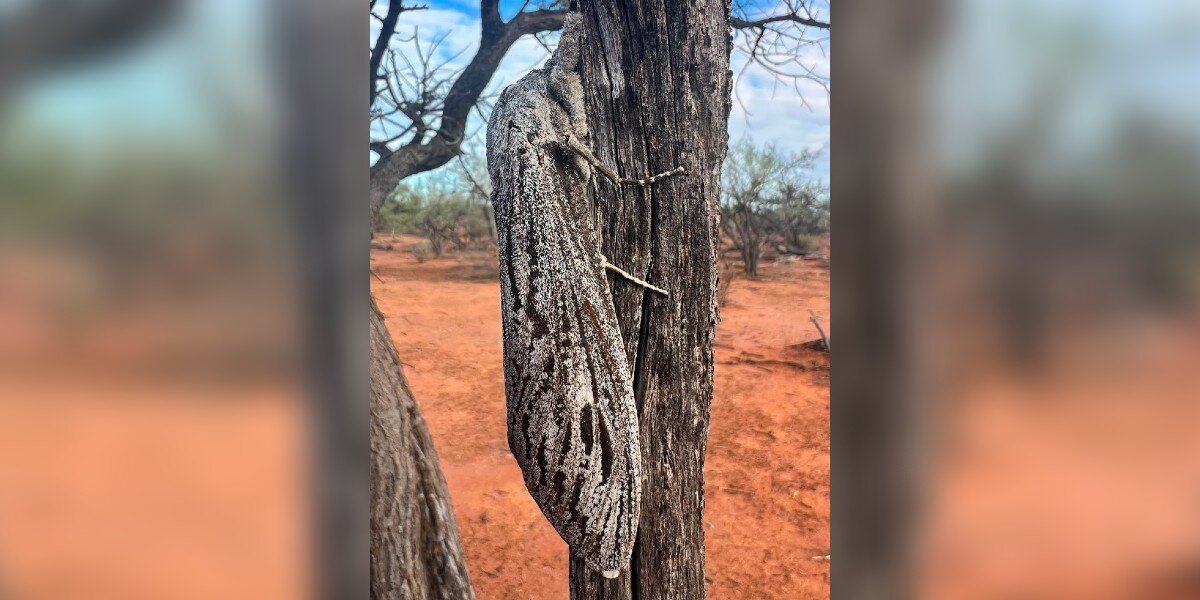
The other day, Ben Parkhurst, a regional ecologist for Bush Heritage Australia, went out to Hamelin Station Reserve to do vegetation monitoring. As he was taking some measurements, he was shocked to notice an enormous moth sitting on an old acacia tree.
“[I ran] the tape next to it and then all of a sudden [I was] like, ‘Ah!’” Parkhurst told The Dodo.
 Ben Parkhurst
The moth, who was longer than Parkhurst’s sunglasses, was blending in perfectly with the bark. The insect’s expert camouflaging explained why Parkhurst only spotted the insect when he was right next to the tree.
“It was hard to notice,” Parkhurst said.
In Parkhurst’s work as a regional ecologist, he spends lots of time outside, getting to know the many unique animals who live in Bush Heritage’s conservation reserves. But he’s never seen a moth quite this huge before.
“I’ve seen ones nearly as big, but that’d definitely be the biggest I’ve seen so far,” Parkhurst said.
 Ben Parkhurst
While it was difficult to identify this insect’s exact species, Parkhurst was able to determine that the moth belonged to the Cossidae family and most likely the genus Enoxyla. The heaviest moth in the world, who weighs up to 32 grams, belongs to the same genus, and the moth Parkhurst spotted appeared to be almost as heavy.
“Australia’s smallest bird species is a little thornbill called the weebill, and that weighs on average five or six grams,” Parkhurst said. “So it’s a moth that weighs as many as a whole bunch of these little thornbill birds.”
Like other moths in this family, the one Parkhurst spotted is a wood borer, which means they lay eggs and the larvae bury themselves in the bark. The animals spend one to two years in their larval stage before metamorphosing into their adult winged forms.

“[W]hen they move out of that larval stage and become that giant moth, they only live for a week,” Parkhurst said. “They don’t have mouths and they don’t eat, so they’re just trying to breed and lay eggs to continue the life cycle.”
This species, like other members of Enoxyla, is primarily nocturnal. So the animal stayed perfectly still as Parkhurst respectfully observed..
 Ben Parkhurst
“It just didn’t move at all,” Parkhurst said. “You could get within a centimeter of it and it would just sit.”
Parkhurst feels lucky that he happened to get close enough to the tree to notice the enormous moth. If he hadn’t walked right by it, he might not have even spotted one of the most unique animals he’s ever seen.
