
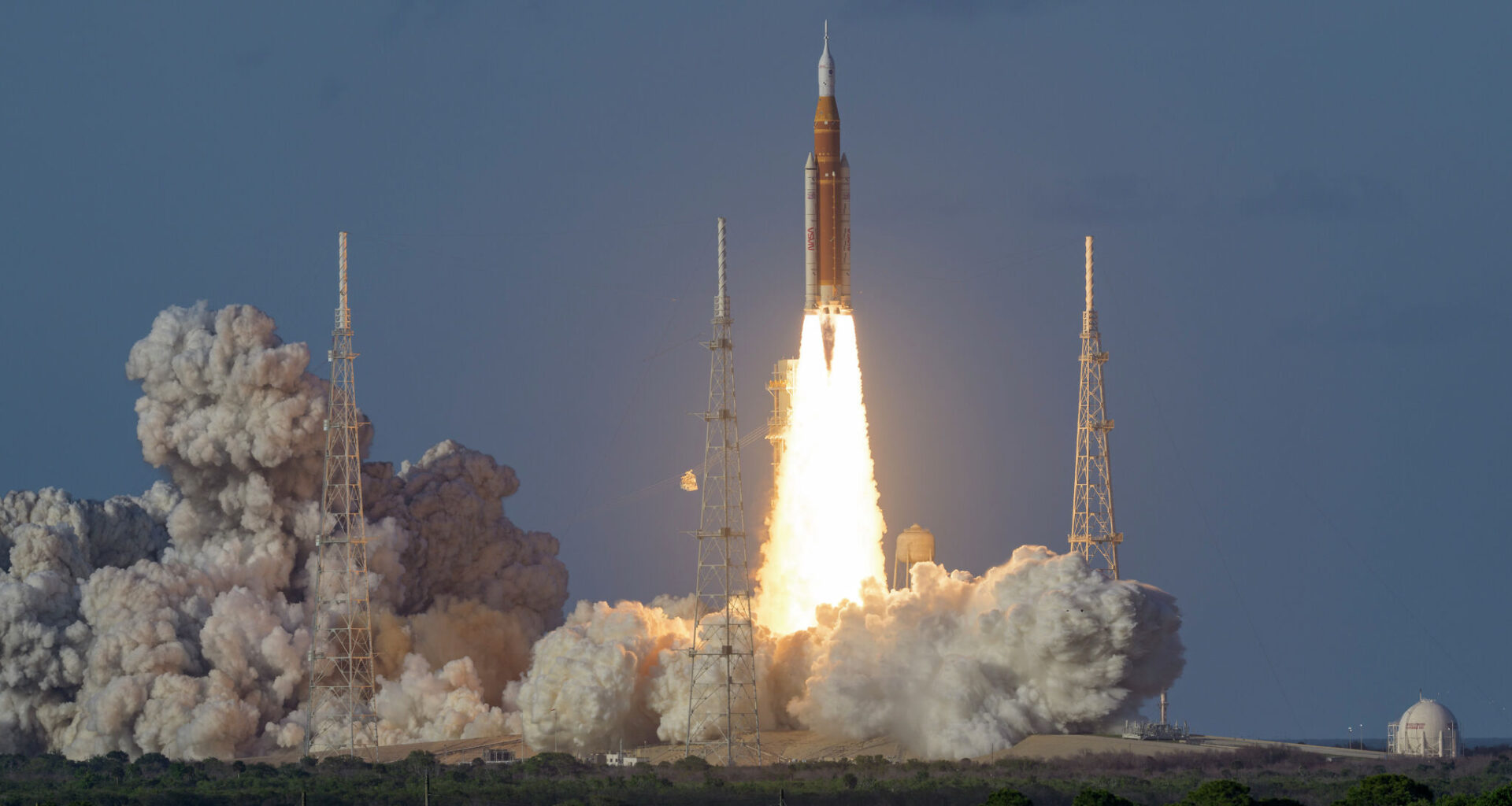
Houston plays a vital role in spaceflight. We don’t launch the rockets, but the intrepid scientists at the Johnson Space Center here in Space City monitor spaceflights and troubleshoot problems that arise. Not long into the historic Artemis II launch, Houston had to fix a problem—of the potty variety.

In a mission setting several historic firsts, including sending the first person of color and the first woman around the moon, the toilet barely rates, though it is no less historic. Artemis II is the first manned mission to fly to the moon since Apollo 17 in 1972, and it has a toilet where the Apollo missions did not. (The Apollo astronauts peed and pooped—sorry, no euphemisms here—into rolled up plastic sheets and bags, but more on that later.)
The toilet was powered up an hour after the launch and promptly broke. Mission specialist Christina Koch called Houston to report a problem with a urine filter in the toilet, which Koch said was “without beads.” Koch also noted a blinking amber light on the toilet. Later, Koch turned the water to the toilet on and its power cut out entirely. Houston told Koch to hold off on messing with the toilet, as Integrity was about to go through a middle of the night apogee burn—an important maneuver to push the Orion spacecraft further into orbit in order to assist with its trip to the moon.
Article continues below this ad
But that pesky toilet would still need to be fixed. The problem, NASA officials told reporters on the ground in Florida, was an issue with electronics. There was also a problem with water tank valves that messed with the flow of water to the toilet.
Koch took on the role of space plumber, and Houston flight controller Amy Dill diligently walked Koch through troubleshooting the toilet. It was a bit like listening in on the world’s funniest IT call, and we’re all lucky that NASA decided to include the potty problems on its video feed of the mission. It was even complete with meta-commentary from NASA employees manning the, uh, stream, who gave us at home the play-by-play with the same hushed voice reserved for golf announcers and Olympic color commentators.
“NASA astronaut Christina Koch reporting they had a successful test of the toilet,” the livestream host helpfully pointed out.
Article continues below this ad
People walk through the White Flight Control Room at the Johnson Space Center’s Mission Control Center in Houston, Texas, on August 5, 2022.
MARK FELIX/AFP /AFP via Getty Images
After successful tests, Houston had Koch reactivate Integrity’stoilet. Koch ran the toilet for a minute and added water. A few minutes later, Koch called Houston again.
“It worked!” Koch, who sounded relieved, said after the toilet reboot was completed. “Houston, Integrity, good checkout.”
“Happy to report that toilet is go for use,” Houston CAPCOM confirmed. “We do recommend letting the system get to operating speed before donating fluid.”
“We are cheers all around, and we will do that,” Koch said, about five hours post-launch.
Article continues below this ad
During the toilet’s short downtime, Artemis II crews had to use CCUs, or Collapsible Contingency Urinals, to do their business. These are small, plastic bags that astronauts pee and poop in. After the toilet was fixed, Koch radioed Houston to ask when they could dump the CCU, which had filled up during the commode catastrophe. When asked for comment, NASA pointed Chron to its blog post about the fix. (Apologies to NASA News Chief Cheryl Warner for me being the millionth person to ask about this today.)
It’s easy to laugh at this debacle, but the toilet on Integrity is a real game changer in the fascinating realm of spaceflight poop-ourri. Astronauts spend anywhere from days to months in space; Artemis II astronauts will spend 10 days as they travel around the moon, the furthest from Earth that humans have ever been. David Munns, a science and technology expert at CUNY, underscored how important having a functional s–tter is.
“The toilet is a ‘mission-critical’ system, so if it breaks down, the whole mission is in jeopardy,” Munns told Scientific American.
As previously mentioned, astronauts with the Apollo program had gone to the bathroom in bags in front of their crewmates with little privacy. During Apollo 10, a turd escaped its containment bag and floated around the capsule, to the bemusement of the astronauts. Understandably, nobody claimed the flying poo.
Article continues below this ad
“There’s a turd floating through the air,” astronaut Thomas Stafford said while laughing.
Because cabin space was at a premium, astronauts with the Apollo missions left a total of 96 bags of waste filled with poop and pee on the Moon, which are still sitting there.
How does an astronaut go to the toilet in low gravity? Ahead of the Artemis II launch, NASA astronaut Christina Koch gave us a look inside the Orion crew capsule’s toilet—complete with handholds, bright orange insulation, and surprisingly loud plumbing. Take a tour of the Orion spacecraft at the 🔗 in bio.
♬ original sound – National Geographic
Artemis astronauts will use what’s called the Universal Waste Management System, first installed on the International Space Station. The UWMS is built into the floor of the Orion capsule and is about the size of an airplane bathroom. It uses suction to pull waste in, and it recycles urine for reuse as water for the crew. It cost $23 million for NASA to develop, is suited for both male and female anatomy, and can handle “dual ops”—”when they’re doing both defecation and urination at the same time,” Melissa McKinley, project manager for the toilet, told Smithsonian Magazine.
Article continues below this ad
The toilet was fixed successfully, but Koch radioed Houston one more time before the Artemis II crew went to bed to check if they could use the bathroom.
“Christina, you are good to use toilet all night,” Houston confirmed to Koch.