
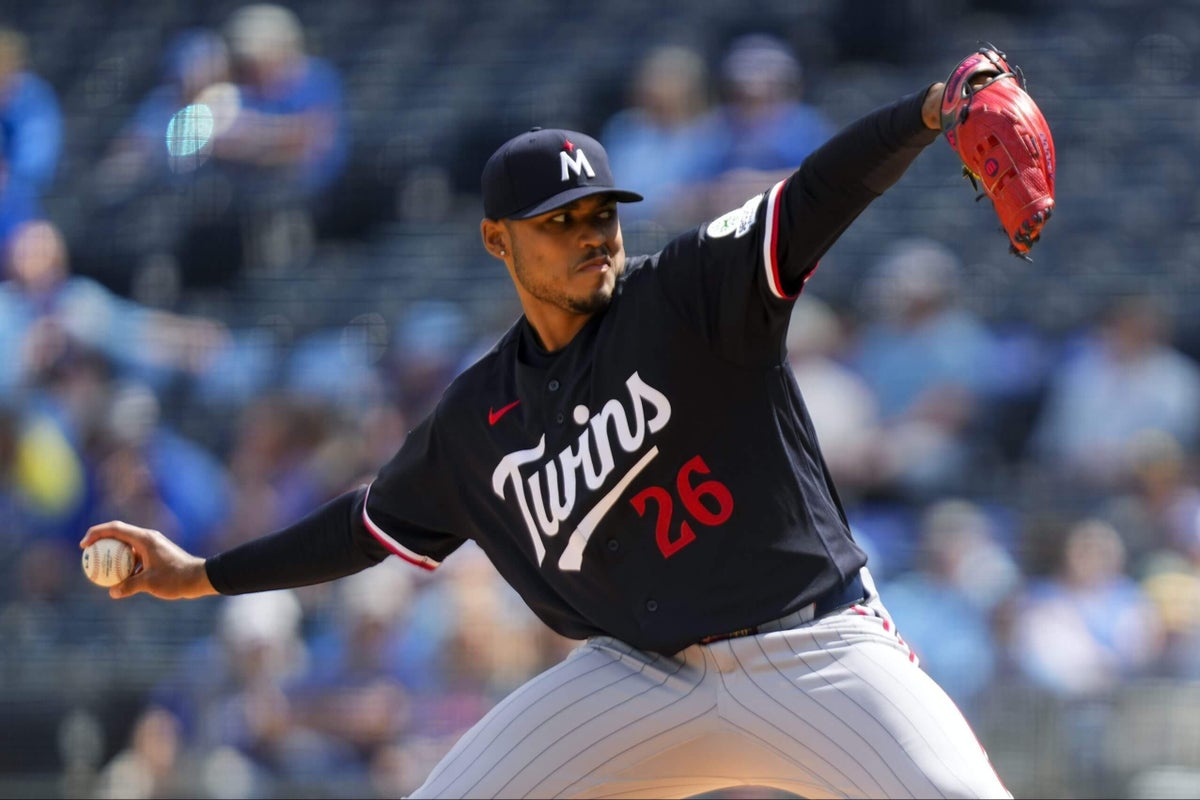
Taj Bradley has been the starting pitcher in both Minnesota Twins wins this season, following up a good but abbreviated first start versus the Baltimore Orioles with an even better outing Thursday in Kansas City.
Bradley shut out the Royals for six innings, allowing no extra-base hits and just one walk, and the Twins’ lineup broke through late with a trio of ninth-inning homers in a sweep-avoiding 5-1 victory.
For the second straight season, the Twins will head into their home opener with a 2-4 record. They’ll host Bradley’s former team, the Tampa Bay Rays, for a three-game series that begins Friday at Target Field. (Mother Nature permitting, of course.)
Bradley mostly struggled in six starts for the Twins last year after coming over from the Rays in a deadline trade for reliever Griffin Jax, but it’s been a much different story this season. Through two starts, he has an 0.87 ERA and 12-to-4 strikeout-to-walk ratio in 10 1/3 innings.
And there’s been a lot to like with Bradley beyond just the shiny ERA. He’s always had impressive raw stuff, averaging 96.3 mph with his fastball before this year, but that’s jumped to 97.2 mph this season, and he reached triple digits Thursday for the first time in a Twins uniform.
Bradley escaped from a two-on, two-out jam in the third inning by freezing Royals superstar Bobby Witt Jr. with a 100.0 mph fastball down the middle for a called third strike. It was the fastest recorded pitch ever thrown by a Twins starting pitcher.
Despite being just eight starts into his Minnesota career, Bradley already dominates the Twins’ leaderboard for fastest pitches thrown by starters in the pitch-tracking era, which began in 2008. He holds the top eight spots and 16 of the top 20 spots. Here’s what the top 10 looks like:
STARTERDATEVERSUSMPH
4/2/2026
Royals
100.0
3/28/2026
Orioles
99.6
4/2/2026
Royals
99.5
4/2/2026
Royals
99.4
9/17/2025
Yankees
99.0
9/10/2025
Angels
98.9
8/30/2025
Padres
98.9
3/28/2026
Orioles
98.9
9/27/2025
Phillies
98.9
9/10/2025
Angels
98.8
Bradley was a consensus top-50 prospect coming up through Tampa Bay’s farm system and debuted in the majors at 22, but he posted a 4.70 ERA in 354 innings across parts of three seasons with the Rays. He showed semi-regular flashes of front-line potential but struggled with inconsistency.
That remains Bradley’s biggest challenge with the Twins, but it’s not hard to see why they valued his upside enough to swap Jax for him last summer and left little doubt during spring training that the right-hander would be in the Opening Day rotation. (I hopped on the bandwagon, too.)
In spring training, Bradley praised the Twins’ coaching staff — including holdover pitching coach Pete Maki and new bullpen coach LaTroy Hawkins — for helping him to simplify things mechanically and mentally in an effort to “blend art with science” for better big-picture results. So far, so good.
Bradley’s already plus fastball velocity has jumped into elite territory for a starter, and it’s part of a deep pitch mix that also features a low-90s cutter, a slow curveball and a revamped splitter, each of which can thrive as swing-and-miss weapons when he’s rolling like this.
Bradley, 25, is younger than some top pitching prospects — including reigning Twins minor-league pitcher of the year Connor Prielipp — yet he’s made 75 starts and logged nearly 400 innings in the majors. He’s a rare combination of youth, experience and upside, and the Twins appear to be unlocking it.
Where to find Twins’ top prospects
I wrote last week about Triple-A St. Paul’s roster being absolutely stacked with top prospects to begin the season, far more so than any Twins minor-league team in recent memory, and how uncommon it is to have that much talent on the doorstep of the majors.
Baseball America agrees, and takes it a step further, ranking the Saints as having the most talented season-opening roster throughout the entirety of the minor leagues, regardless of level. BA calling the Saints “the best team in the minors” should provide some much-needed optimism for Twins fans.
Eight of the Twins’ top 20 prospects from my preseason list are in St. Paul, including six of the top nine and all three of the system’s consensus top-100 prospects — 21-year-old outfielder Walker Jenkins, 23-year-old outfielder Emmanuel Rodriguez and 23-year-old infielder Kaelen Culpepper.
While it can’t compete with St. Paul’s talent collection, High-A Cedar Rapids is also starting the season boasting plenty of prospect star power with No. 6 Eduardo Tait, No. 7 Dasan Hill, No. 10 Marek Houston, No. 13 Brandon Winokur and No. 18 Khadim Diaw.
Tait, a 19-year-old catcher acquired in the Jhoan Duran trade, and Hill, a 20-year-old left-hander picked in the second round of the 2024 draft, are two of the farm system’s highest-upside players. Houston, a slick-fielding 21-year-old shortstop, was the Twins’ first-round pick out of Wake Forest last July.
RANKPROSPECTPOSLEVEL
1
Walker Jenkins
OF
Triple A
2
Kaelen Culpepper
IF
Triple A
3
Emmanuel Rodriguez
OF
Triple A
4
Mick Abel
SP
MLB
5
Connor Prielipp
SP
Triple A
6
Eduardo Tait
C
High A
7
Dasan Hill
SP
High A
8
Gabriel Gonzalez
OF
Triple A
9
Kendry Rojas
SP
Triple A
10
Marek Houston
IF
High A
Because of how much high-end talent is concentrated in St. Paul and Cedar Rapids, the Twins’ two other full-season affiliates are comparatively lacking in top prospects.
Double-A Wichita’s roster features just two of my top-20 prospects: No. 15 Hendry Mendez and No. 19 Ryan Gallagher. And it’s likely Mendez, who hit .324 in 33 games for Wichita last year after arriving in the Harrison Bader trade, would be in St. Paul if the Saints weren’t overflowing with top bats.
Low-A Fort Myers has three top-20 prospects in No. 14 Riley Quick, No. 17 Quentin Young and No. 20 Enrique Jimenez, although it’s also worth noting Low-A affiliates have such young, inexperienced rosters that the prospects often haven’t had time to make names for themselves yet.