
With the NFL’s spring meetings complete, it’s time to check in with executives across the league for thoughts on the best and worst moves in free agency so far.
And there were definitely thoughts.
What is the plan? What is the vision?
I give them a lot of credit. Obviously, these guys are not all superstars. But they HAD to do that.
If you’re the GM, that’s a tough situation.
We begin with AFC teams today, followed by NFC teams on Friday. For each team, we’ve listed their average salary per year (APY) added, lost and the differential, along with their rank in each category. Figures include contracts with values reported as of April 1.
Baltimore Ravens
Added: $47.2M (13th) | Lost: $74.3M (4th) | Differential: -$27.2M (25th)
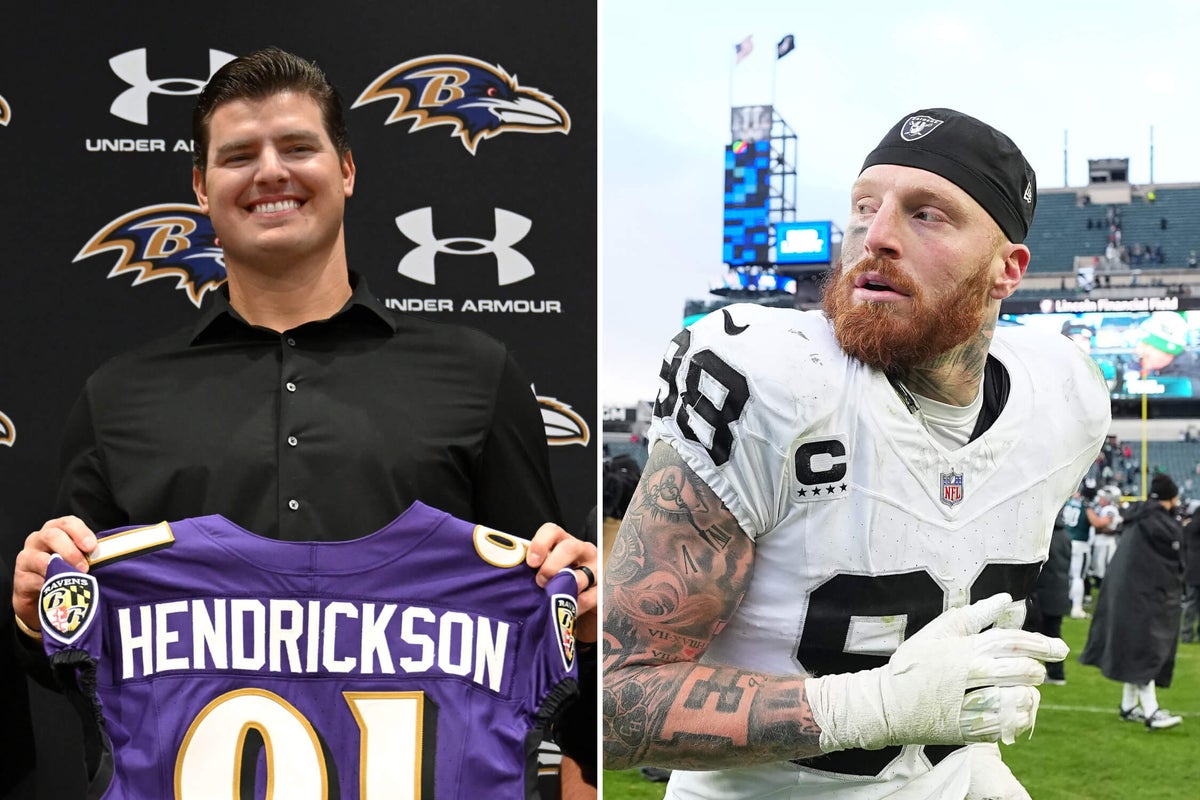
The Ravens’ pursuit of Maxx Crosby and Trey Hendrickson generated enough controversy to obscure the reason Baltimore was willing to make big swings for veteran edge rushers: A franchise with a rich history of drafting and developing players at the position could not trust its ability to do that now.
Perhaps that will change with Jesse Minter returning to coach the team.
In the meantime, the Ravens will move forward with Hendrickson, whom they signed for $28 million per season after tentatively agreeing to acquire Crosby from the Raiders for two first-round draft picks. Three weeks after the Ravens cited medical concerns for backing out of the Crosby agreement, league insiders suspect Baltimore acted in bad faith.
“I don’t think we’ll ever find out the answer,” an exec from another team said. “I would not put it past them to agree to this trade and then slow-play the physical.”
The Ravens and Raiders agreed to the trade on the Friday before free agency. Crosby underwent his physical exam with Baltimore on Tuesday, one day before free agency officially opened, but after the Raiders and other teams reached agreements with players during the legal tampering window.
“If you really wanted the guy, you would get him in there for his physical as soon as possible,” another exec said. “You would pull your doctors off whatever they were doing. That’s easy. It was advantageous for the Ravens to slow-play the physical and keep open their options. That is why I believe the narrative.”
The delay allowed Baltimore to agree with Hendrickson, whose acquisition did not require parting with draft capital.
“My point is, the Ravens didn’t get cold feet,” another exec said. “They wanted one high-quality edge rusher, and they felt Maxx Crosby, like most people did, was the best one available, and he was worth two first-round picks, presuming they could not get Hendrickson.”
Adding Hendrickson cost the Ravens a shot at recouping a 2027 third-round compensatory pick for center Tyler Linderbaum, whose departure also weakened the middle of the offensive line. Newly signed guard John Simpson fills some of the void.
“Simpson is a purposeful run blocker who can give you some (aggressive) play style at a position where it is hard to get play style,” another exec said. “They lose Linderbaum. Simpson will help them not as a leader, but just solidifying up front a little bit.”
Buffalo Bills
Added: $68.3M (5th) | Lost: $43.1M (15th) | Differential: $25.2M (8th)
Sending a second-round pick to Chicago for receiver D.J. Moore stood out as the most confounding move for execs from other teams.
First, the positive.
“The price they got for Bradley Chubb was not bad,” one exec said. “(Cornerback) Dee Alford at $5 million is really good. He makes plays. If you are going to lose Taron Johnson, getting younger and still getting some playmaking is good. (C.J.) Gardner-Johnson for $3.5 million is a ball-hawking, playmaking safety. Those moves look solid.”
Lloyd Cushenberry III and Austin Corbett provide experience on the interior after guard David Edwards signed with New Orleans.
Now, the less positive.
“D.J. Moore was gonna get cut, and they gave up a second-round pick to get him,” one exec said. “They gave up a second-round pick and $40 million (in guarantees). What is going on?”
As one agent noted, getting free agents to choose Buffalo over other NFL cities can be tricky. Recent history could be another factor, as former coach Sean McDermott complained about personnel, especially at wide receiver. Moore played under new coach Joe Brady in Carolina. No one can say the Bills did not get the receiver Brady sought.
“D.J. Moore has two years of regression now,” another exec said. “He is a non-traditional receiver that wins with size and yards after the catch. I still feel they needed someone that could win down the field. Moore can do that — he did it to beat Green Bay. But I feel like his strength is on the underneath catch-and-run stuff, which they already have with (Khalil) Shakir.”
Another exec saw Moore’s skill set as part of a Josh Allen regulation plan.
“A non-traditional receiver for a non-traditional quarterback,” this exec said. “It’s not like Josh picks you apart. He overwhelms you. To operate on time, they are one of the best running teams in football, and it’s smokes and tunnel screens and jailbreaks on early downs in the pass game, getting the ball out of his hands.”
That still leaves plenty of opportunities for Allen to work his magic in dropback situations.
“I like the Waddle move for Denver more because he’s just a better player and he’s younger,” another exec said. “You look at how (the Bills) were rumored to have Waddle at the deadline last year and then what they ended up giving for D.J., and it’s like, wouldn’t you rather have Waddle for a year and a half? Now, Miami might not have traded him within the division.”
Moore averaged a career-high 18.1 yards per catch in 2020, when Brady was his offensive coordinator in Carolina. He is coming off a career-low season for yards per game (40.1) with Chicago, turns 29 on April 14 and has solid guarantees through 2027.
Cincinnati Bengals
Added: $45.9M (16th) | Lost: $47.0M (12th) | Differential: -$1.1M (16th)
Multiple would-be AFC contenders made major moves after failing to capitalize on the rare opportunity last season to navigate the playoffs without Patrick Mahomes standing in the way.
Baltimore and Buffalo fired their longtime head coaches. Both teams also made major moves in free agency and/or the trade market. Their urgency was clear.
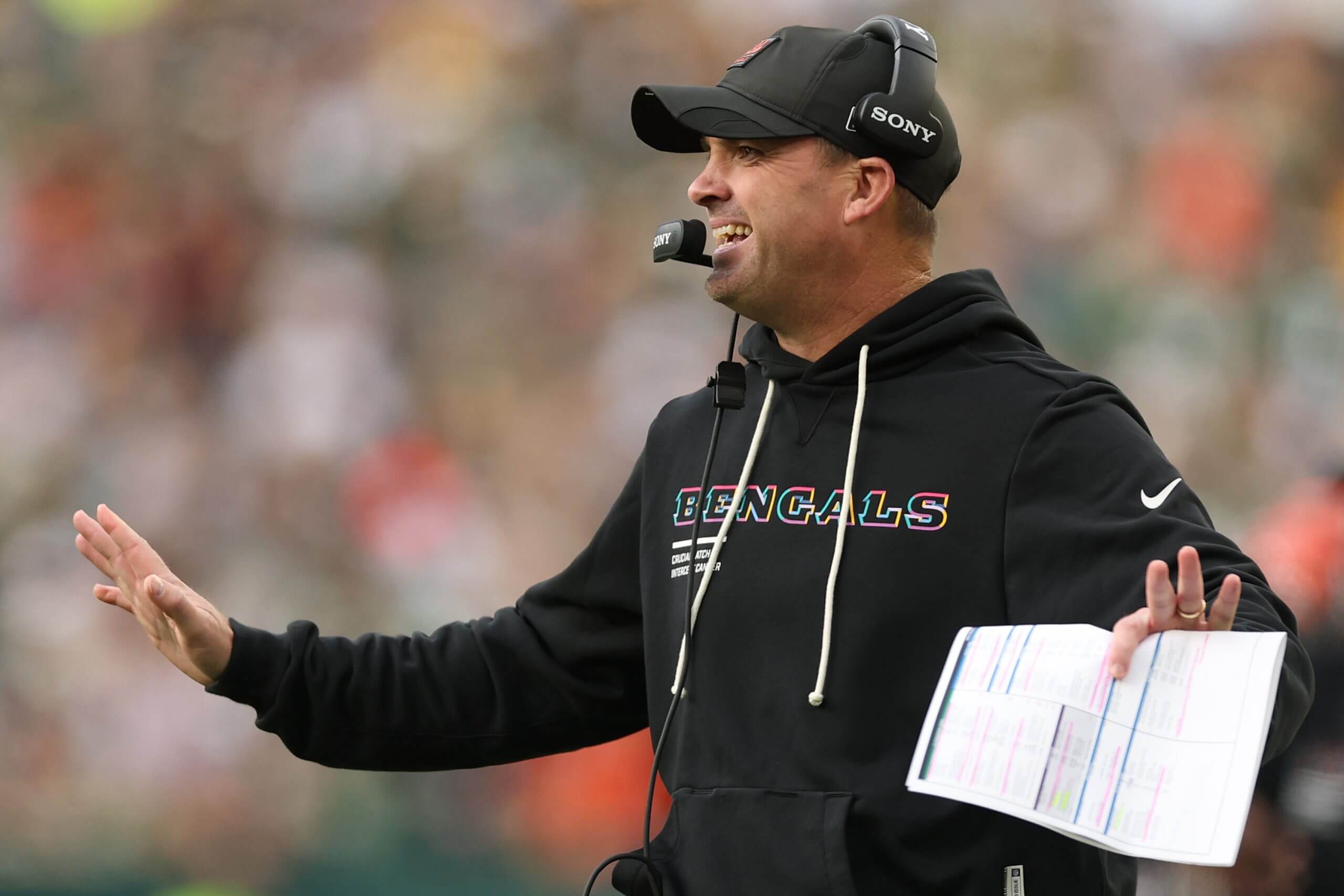
As for the Bengals, who ranked 29th in defensive EPA per play last season and over the past four, it was out with the old (Trey Hendrickson) and in with the new (Boye Mafe) at edge rusher. Safety Bryan Cook and defensive tackle Jonathan Allen were the other big additions on that side of the ball.
“They knew they had to fix some stuff on defense,” an exec said. “It looks like they are saying, ‘You guys have one year to figure this out. Otherwise, we can get out of the coach’s contract.’”
Coach Zac Taylor is reportedly signed through 2027 (the team has announced an extension through 2026 only).
“Mafe is a lesser player than (Malcolm) Koonce, who the Raiders signed (for $11 million per year, compared to the $20 million that Mafe commanded),” another exec said. “Mafe makes me cringe because he is really a DPR (designated pass rusher) who does not play the run at all.”
That was not a unanimous view.
“He’s not gonna be playing with the same caliber of players (as in Seattle), but he’s probably gonna be allowed to just rip upfield with Cincinnati, which could help his individual production,” another exec said. “He can win quickly, but in Seattle, it was more about rushing four as one. He does have to become a better finisher.”
Zac Taylor’s job could be at stake if the Bengals’ defense isn’t fixed in 2026. (Michael Reaves / Getty Images)
Cleveland Browns
Added: $58.8M (7th) | Lost: $14.5M (29th) | Differential: $44.4M (5th)
While the Browns were the ones proposing a rules change allowing teams to trade draft choices further into the future, the Rams have been most outspoken in favor of the change.
Could that be because the Rams, desperate to win a championship in what could be Matthew Stafford’s final season, are interested in a certain Browns defensive lineman whose contract recently became easier to trade?
“The report of the option bonus date moving later for Myles Garrett makes me think Cleveland is planning on trading him,” an exec said.
Cleveland withdrew the proposal during the NFL owners’ meetings this week rather than subject it to a losing vote. Consider the subject on the table for the future.
There is no shortage of Browns moves that have actually happened.
No team invested more in its offensive line during free agency, after all five of the Browns’ primary starters from 2025 hit the market.
Cleveland landed its two most expensive line additions (Tytus Howard and Zion Johnson) from the Texans and Chargers, two teams desperate to improve their lines.
Howard and Elgton Jenkins, signed from Green Bay, rank second (Jenkins) and fourth (Howard) among 40 offensive linemen from the 2019 draft in Pro Football Reference’s Draft Approximate Value metric, which measures contributions from players to their original teams.
“They had to do that,” another exec said. “Their line was absolutely abysmal, which is crazy. It shows you how quickly it can go on the offensive line. They had (acclaimed line coach Bill) Callahan there two years ago. I give them a lot of credit. Obviously, these guys are not all superstars. But they had to do that.”
Quarterback remains a question mark for another day.
Denver Broncos
Added: $28.3M (25th) | Lost: $31.0M (24th) | Differential: -$2.8M (18th)
The 2025 Broncos became the 32nd team in NFL history to win exactly 14 games in a season. Their point differential (+90) ranked last among the 32, an indication that regression was coming.
Acquiring receiver Jaylen Waddle from Miami for a package including a first-round pick (No. 30) should help.
“You might fight regression for a year or two with a move like that,” an exec said.
Another exec said the Broncos thought they were going to sign former Jaguars running back Travis Etienne, only to have the Saints land him instead.
“They were shocked,” this exec said.
Denver later re-signed running back J.K. Dobbins.
Waddle, 27, led the NFL in yards per reception (18.1) in 2022 and has started at least 14 games in each of his five seasons but has struggled through injuries.
“Denver wants to give Bo Nix his best chance with a new (play caller), so take your shot,” another exec said of adding the 185-pound wideout. “But you’d better know some of the flaws. Availability is a concern, and Waddle does not exactly exude toughness. Maybe your culture changes that.”
Letting defensive lineman John Franklin-Myers leave for $21 million per year in Tennessee showed there were limits to Denver maximizing whatever window exists while Nix is on his affordable rookie contract.
As for Waddle, he has been an average starting receiver by yards per game (53.4) over the past two seasons.
“He opens things up,” another exec said. “He is a good complement to Courtland Sutton, who is more of a possession receiver. He is a good stretch-the-field receiver, which they already have with (2024 fourth-round pick Troy) Franklin. Waddle can run all these crossers and beat man coverage, and he’s in his prime.”
Houston Texans
Added: $47.2M (14th) | Lost: $37.1M (21st) | Differential: $10.1M (13th)
Signing Danielle Hunter, Sheldon Rankins and E.J. Speed to extensions helped maintain defensive continuity for one of two teams with a playoff victory in each of the past three seasons.
As usual, the questions are on offense.
The latest round of shuffling along the Texans’ offensive line came as quarterback C.J. Stroud became eligible for a contract extension.
“I think (GM Nick) Caserio is going to let it go year to year,” one exec said. “He very well may be inclined to draft another guy. It could be another year of Davis Mills (as the backup), and then Caserio drafts another quarterback.”
Another exec said he liked Mills as much as he liked Stroud, whom Caserio and ownership have backed this offseason.
Up front, signing Braden Smith while trading Tytus Howard to Cleveland made the Texans less expensive at right tackle. Did it make them better?
“Braden Smith is one of those thin, linear guys — just kind of a get-by guy,” an exec said.
The Texans under Caserio have done a much better job building the rest of their roster than the offensive line.
“It seems to me that Nick can’t decide on an offensive line,” another exec said. “He has drafted them high and moved them on. He has signed them and moved them on. He (extended) the tackle from Miami (Laremy Tunsil), moved on from him. At a certain point, you have to pick a lane.”
On the other side of the ball, Houston lost one of its best run defenders in Tim Settle, who signed with Washington. Running back David Montgomery and safety Reed Blankenship were the highest-ranked players Houston added in terms of APY at their positions (15th for Montgomery, who was acquired by trade from Detroit, and 23rd for Blankenship, formerly of Philadelphia).
“Blankenship is clearly a scheme fit for DeMeco Ryans,” another exec said. “They brought in Braden Smith and Evan Brown for their offensive line. Do I like either of those for the future? Probably not. They are both 30 (or almost 30) years old. It would make a lot of sense if the Texans were putting a lot of effort into the O-line in the draft.”
Indianapolis Colts
Added: $16.3M (29th) | Lost: $71.8M (5th) | Differential: -$55.4M (29th)
Indy used the transition tag for quarterback Daniel Jones — setting his baseline at $37.8 million for one year — and then signed him to a two-year, $88 million deal that slotted him 13th among 16 veteran QBs on starting-level contracts.
“I think they did the right thing with him,” one exec said. “They couldn’t afford not to have him.”
Not that this was an optimal position.
“Let’s face it, their troubles all started by drafting Anthony Richardson,” the exec added. “Here they are.”
Another exec thought the Colts — who also paid a premium ($28.5 million per year) to re-sign receiver Alec Pierce — made a bad situation worse by using the transition tag instead of letting the market work against Jones.
“You probably had a natural transition tag anyway, because Daniel wasn’t going anywhere without checking with you first,” this exec said. “It’s not like he wanted to go to the Jets. The Vikings had no ability to sign high-priced players, so they weren’t really a factor.”
What was the worst-case scenario if Jones had tested the market?
“Let’s say another team offers him $50 million a year over four years, and $110 million is fully guaranteed,” an exec said. “What is worse: That awful deal where you are tied to him for $110 million for the next two years, or what you just did? Your downside is an extra $15-20 million over two years, but at least you get him for two more years on the back end.”
Unless, of course, Jones decided to leave. Then, what?
“There are worlds where they don’t tag him, he gets paid elsewhere and it would have been hard to find someone to fill that gap,” another exec said. “This was the smart play if you are banking on him continuing to thrive in Year 2 of your system. By the same token, I do not know if it pushes the needle.”
Jacksonville Jaguars
Added: $5.0M (31st) | Lost: $39.5M (18th) | Differential: -$34.5M (27th)
Losing running back Travis Etienne and linebacker Devin Lloyd made the Jaguars worse on the field while arming them with future compensatory picks.
“Those might have been their two best players,” an exec said. “They are trying to win comp picks to get a couple third-rounders for next year. OK, we’ll see. The question is, do they know what to do with them? Because the receiver they traded two No. 1s to get (Travis Hunter) did nothing.”
Hunter is expected to focus more on cornerback than receiver in 2026. There have been scant signs he’ll be the game-changing force Jacksonville hailed on draft day, although it’s very early.
“(GM James) Gladstone said he likes having comp picks to acquire guys like Jakobi Meyers at the deadline,” another exec said. “It seems like they at least have a definitive plan.”
The Jaguars have 11 picks in the upcoming draft, including none in the first, but three in the third.
Will they secure even more draft capital?
Receiver Brian Thomas, who had 87 catches for 1,282 yards and 10 touchdowns as a rookie first-round pick in 2024, dipped to 48-707-2 in three fewer games under a new staff last season.
“The Brian Thomas situation is interesting,” another exec said. “It’s smart to hold onto him. He is too young to give up on that early. I could see him being moved on draft day, if people’s favorite receivers get picked.”
Kansas City Chiefs
Added: $52.4M (9th) | Lost: $87.9M (3rd) | Differential: -$35.5M (28th)
Patrick Mahomes’ season-ending knee injury appears to have increased the urgency for the Chiefs to finally lean into the running game more meaningfully.
Trading for quarterback Justin Fields and signing Super Bowl MVP running back Kenneth Walker III could signal a change in how the team plans to play offense if Mahomes misses time, and even after he returns.
“I think it points to, ‘OK, let’s survive the early part of the season,’” an exec said. “I bet they just run the tread off Justin. It will be a lot of RPO. And they maybe get Walker involved in the passing game so that he can continue to be a two-phase player when Mahomes comes back.”
Chiefs running backs ranked 30th last season in yards per carry (3.7) and 32nd in rate of rushes gaining at least 12 yards when gaining that many was possible.
“If Mahomes keeps on going up against five- and six-man boxes, he can only do so much,” another exec said. “They need that run threat.”
On defense, the Chiefs parted with Trent McDuffie and Jaylen Watson, their top two cornerbacks last season.
The draft capital Kansas City sent to New England in 2022 when trading up eight spots to select McDuffie matches almost exactly the draft capital the Chiefs recouped from the Rams when trading the cornerback this offseason. That package included the Rams’ 2026 first (No. 29) and 2027 third-rounder.
“They got their picks back that they spent to get McDuffie, so it is a net zero, and they won two Super Bowls with him in the meantime,” an exec said.
Not a bad deal for the Chiefs, who will miss McDuffie, but not the $31 million annual salary the Rams will pay him on a new deal (the Rams also signed Watson, while safety Bryan Cook signed with the Bengals).
“They are banking on (defensive coordinator) Steve Spagnuolo and the defensive scheme,” another exec said. “It looks like Spags saying, ‘Just get me some guys, we’ll be fine.’”
Las Vegas Raiders
Added: $96.1M (2nd) | Lost: $10.8M (31st) | Differential: $85.3M (1st)
Execs understood and generally endorsed what the Raiders were trying to accomplish despite the embarrassing failed trade with Baltimore involving Maxx Crosby, who remains with Las Vegas.
“They will probably wind up trading someone else as a result (to move salary and add picks),” an exec said.
Why not trade Crosby now, even for, say, first- and third-round picks instead of the two No. 1s Baltimore was offering before reneging on the deal?
“They should because the windows don’t match up for them being good and Crosby making what he is making,” another exec said. “But I don’t think they want to be perceived as being taken advantage of again, and so I don’t think they will do that.”
While the public focused on the Crosby fiasco and the premium Las Vegas paid to land center Tyler Linderbaum, execs universally applauded the Raiders for an under-the-radar signing.
“A lot of people liked Jalen Nailor, including us,” one exec said. “Underrated guy who was lost in the shuffle with Justin Jefferson and Jordan Addison in Minnesota. Fast, has reliable hands, has inside-outside flexibility, runs good routes. I would much rather have Nailor at his price ($11.7 million per year) than Wan’Dale Robinson at his price ($17.5 million) or even (Michael) Pittman at his price ($17.5 million).”
There were multiple ways to look at Las Vegas signing Linderbaum for $27 million per year at a time when no other center earns more than $18 million annually.
One exec saw it as the Raiders realizing they must pay a premium to attract the best talent at this stage of their development.
“Linderbaum is one of the blue-level players at that position, the best of the best,” a different exec said, “so if you are going to do it and you want to say he is as valuable as a guard, that is fine because you are going to have a rookie quarterback underneath him. ‘We are going to overspend by $3-4 million to help our No. 1 draft choice, who is hopefully going to change this franchise.’ That is why you make this move.”
Los Angeles Chargers
Added: $33.0M (23rd) | Lost: $48.2M (11th) | Differential: -$15.2M (21st)
The Chargers did not make a premium addition in free agency or by trade. Partly as a result, they dropped from 20th in cash spending last season to a projected 31st heading into 2026.
Some might call that logical restraint after the team went all-in unsuccessfully three years ago. Others think the Chargers should be taking bigger swings to maximize their chances of winning a championship instead of simply competing for playoff spots (the team last won its division in 2009).
“Once you have the owners who say, ‘No, I want to go for it,’ it becomes really hard for the teams who are passive to win big,” one exec said. “If you’re the Chargers or the Bengals and you’re gonna play this thing passive, yeah, you’re going to compete with the Ravens right now and the Broncos right now, but in two years, it’s gonna be a different team that passed you.”
The Chargers are banking on better health, especially along their offensive line, where they added center Tyler Biadasz and guard Cole Strange.
“They are playing draft and develop while they are paying a quarterback,” another exec said. “It changes the math of how you bring in players.”
Does it have to change it this much?
“Their quarterback is making $24 million (in base salary) this year, and they are going to be the lowest cash spending team in the league,” the first exec said. “Take advantage of this and get good players, even if it’s just on one-year deals.”
The Chargers stepped up to keep 13th-year pass rusher Khalil Mack for his age-35 season. They watched edge rusher Odafe Oweh, acquired during the 2025 season, sign with Washington for $24 million per year, a price driven higher after Carolina paid $30 million per year for another edge rusher, Jaelan Phillips. Oweh had 7.5 sacks as a 12-game rental for the Chargers.
“That is two teams now that have let Oweh walk, and it wasn’t like his former coach (John Harbaugh, now with the New York Giants) was banging down the doors for him,” an exec said. “It wasn’t like Baltimore was trying to get him back with Jesse Minter. Todd Monken wasn’t trying to bring him to Cleveland.”
Mack was solid for the Chargers last season but missed five games to injury.
Several pass rushers with similar draft pedigrees and at least 100 sacks through 12 seasons have produced double-digit sacks in Year 13 or beyond. Reggie White, Chris Doleman, Bruce Smith, Julius Peppers and Terrell Suggs all did it as top-10 picks in the sack era (1982-present). Von Miller, Leslie O’Neal and Neil Smith did not (Miller had nine sacks last season and remains active).
Miami Dolphins
Added: $36.1M (22nd) | Lost: $115.2M (1st) | Differential: -$79.0M (32nd)
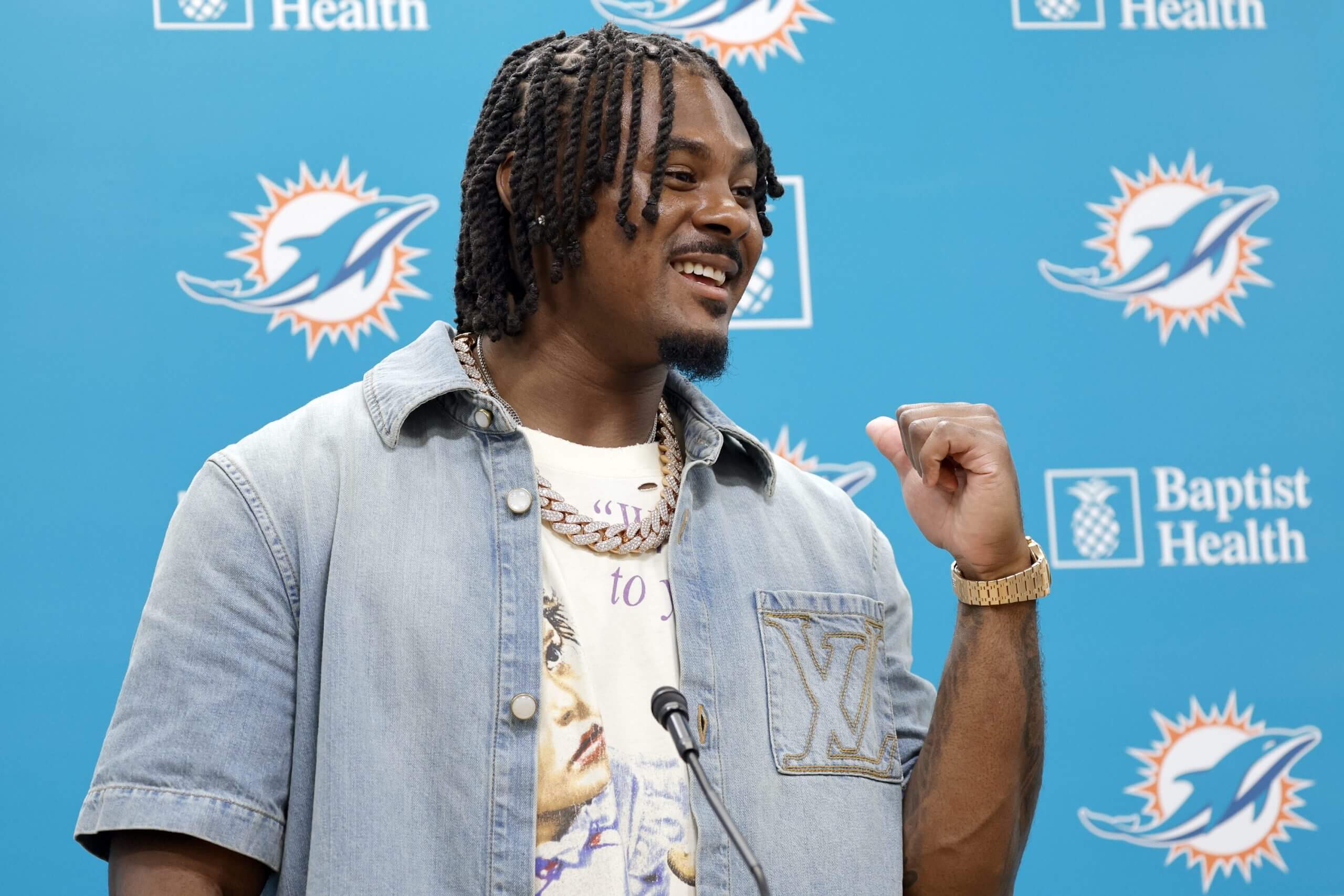
Cutting quarterback Tua Tagovailoa less than two years after signing him to a $212.4 million extension signaled a rebuild that some think will have the Dolphins swimming in circles.
“To me, this is 2019 all over again,” one exec said.
Back then, the Dolphins signed veteran quarterback Ryan Fitzpatrick to play with a bunch of newcomers. They entered the season with the NFL’s lowest Vegas win total but secured only the fifth pick in the 2020 draft. Unable to draft Joe Burrow, who went No. 1 to Cincinnati that year, the Dolphins used the fifth pick for Tagovailoa, only to realize Fitzpatrick was better. Ownership forced Tagovailoa into the lineup. It wasn’t pretty.
“They should not have signed Malik Willis,” the exec said. “They should have taken the full Tua cap charge in one season. They should have gone with Quinn Ewers and just played out the season.”
The Dolphins added Malik Willis but said goodbye to several key contributors. (Amy Beth Bennett / South Florida Sun Sentinel / Tribune News Service via Getty Images)
The fear is the Dolphins will select a quarterback early in the 2027 draft, only to realize Willis is better. Then again, if Willis shows real upside, the Dolphins might not need to select a quarterback next year.
“You should know enough about Willis to know many of his throws were flareouts and simple stuff,” another exec said. “So, unless you plan on running an offense like that, what are you doing? And then I don’t think they got enough for (Jaylen) Waddle. They got the equivalent of the 25th pick in the draft. It should have been a lot more.”
Does anyone like what the Dolphins are doing?
“Give me another idea,” a third exec said. “They will have as many minimum-salary guys on their 53 as any team in the league. The problem there is that they have an absentee owner and some really empowered people in the front office, including the president. If you’re the GM, that’s a tough situation.”
New England Patriots
Added: $64.3M (6th) | Lost: $36.8M (22nd) | Differential: $27.4M (7th)
Execs expect the Patriots to acquire receiver A.J. Brown from Philadelphia in June, once the salary-cap implications become more tenable for the Eagles. They disagree over what Romeo Doubs adds at the position on a deal worth $17 million per year, which ranks 27th among receivers.
“Doubs was my top-rated receiver out there,” one exec said. “He’s a little inconsistent and can handle only so much, so you should play him at only one spot. But I think he’s really talented.”
Another exec said he would have bet Doubs would command more than Wan’Dale Robinson, who commanded $17.5 million per year from Tennessee.
“I was not high on Doubs,” a third exec said, citing the receiver’s inconsistent concentration. “They did not improve on the field from (Stefon) Diggs. Maybe they did off the field from a headache standpoint. It seems just a matter of waiting until June 1 passes for Philly to trade A.J. Brown, who in my opinion is a declining player each of the last three seasons.”
This exec thought New England would have been an ideal landing spot for D.J. Moore, who landed in Buffalo, or Alec Pierce, who re-signed with Indianapolis.
“I like (Alijah) Vera-Tucker at guard, and I like the inside rush of Dre’Mont Jones,” the second exec said. “They know what they are getting from Kevin Byard, a playmaker on the back end and a veteran that knows their system. They lost (K’Lavon) Chaisson, but they kind of created him. I think he’ll revert to what he was before.”
New York Jets
Added: $69.0M (4th) | Lost: $64.8M (7th) | Differential: $4.3M (15th)
The Jets are an easy team to mock, but most execs thought their plan made sense given the stakes for second-year coach Aaron Glenn.
“People were crushing them for getting old guys, but you gotta give Aaron Glenn a chance,” one exec said. “To completely tank next year to try to get the quarterback the following year and build around the draft capital they got from the Quinnen Williams and Sauce Gardner trades, you still gotta raise the floor and turn the culture. You don’t want to be like Cleveland with a tanking culture hanging over your franchise.”
Key newcomers Minkah Fitzpatrick (age 29), Demario Davis (37), David Onyemata (33) and Geno Smith (35) are not exactly long-term investments. Edge rusher Joseph Ossai (25) is younger.
“Let’s just be honest,” the exec added. “If they were to get the top guys, they would have had to Tyler Linderbaum the thing. Instead, they get some older guys to teach these guys.”
If this sounds familiar, it should.
“The Jets keep doing the same thing,” another exec said. “They trade good players off their team, they get draft picks, nobody wants to play there, they are a young team, they have to find a journeyman quarterback. Then they bring in all these picks, they can’t find a quarterback still, and then they trade all those players for more picks and still can’t find a quarterback.
“I would guess the owner is very involved with that thought process.”
Another exec said the Jets were bringing in veterans to help the culture because Glenn could not do for the Jets what his old boss in Detroit, Dan Campbell, did for the Lions.
“They’ve done a good enough job supplementing their roster to where they don’t have a lot of glaring holes now, so they could move up or down in the draft,” another exec said. “Their roster is not bad. This should probably be the last free-agency period where they are really aggressive. You need to plan and budget like you are hitting on these draft picks.”
Pittsburgh Steelers
Added: $45.0M (17th) | Lost: $25.5M (25th) | Differential: $19.5M (12th)
Fans who had grown weary of the good-not-great status quo under former coach Mike Tomlin will have to find someone else to blame if nothing changes this season.
Is there reason to believe anything will change?
“What is the plan? What is the vision?” one exec asked.
For the second offseason in a row, the Steelers are waiting for Aaron Rodgers to decide when he wants to sign with the team and lead the offense. Also for the second season in a row, the Steelers acquired a veteran receiver by trade: DK Metcalf from Seattle last year, Michael Pittman Jr. from Indianapolis this year. The compensation for Pittman was lower. Has the ceiling gotten higher?
“They got slower,” another exec said of the Pittman addition. “Rico Dowdle is a comfort signing for Mike McCarthy, who had him in Dallas. Mike knows what he’s getting. Pittsburgh, until they figure out who is going to pull the trigger, is a B-minus team.”
It’s going to be Rodgers, almost certainly.
“Nothing flashy,” another exec said of the Steelers’ free agency. “The thing that people may or may not realize, and you’ll see, is that the head coach really kept that thing afloat. Tomlin was able to cover up some deficiencies and get them going. They have some receivers that should be an upgrade. Defensively, when those guys stay healthy, they can play well.
“Are they a Super Bowl-talented team? They can battle for the playoffs, but I do not think they are a Super Bowl team.”
Tennessee Titans
Added: $114.0M (1st) | Lost: $43.4M (14th) | Differential: $70.6M (2nd)
It’s logical for teams to sign free agents their coaches have worked with in the past, but execs thought the Titans took this to an unhealthy extreme, especially when reuniting new offensive coordinator Brian Daboll with receiver Wan’Dale Robinson and cornerback Cor’Dale Flott, who both played under Daboll on the Giants.
“They signed two really high-level players in free agency: John Franklin-Myers, who (head coach Robert) Saleh did have a relationship with, and they signed Alontae Taylor, who they did not have a relationship with,” an exec said. “But then you bring in Wan’Dale Robinson and Cor’Dale Flott for a lot of money, and it’s like, what are you doing? I did not get that.”
Multiple execs were surprised by how much Robinson commanded.
“Wan’Dale stepped up for the Giants when (Malik) Nabers went down,” one said. “He’s really small, but he is quick, and he’s tough. I liked him, but he is really like a No. 3. He got paid the same as Rashid Shaheed, another small guy who is explosive and competitive. This is the GM (Mike Borgonzi) giving Daboll what he says he needs to develop the young QB.”
Execs liked the addition of Franklin-Myers, who signed for $21 million per year from Denver and played for Saleh on the Jets previously.
“They are trying to change that culture,” another exec said. “I really like John Franklin-Myers. He brings a lot of juice on that defensive line. He’s active, he’s a playmaker, he gets in the backfield, he is very disruptive and he plays the style that Saleh likes — that attacking, upfield style. It’s a lot of money for a smaller guy, but just like the guy in New England a year ago, Milton Williams, they get overpaid.”
Heavy investments on defense could indirectly help second-year quarterback Cam Ward by taking pressure off the offense to keep pace, even though one exec said he did not consider Flott to be a starting-caliber player.
“Tennessee struck me as impressive,” another exec said. “The defensive moves made sense. Jermaine Johnson is an edge rusher Saleh is familiar with. Franklin-Myers was the best interior rusher on the market. The nickel role is important, and Alontae Taylor is a guy with ball skills who can pressure from the nickel position. The defense definitely got better, and that’s a great way to support a No. 1 pick quarterback.”