
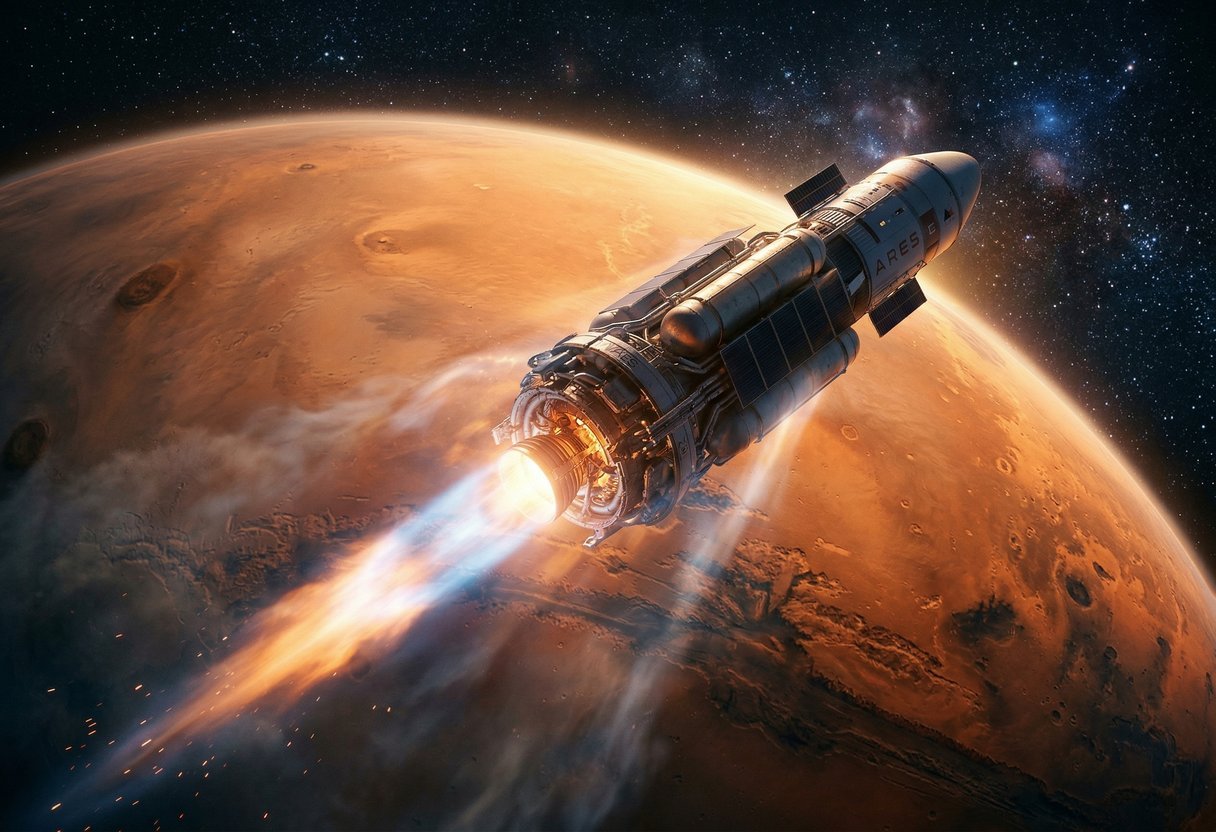
Halving the trip to Mars sounds straightforward, until you learn what has to spin at blistering speed to make it possible. Are we ready to trust a whirling, little-tested heart with the most ambitious voyage of our time?
Chemical rockets have hit a performance wall at about 450 seconds of specific impulse, which is why most space players are squeezing costs instead of time. A different track comes from researchers at the University of Alabama at Huntsville and Ohio State University, who propose a centrifugal nuclear thermal rocket that spins liquid uranium into a torus and uses it to superheat hydrogen. Early models outperform the NASA and DARPA DRACO target of 900 seconds and flirt with 1,500, the kind of leap that could redraw Mars mission schedules. The catch is formidable, from reactor poisons like xenon and samarium to fickle hydrogen bubbles and escaping fuel, so the team is probing solutions with Ant Farm, BLENDER II and a recovery method called dielectrophoresis.
The limits of current space travel technology
Chemical rockets gave us orbit, the Moon, and a launchpad for dreams. Yet their specific impulse has plateaued at 450 seconds. That cap locks mission timelines and payload choices, even as costs fall and reusability spreads. SpaceX fine-tunes economics, NASA strategizes cadence, but performance barely budges. So what could push us faster to Mars?
Unlocking potential with nuclear thermal propulsion
Nuclear thermal propulsion is hardly a new spark. The idea is to heat a light propellant with a compact reactor, then let physics do the heavy lifting. NASA and DARPA’s DRACO program aims to test a flight engine by 2027, targeting 900 seconds of specific impulse. That is roughly double chemical rockets. Ambitious teams still want more.
How the centrifugal nuclear thermal rocket works
Enter the centrifugal nuclear thermal rocket, or CNTR. It swaps solid fuel for liquid uranium, stabilized by rapid rotation in a ring-shaped torus. Hydrogen flows through the blazing core, soaks up heat, then rockets out a nozzle to make thrust. Simulations estimate up to 1,500 seconds of specific impulse, nearly 4x conventional engines. That kind of leap could reshape Mars mission plans.
Challenges standing between concept and reality
Between a bold blueprint and a working flight article stands a tough engineering gauntlet. Researchers are methodically tackling the most stubborn issues.
Fission by-products such as xenon and samarium can poison the reactor. Additives like erbium-167 and selective removal techniques may keep reactions steady.
The behavior of hydrogen bubbles inside liquid uranium remains uncertain. Teams are running surrogate tests with galinstan and nitrogen in rigs dubbed Ant Farm and BLENDER II to map the flow and heat transfer.
High rotational speeds and intricate plumbing complicate reliability, while uranium loss through the nozzle risks efficiency. Dielectrophoresis, called DEP, is being tested to recapture vaporized fuel and return it to the core.
What’s next for interplanetary propulsion?
The CNTR is still early, without a full prototype. The near-term agenda is clear: refine experiments, improve physical models, and prove DEP can close the fuel loop in the lab (according to this study). If those hurdles fall, the prize is substantial. Travel times to Mars could be cut in half, with safer schedules and sturdier payloads riding a new kind of engine.