
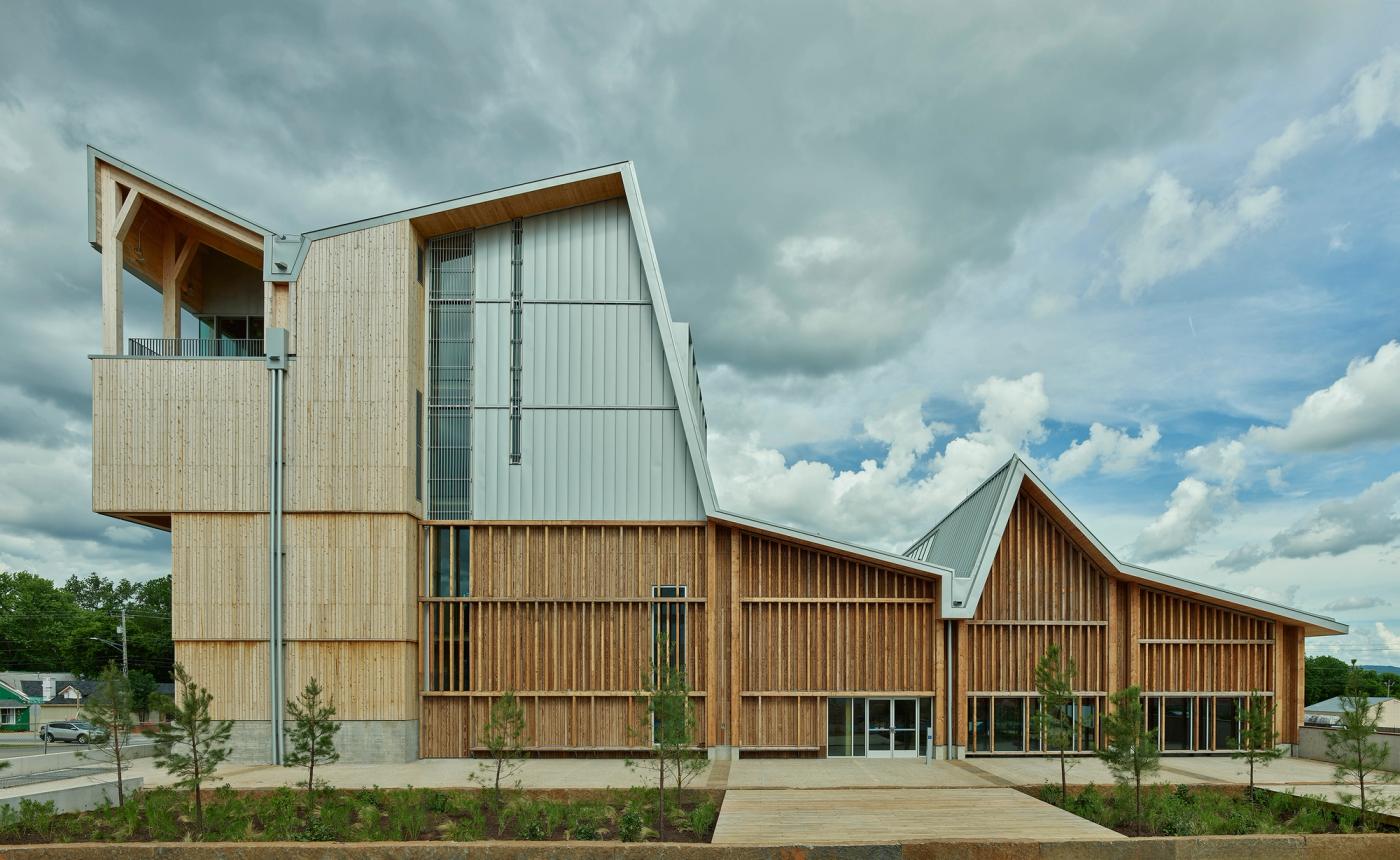
The Anthony Timberlands Center is 42,000 square feet and uses a whole range of different kinds of timber, from hand-tooled to innovative mass timber components. I’m curious about the difference between handicraft and high-tech making.
When we won the competition, we thought we’d be wandering around the forests of Arkansas, choosing this or that tree. But the industry of timber is about transforming smaller pieces to be able to do bigger work and less about craft as it would be with a door or bench.It’s different when you see somebody whittling, when you touch a chair handle that hundreds of people, maybe even through the generations, have touched. It’s amazing. When I was a child, there were Hawthorn trees, that cattle would rub themselves against, and the bark of the tree would become like leather because of this friction over time. Timber is a marvelously elegant material, but it does have limits, and it does morph into an industrialized material at certain scales. Yet there’s ongoing research into the glues used in timber manufacturing and there’s also a push to make concrete a more sustainable material. I think that the future is hybrid.
It’s a time of deep polarization in the U.S. When you curated the 2018 Venice Architecture Biennale, the theme was “Freespace” and Grafton Architects’ buildings are famous for bringing people together. How might architecture play a role in gathering us, perhaps not in agreement, but within a shared space?
I was reading recently about what happens when algorithms feed you information so you think a certain way. As it keeps feeding you, you get more and more convinced of that certain way, and other people become more and more othered. Societies are diminished by that kind of strategy, yet architecture has this incredible ability to gently hold you. You ask about how people meet. Students meet by a shared need for a cup of coffee, or by bumping into another on a stairway. As humans, we’re social beings, and architecture has this fantastic ability to orchestrate ordinary things. You’ve asked a very big question: What can architecture do to encourage people to trust each other? I think blurring boundaries is a lovely thing. You’re neither outside nor inside. Some ambiguity is a great thing. Architecture is about gently making that tissue between your private world and your public world safe, so that you can be yourself. You know, those students sitting up in the studio terraces in the Anthony Timberlands Center, they’re looking out at the hills in Arkansas. It’s a beautiful landscape and a busy road. Architecture holds people, so they might be their best self.
There’s something really beautiful in architecture allowing people to just be — the pretense drops away.
Architecture doesn’t have to be the Taj Mahal. We’re trying to make things that are meaningful enough that they don’t have to be standing on their head to do that. We have to have the courage to stand our ground on decency, generosity, and respect. Somebody should know where the door is. A building should say “Welcome, would you like to sit on that comfortable seat?” Life is difficult, and so the role of architecture should be to make it as poetic as possible, in an ordinary way — a nice high ceiling, a window you can open, and a little terrace for your table. We have to push against the so-called extraordinary; we should make really good ordinary things.