
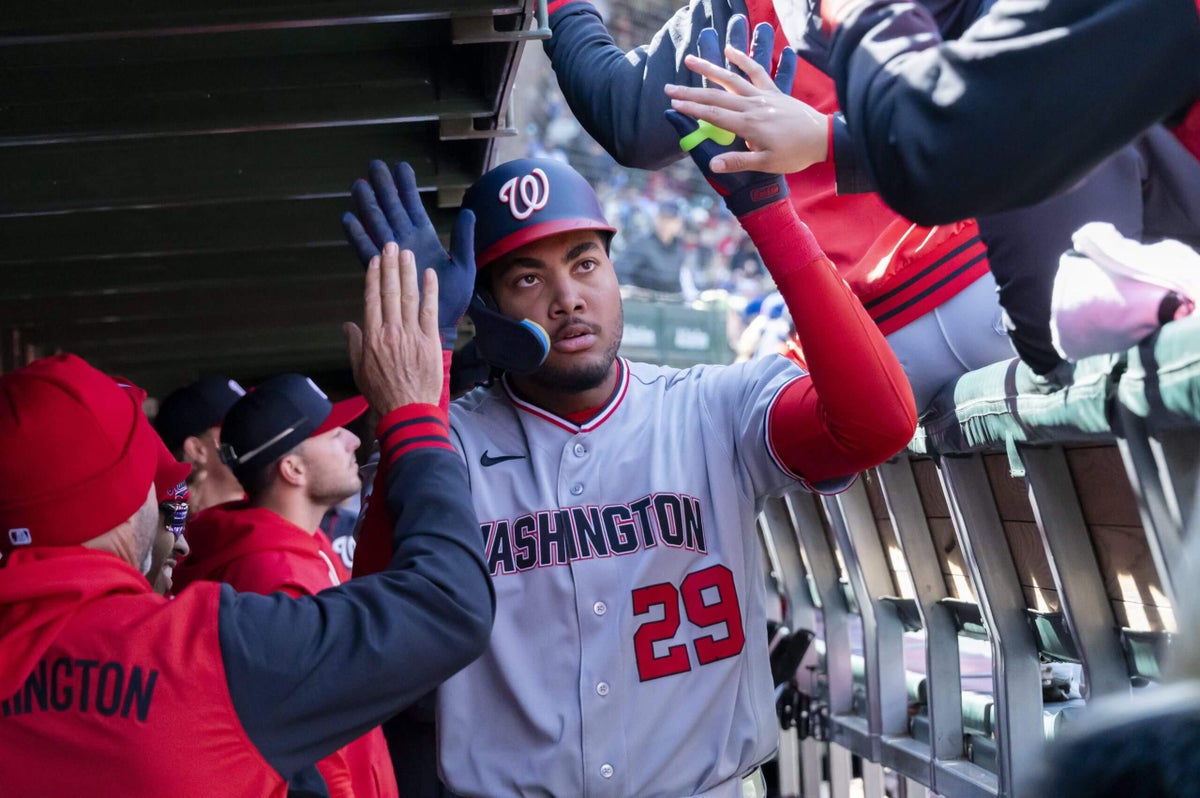
On Friday afternoon, James Wood will tap his bat along the dirt on his way into the batter’s box. He will hear applause, which will represent a fan base’s expectations for him to thrive as the fulcrum of an offense and the face of a franchise.
They will hope, in the home opener against the Los Angeles Dodgers, that he looks like the All-Star he was in the first half last year. He will hope, in one way or another, that there is limited baggage from a second-half swoon that may have been caused, in part, by physical issues that he mostly kept hidden from the public.
And he will have to decide, now and over the course of the season, what to divulge to his team.
The answer, so far, has been everything.
Most players play through something to help their team win as often as possible. Most coaching staffs want their players to be forthcoming for the very same reason. The Washington Nationals are trying to bridge that gap with their players to maximize the roster and keep players healthy.
How does that happen?
“I mean, I just think it’s kind of a two-way street,” Wood said. “I feel like, as players, we would appreciate it if they were kind of honest and straightforward with us. So I feel like it’s only fair that we’re the same way with them.”
Last year, Wood missed time in spring training with left quad tendonitis. Though he recovered at the start of the season — then excelled, and did not have a day off until mid-July — Wood told The Athletic that he played through some knee and quadriceps issues.
“I felt like I was playing 100 percent or close to it pretty much every day,” Wood said. “It was just kind of more of a nagging thing. … One series I’d feel great, and the next, not so great. So it was just kind of a series-by-series, or week-by-week thing.”
Wood has never directly pinned his sluggish second half on that detail. He participated in the Home Run Derby, which can affect a player’s timing. He said that teams pitched to him differently in the second half, and he began to struggle against outside pitches. He returns to D.C. healthy, yet in a small-sample slump, hitting .111 with one homer, 12 strikeouts and a .496 OPS.
But this year, he feels more equipped to handle these slumps. That’s in part because he has been through them before. It’s also because he no longer has to worry about his lower half and what to tell anyone about how it feels.
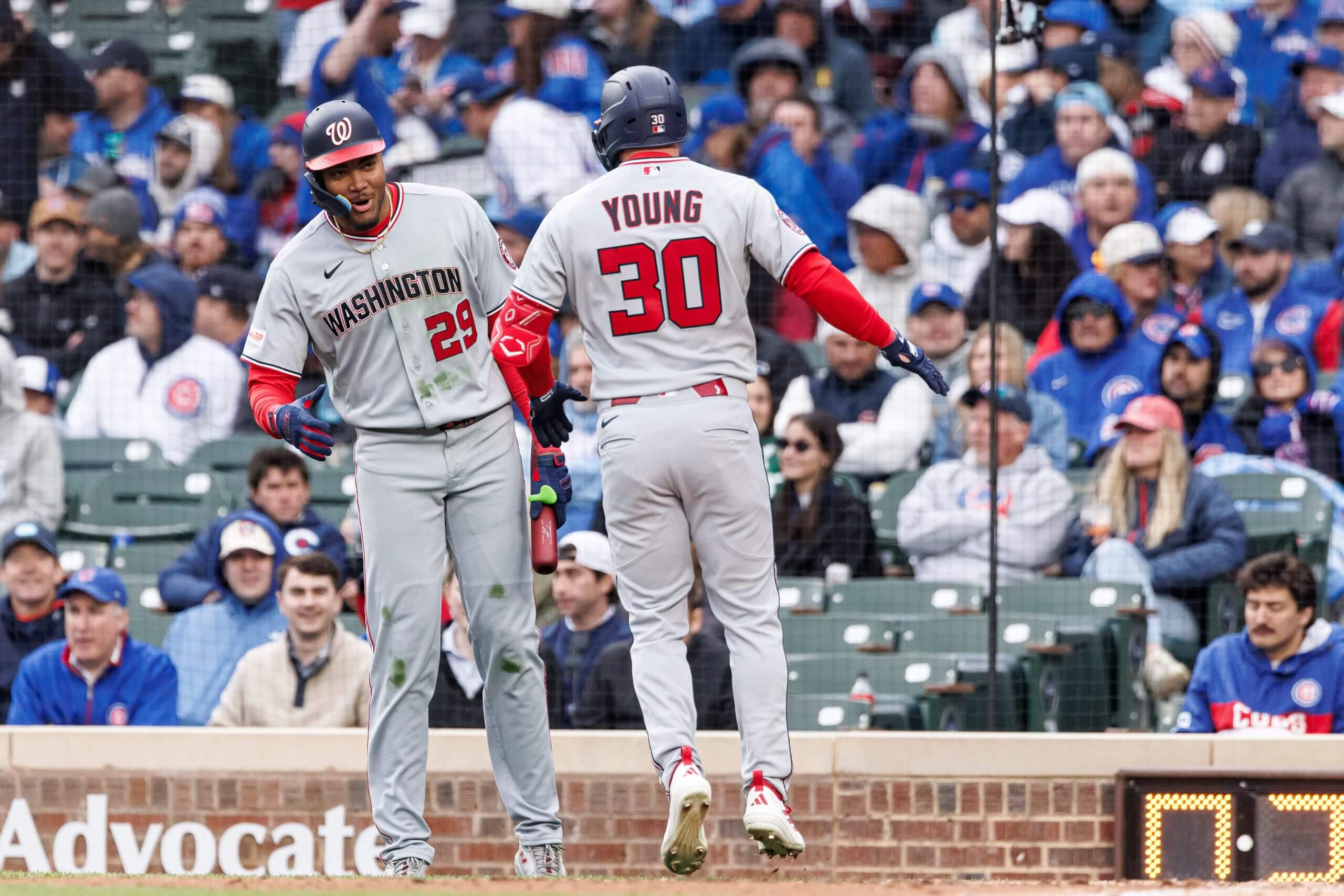
An All-Star in 2025, James Wood posted a .915 OPS in the first half of the season, slugging 24 home runs. (Griffin Quinn / Getty Images)
That began with early engagement from the organization.
After he took the job in October, one of manager Blake Butera’s first calls went to Wood. Bench coach Michael Johns visited the slugger when he trained at IMG Academy. When Wood went back north to D.C., he found himself sweating next to team trainer Harvey Sharman.
“He was kind of killing me this offseason,” Wood said with a big smile. “Every version of split squat you can imagine.”
“It wasn’t just like, ‘Hey, yeah, we trust you, we’ll see in four months,’” Butera said. “We went and saw him and talked to him about all of that stuff.”
“This year compared to last year, I feel like I’m in a much better spot,” Wood said.
This, the Nationals have stressed, is part of a team-wide goal of improving transparency and increasing accountability.
Early on in his tenure, Butera told players he wanted them to run the ship. He wanted his coaching staff to be honest, even when it was difficult. So far, they’ve done just that.
Pitchers have said that pitching coach Simon Mathews is blunt with his feedback, offering a “heck yeah” or “heck no,” depending upon the results. Daylen Lile said that first base coach Corey Ray is always on him about his prep step and reaction time. The staff has also been forthcoming that there will be a lot of movement between Triple-A Rochester and Washington, a complicated conversation they feel is necessary to have.
“You can’t be accountable if you don’t have trust,” starter Trevor Williams said. “If you’re not feeling 100 percent, you can be like, ‘Hey guys, I can’t give you 100 percent today. You deserve 100 percent today, so let’s take a day so I can give you 100 percent tomorrow.’”
It will take time for the staff to earn everyone’s confidence. But the Nationals have quickly earned Wood’s ear. This spring, Butera realized quickly that he would not have to worry about Wood’s candor. If he woke up on the wrong side of the bed, he would let Butera know. If he needed six innings, rather than nine, he’d tell that to the staff.
“He’s just someone that, when you ask him how they’re feeling or what they need, you just get that feeling like he’s not holding anything back,” Butera said. “Like he’s not afraid to tell you (something) whether it’s good or bad.”
Beyond trust and communication, Butera also reasoned that Wood’s transparent nature comes from the circumstances of his situation. He is established in the big leagues, meaning he no longer has to fight for playing time and can instead fight to be the best player he can be. And, obviously, he has had a chance to reflect on the second half, and how talking through his issues can help him get through them.
“I told him, ‘I need you to give me the truth,’” Butera said. “Because on days where you’re not feeling great, we can get you a DH day. We can get you a day off early. The goal is for when August, September rolls around, that you feel like you’re hitting your stride. … We want to play October baseball, and I want you to be like, ‘Hell, yeah, I feel good.’
“You can’t manage his workload accurately or correctly unless he’s given us honest feedback. So that was a big part of the conversation.”
Even now, with his legs at 100 percent, Wood has also been the first to concede that this is not how he wants to start his season. He is focused on shortening up his swing and taking advantage of good pitches to hit. Though his six hardest-hit baseballs this season have been on pitches over the middle or inner third of the plate, he is swinging at more pitches over the outer third than he did in 2025 and has swung at just 5 of 11 pitches down the very middle of the plate, the second-lowest rate of anyone who has seen at least 10 “meatballs.”
In short, he sees them as minor items — adjustments that may be easier to make this year with another year under his belt, and, this season, a clean bill of health.
“I feel like that’s why it was important to try and get ahead of it as well as we could, so that during the season you’re not really playing catch-up,” Wood said. “Because at that point, that’s really kind of all it is. You can’t really take back the wear that you put on it.”
“I just think he’s at a place now where he knows what he needs,” Butera said. “He’s confident in himself. He’s not trying to hide anything. I think that will happen more and more with more guys. But right now, with James, it happened pretty quickly.”