
LEELANAU COUNTY, Mich., (WPBN/WGTU)– An invasive species has been impacting trees in parts of Michigan in recent years.
Meteorologist Ethan Foreman explains what you can do to protect the trees in your yard.
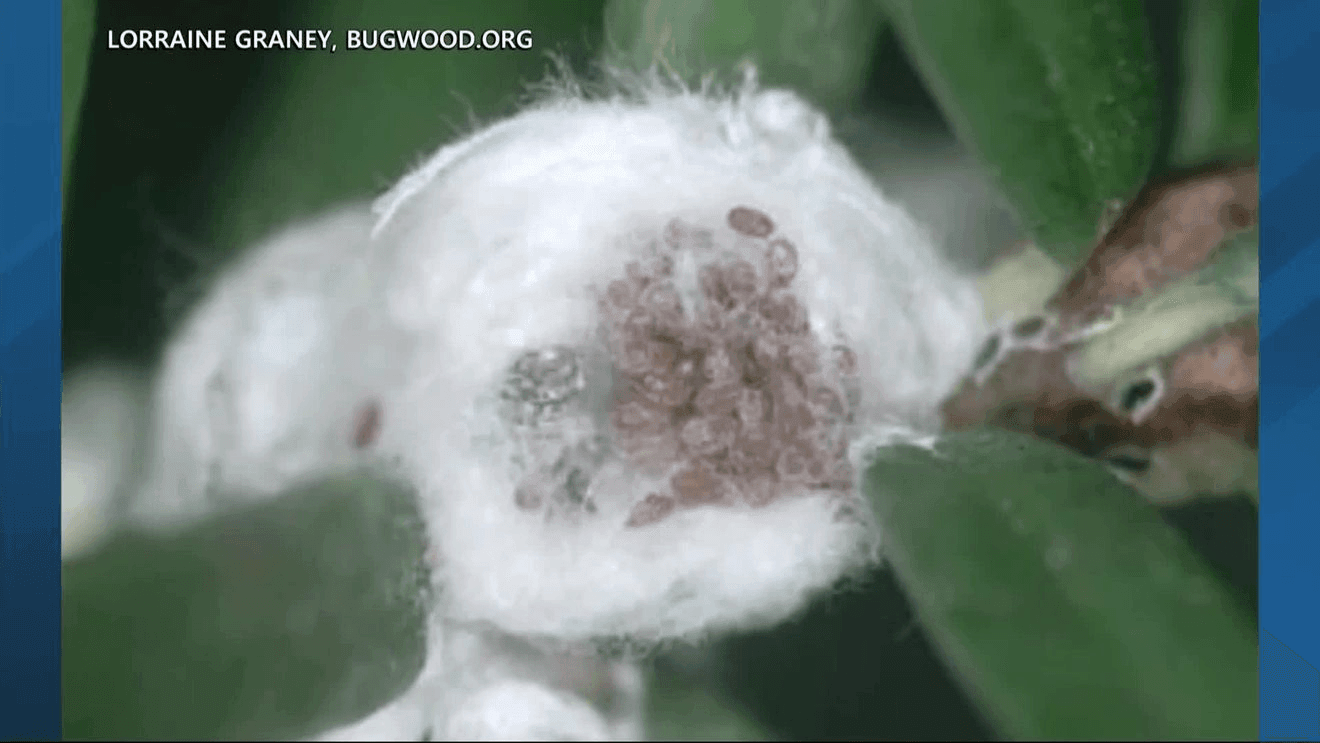
“Hemlock woolly adelgid is a sap-sucking insect native to Asia, invasive here in North America,” said Erin Biggs, a forest health enologist with the Department of Natural Resources.
Biggs said that this invasive species started to infect the hemlock trees around 2006, but has been a major issue in parts of Michigan since about 2015.
“It feeds on the sap of the tree and that ultimately weakens the tree over time as the populations build,” said Biggs. “And the trees will succumb to death in a matter of maybe four to 10 years, depending on the existing health of the tree and the severity of the infestation.”
The hemlock woolly adelgid has been observed in Allegan, Antrim, Benzie, Leelanau, Manistee, Mason, Muskegon, Oceana, Ottawa, Van Buren, and Washtenaw counties, and may continue to expand.
“Just last year was the first time that I’ve noticed it on a customer’s property,” said Dean Baughman, a certified arborist of Deering Tree Service. “And so yeah, we’re getting geared up to offer alternatives to our customers for that since we’re now starting to see it on customers’ properties.”
Tom Deering and Dean Baughman, two certified arborists of Deering Tree Service in Maple City, said that there are certain chemicals you can use for this to protect these trees, but if you are not comfortable using this chemical, make sure to call a professional.
“Imidacloprid is a product that’s good to get it right into the vascular system of the tree, and that helps put it right into the location, but it moves through the tree a little bit slower,” said Baughman. “Sometimes it may take a year, even to get to the very tops of the tallest trees.”
Deering said they have a specific tool they use to protect the trees.
“We can inject these trees with this particular injection gun with imidacloprid, which will get the insecticide into the vascular system, and it will move through the tree a little faster than if you did a collar drench,” said Deering.
Baughman said that the weather may have a role in why this is more common in some areas than others.
“The main reason that it’s found along the lakeshores are winter temperatures are more moderate than they are further inland in Michigan,” said Baughman. “So that more moderate temperature in the wintertime allows the insect to survive and therefore spread.”
Experts say the invasive species tends to die out faster when temperatures drop well below zero for several days.