
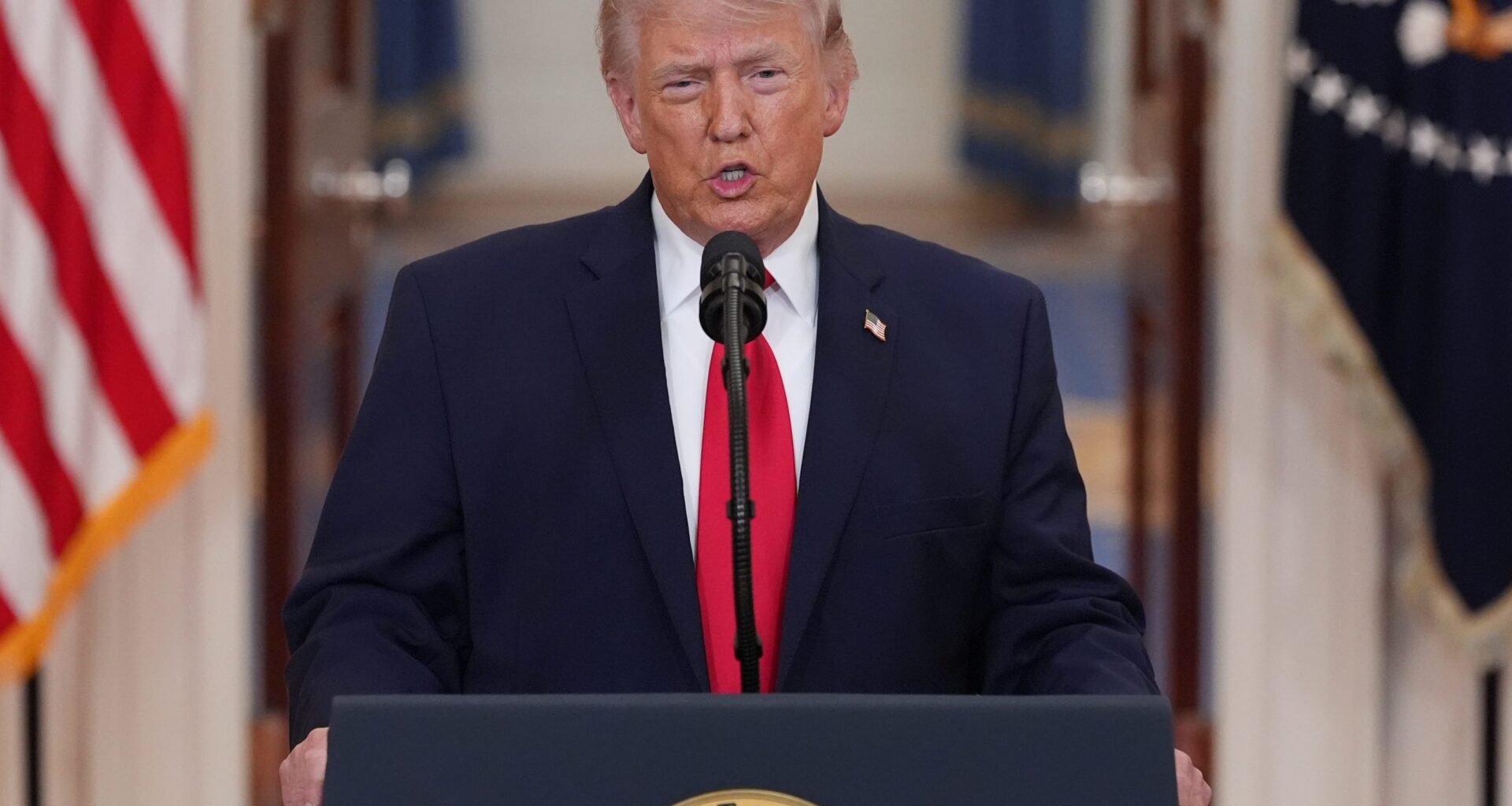
WASHINGTON – In a prime-time speech Wednesday, President Donald Trump said the Iran war was “nearing completion,” though he failed to offer a concrete timeline and said U.S. forces would hit Iran “extremely hard over the next two to three weeks.”
The comments sent oil prices soaring and the stock market swooning. But that was not the only eyebrow-raising address Trump gave that day.
In a private Easter Lunch and prayer service earlier in the day, the president was perhaps more candid.
The speech to faith leaders was shut off to the press but released in a video briefly before it was pulled off the White House website.
In that speech, Trump returned his fixation on Minnesota’s Somali community. He once again called Somalis “low IQ people” and “bad people” and repeated unproven smears of Rep. Ilhan Omar, D-5th District, whom he called a “stone cold crook.”
Related: Trump, at the Davos forum, takes more shots at Minnesota, Somalis
But Trump also said something new. He intimated that the states should bear the full burden of subsidized daycare for low-income families.
“We can’t take care of daycare. That has to be up to the states,” Trump said. “The states have to take care of daycare, and they should pay for it.”
Trump also suggested that other programs, including Medicaid and Medicare, should be left to the states, which he said could raise taxes to cover the expense.
“It’s not possible for us to take care of daycare, Medicaid, Medicare, all these individual things. They can do it on a state basis,” Trump said. “You can’t do it (federally). We have to take care of one thing: military protection.”
And the president praised Education Secretary Linda McMahon for largely dismantling the U.S. Department of Education. “Linda McMahon, she’s done a great job,” Trump said. “She’s left education all to the states.”
Trump’s musings on cost-shifting to the states were largely prompted by the cost of the Iran war. The White House is expected to soon ask Congress for $200 billion to cover the cost of that conflict. But that is expected to receive pushback from most Democrats.
Rep. Betty McCollum, D-4th District, the top Democrat on the House Appropriations Defense Subcommittee, has made it clear she will oppose the White House’s request for more money for the war.
“President Trump’s war in Iran is a strategic and diplomatic failure,” McCollum said in a release. “His actions have made the Middle East more unstable … He failed to consult Congress or our allies. Now, he’s asking Americans for an additional $200 billion to finance this conflict without explaining why this astounding amount of taxpayer funding is necessary.”
Much more troubling for the White House is that there’s no guarantee the war supplement would be supported by enough Republicans.
A growing number in the party’s conservative wing insist the money be offset by cuts in other programs and other GOP lawmakers, including Sen. Rand Paul, R-Ky., oppose the war itself.
Bondi out
President Donald Trump on Thursday announced in a Truth Social post that he had fired U.S. Attorney Pam Bondi.
Trump was reportedly unhappy with Bondi’s handling of the “Epstein files,” the documents the Justice Department had collected on disgraced financier Jeffrey Epstein, which had become a political liability for the president.
The president was also reportedly frustrated by Bondi’s failure to successfully prosecute his political enemies.
His former personal lawyer, Todd Blanche, will become acting Attorney General. Blanche had been Bondi’s deputy.
Bondi is the second Cabinet secretary Trump has ousted. He removed Kristi Noem as Homeland Security secretary last month.
The public may not have seen the end of Bondi, however. She was subpoenaed last month to testify April 14 before the House Committee on Investigations and Government Oversight about her handling of the Epstein files.
Liberation Day
Thursday marked the one-year anniversary of “Liberation Day,” the day President Donald Trump unveiled his global tariff plan.
The tariffs Trump announced that day have been found unconstitutional by the U.S. Supreme Court and removed.
But a group of Democratic state finance officials said this week that the duties have caused lasting damage to businesses and consumers and that the chaos they provoked will continue as Trump imposes other types of tariffs over which he has authority.
“This was predictable and avoidable,” Minnesota state Auditor Julie Blaha said.
At a press conference with three Democratic colleagues, Blaha said Trump’s tariffs have hit Minnesota farmers especially hard as other nations, including China, hiked their tariffs on U.S. farm exports or shut off their markets completely to American farmers.
She said tariffs amplified other problems on Minnesota farms. Those include higher costs for fertilizer and fuel due to the shipping logjam in the Strait of Hormuz caused by the Iran war, the loss of immigrant labor as farm laborers declined to show up for work because of Operation Metro Surge and cuts to nutrition programs, including food stamps.
Blaha insists the Trump administration should pay reparations to all who were hurt by the president’s tariff policies, including consumers who paid higher prices for many goods.
The Trump administration is developing a system to compensate businesses for the levies they’ve paid, even if they passed much of that cost on to consumers.
Blaha said compensation should go to consumers, too, but failed to say how that would be done.
“The federal government caused the problem,” she said. “They should be responsible for the big lift to the money back to consumers.”
In other news:
▪️Metro reporter Trevor Mitchell had a story this week about a plan to help Minneapolis businesses that have been hurt by Operation Metro Surge and digs into whether the money procured for that aid will be enough.
▪️Greater Minnesota reporter Brian Arola wrote about how student newspapers in the state are battling a tide and even thriving in a dire journalistic landscape.
▪️Sure, the Iran war has caused gasoline prices to skyrocket across the nation and the globe. But not so much in Minnesota. This story explains why.
▪️And it’s not only gasoline prices that have risen because of a shipping bottleneck in the Strait of Hormuz. Fertilizer shipments are impacted as well, resulting in a global spike in the cost of fertilizer as Minnesota farmers are entering planting season.
This and that
A reader who read our story on the Iran war’s impact on the price of fertilizer was critical of what he said is President Donald Trump’s unfamiliarity with American farming.
“Trump has no understanding of agriculture or empathy for farmers and it shows,” the reader wrote. “He would have benefitted from a week of bailing hay, putting in 12 hour days.”
Please keep your comments, and any questions, coming. I’ll try my best to respond. Please contact me at aradelat@minnpost.com.
Related