
North Carolina joined more than 20 other states in challenging President Donald Trump’s new executive order on mail-in voting, alleging in a federal lawsuit that the order is an unconstitutional power grab that would disrupt upcoming elections and disenfranchise voters.
“The president’s latest attempt to interfere with the states’ administration of their elections is as unprecedented as it is unconstitutional,” the states wrote in the lawsuit, which was filed Friday. “Under our Constitution, the president has no authority to restrict voter eligibility or mail voting to lists of voters pre-authorized by the federal government.”
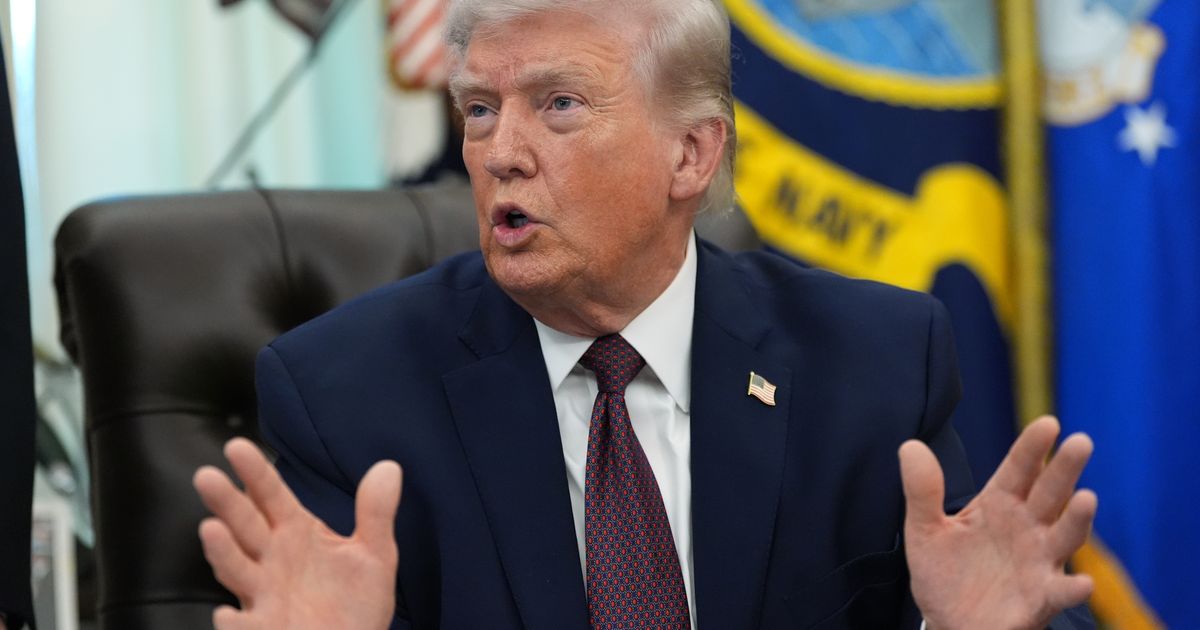
Trump on Tuesday signed the order, which calls for the creation of a nationwide list of verified eligible voters and to restrict mail-in voting ahead of this year’s midterm elections — the latest in a torrent of efforts to influence how Americans vote based on disproven allegations of fraud. Federal funding could be withheld from states and localities that don’t comply.
“The cheating on mail-in voting is legendary. It’s horrible what’s going on,” Trump said, repeating disproven allegations about mail ballots as he signed the order. “I think this will help a lot with elections.”
North Carolina Attorney General Jeff Jackson says he joined the lawsuit to protect the votes of North Carolinians who vote by mail, including active-duty military personnel and those who cast ballots in the aftermath of natural disasters such as Hurricane Helene. North Carolina has one of the highest populations of military personnel in the country, and hundreds are currently deployed to the Middle East.
The order seeks to bar the U.S. Postal Service from sending absentee ballots to those not on each state’s approved list. That puts ballots by military personnel at risk, Jackson says.
“Under current law, we can request and receive absentee ballots up until the day before the election, which matters because deployments can happen fast,” Jackson said in a statement. “Under this executive order, our absentee ballots would run a very high risk of being rejected by the post office — essentially thrown in the trash — if we deploy within 60 days of the election. That is unacceptable.”
In a statement Friday, White House spokeswoman Abigail Jackson described the order as a lawful effort to secure American elections.
“President Trump campaigned on securing our elections and the American people sent him back to the White House to get the job done,” she said in a statement.
Lawmakers’ lawsuit
The lawsuit comes two days after Democratic lawmakers sued to block the order. That lawsuit was filed by Senate Minority Leader Chuck Schumer, House Minority Leader Hakeem Jeffries, the Democratic National Committee and other party organizations working on campaigns for the House, Senate and governor offices around the country.
The legal challenges are the latest round of battles over the president’s power to control elections. Trump’s opponents handily won the first round last year, blocking his initial executive order intended to reshape election procedures by convincing multiple federal judges that it was likely unconstitutional.
Democrats say Trump was attempting to strike at the heart of America’s democratic machinery.
“President Trump has tried again and again to rewrite election rules for his own perceived partisan advantage,” the Democratic lawmakers’ lawsuit said. It adds that “our Constitution’s Framers anticipated this kind of desire for absolute power,” dispersing the power to control elections to individual states and Congress.
Mail voting has existed for more than a century and had steadily been increasing in popularity in both Democratic and Republican states until 2020. Then Trump decided to target the method, levying unproven claims of mass fraud. As a result, it’s become less popular among Republicans and more among Democrats, giving Trump additional incentive to throttle it before midterm elections that will determine whether his party continues to control Congress.
Trump himself often votes by mail, as recently as in a special election in Florida last month.
Since he returned to office, Trump has sought to influence the administration of state-run elections, citing often-disproven falsehoods about how fraud cost him the presidency in 2020. Repeated investigations, including ones by Republicans, showed no significant fraud in the 2020 vote.
Nonetheless, Trump has called for his administration to “take over” voting in Democratic areas, launched a probe of the 2020 vote fueled by election conspiracy theories and unsuccessfully pushed Congress to pass a law that would create new hurdles on voting, including a requirement that people provide in-person, documentary proof of citizenship when registering. That bill has stalled in the U.S. Senate over Democratic opposition.
Implications for North Carolina election process
Nearly half a million North Carolina voters — out of about 7.8 million registered voters — requested a mail-in ballot in the 2024 elections, including 161,000 Democrats and 119,000 Republicans. Under state law, any registered voter may request an absentee ballot without providing a reason, but must follow strict deadlines and return requirements.
Voters requesting an absentee ballot must attest they are U.S. citizens when registering to vote. Submitting false information could lead to felony charges.
North Carolina law requires voters to provide identifying information — such as a driver’s license number or the last four digits of a Social Security number — when registering. While the State Board of Elections doesn’t independently verify citizenship status, it recently started participating in data-sharing agreements with federal agencies to compare voter registration records with available databases as part of election integrity efforts.
Most absentee voters are required to include a witness signature verifying the ballot was completed by the voter. Election officials review absentee ballots through a verification process before they are counted.
Noncitizens are prohibited from voting under both state and federal law, and there is no evidence of widespread voter fraud by noncitizens in North Carolina.
Election officials told WRAL on Wednesday that voters should be confident their ballots will be counted fairly.
“We want voters to know that their elections are secure,” said Jason Tyson, director of external affairs for the State Board of Elections.
Still, Trump and other Republicans say stronger safeguards are needed.
“President Trump and Republicans have consistently fought for stronger election integrity measures and eliminating the potential for fraudulent voting to undermine confidence in the process,” Matt Mercer, a spokesman for the North Carolina Republican Party, said in a statement Wednesday.
Democratic U.S. Rep. Deborah Ross was among the Democrats who spoke out against Trump’s order this week, reiterating an argument laid out in the lawsuits: that only Congress and the states can enact such changes to election law — not the president.
“Trump’s attempts to restrict voting rights via executive order have been struck down by the courts, and this latest order will be no different,” Ross, a Raleigh Democrat, said in a statement.
The Associated Press contributed to this report.