
Deep in the heart of Yellowstone National Park, audio recorders roughly the size of hardcover books are documenting wolf barks, elk bugles and bird chirps 24 hours of the day, seven days a week, 365 days a year.

But it’s the new insights into wolf behavior that have proven most useful. The recorders, and the artificial intelligence technology that parses the sound they capture, are helping scientists better monitor and protect the controversial and ecologically important apex predator that brings thousands of tourists to Yellowstone annually.
The “Cry Wolf” project is a collaboration between Jeff Reed, a computational linguist with three decades of experience in the tech industry, and the Yellowstone Wolf Project. Yellowstone National Park spokespeople did not respond to repeated interview and information requests.
Article continues below this ad
FILE: The Junction Butte wolf pack in Yellowstone National Park, which includes parts of Wyoming, Montana and Idaho, in 2018.
Dan Stahler/NPS/Cry Wolf Project
Reed lives just north of Yellowstone in Montana and had been recording sounds on his own property with his company’s GrizCam, which also captures video, when something clicked. Why not record Yellowstone wolves? Wolves are notoriously hard to monitor and live in a rugged environment, the perfect fit for audio surveillance over many miles. He pitched the idea to Dan Stahler, the lead wolf biologist in Yellowstone, in 2023. “I grew up here and I love it,” Reed told SFGATE. “I want to protect it.”
Stahler, Reed and other members of the Yellowstone Wolf Project team installed 25 recorders during the summer of 2024. Some are attached to trees, while others are tucked under rocks. Today, 50 recording units span 500,000 acres in the park, monitoring Yellowstone’s wolves as they bark, yip, howl and whine.
Make SFGATE a preferred source so your search results prioritize writing by actual people, not AI.
Add Preferred Source
“Wolves are generally loud,” Reed said. “You can pretty much pick them up in that grid anywhere, depending upon things like wind.” Wolf packs north of Yellowstone Lake and between Gardiner and Cooke City in the park’s Hayden Valley and northern mountain ranges are covered by the technology, which helps researchers identify and geolocate them by their sounds.
Article continues below this ad
According to Reed, the project has analyzed over 200,000 hours of recordings, making it the largest database of wolf vocalizations in the world. Stahler told PBS News Hour that over 7,000 wolf sounds had been catalogued, and further analysis led researchers to determine the distinct “acoustic signatures” of several packs.
FILE: The acoustic signatures of four wolf packs doing chorus howls in Yellowstone National Park, which includes parts of Wyoming, Montana and Idaho.
Jeffrey T. Reed/Cry Wolf Project
While other bioacoustics researchers have recorded wolves for decades, they’ve done so on foot with handheld microphones. That means they have to be in the right place at the right time. Setting up hardware that records automatically provides a much larger dataset and potentially more answers to questions about how wolves communicate with each other.
“It would almost be like standing at a location for a year, never going to sleep and always listening,” Reed said.
Article continues below this ad
Reed uses technology from companies like Google, Microsoft, Nvidia and OpenAI to analyze the sheer volume of audio recordings, search for patterns, isolate individual sounds and more. Google AI, for example, can help pick out the sounds of individual wolves in a pack’s chorus howl.
The tech companies don’t fund the bioacoustic operation, and neither does the National Park Service. Yellowstone Forever, the park’s philanthropic arm, and Colossal Foundation, a genetic engineering company known for its “de-extinction” efforts, provide some funding. Reed functions as a volunteer, donating his time and technical expertise.
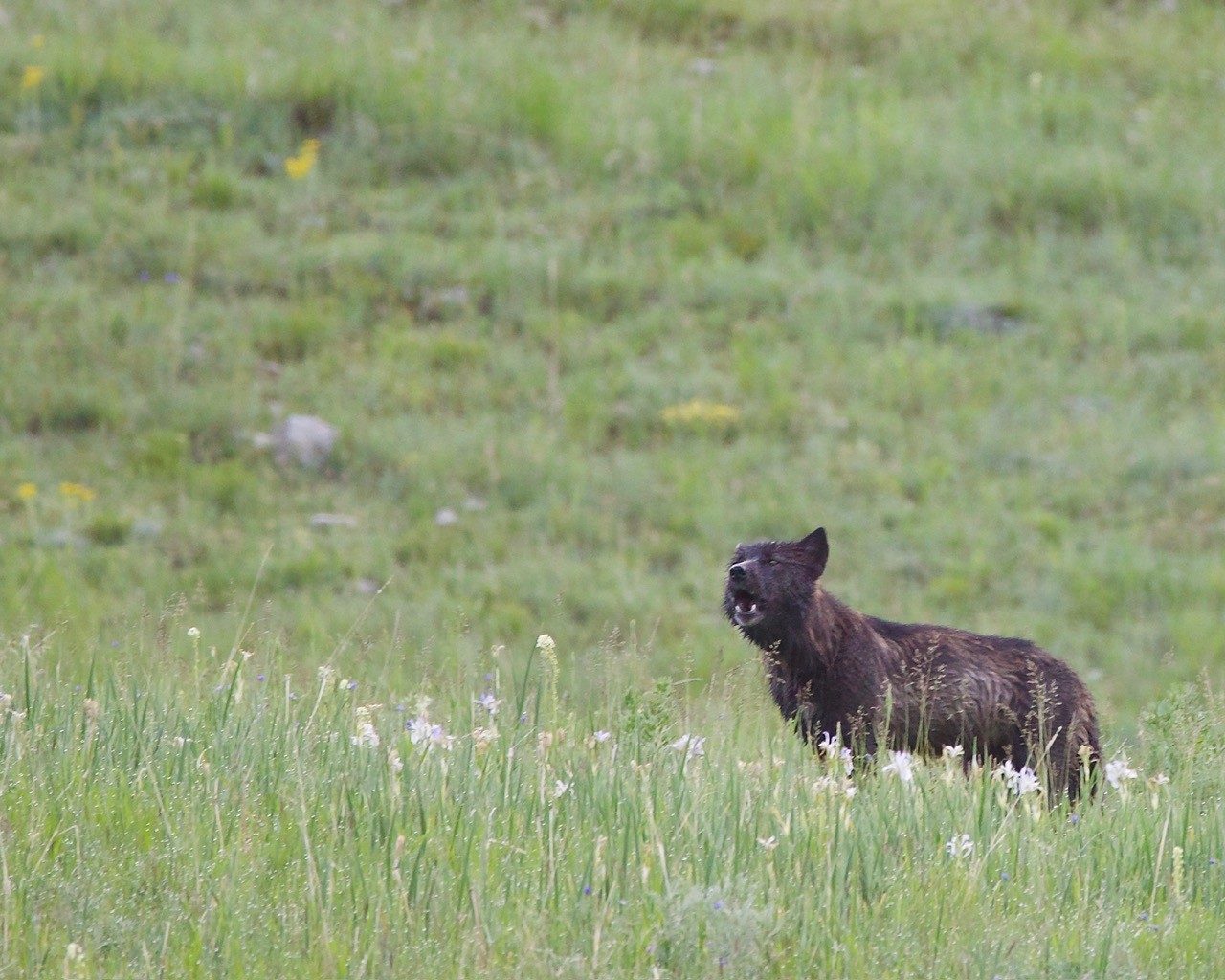
FILE: A howling wolf in Yellowstone National Park, which includes parts of Wyoming, Montana and Idaho.
Holly Pippel/Cry Wolf Project
So far, the sound recordings have revealed interesting new information about wolf communication. Researchers are tracking how often wolves howl, and it appears they do so mostly at night, all year round. Wolves have individual “voices” that are distinct from others. And, at least once, a wolf even howled back at a park ranger’s siren.
Article continues below this ad
Audio technology could revolutionize how wolves in the park are monitored in the long term. Setting up solar-powered recorders is far less invasive, time-consuming, expensive and hazardous than traditional wolf monitoring, which involves the use of airplanes, helicopters, dart guns and GPS collars.
If a recorder can tell how many wolves are in a pack from its chorus howls, that can then help researchers better estimate population numbers. Tracking individual packs’ signatures can also help keep a wolf pack from getting counted twice.
FILE: The sound waves of 50 solo wolf howls in Yellowstone National Park, which includes parts of Wyoming, Montana and Idaho.
Jeffrey T. Reed/Cry Wolf Project
“What I could envision down the road a decade from now is that we may not have to collar certain packs or put out collars in certain areas of the park,” Stahler told PBS.
Article continues below this ad
Reed is thinking big for sound recording’s broader potential. He told SFGATE that it goes beyond wolves — sound data can be used to understand what’s happening on public and private lands, from poachers to trespassers to wildlife movement. He believes it’s the natural extension of the technology that we already have in our homes, like the Google Nest home security cameras.
“This is coming,” Reed said. “It’s in all our homes today, and it will come into the broader world. Because 95% of the planet doesn’t have an electrical socket to plug into.”
We love national parks just as much as you do, so we have a newsletter that covers them from top to bottom. Sign up here.
Article continues below this ad