
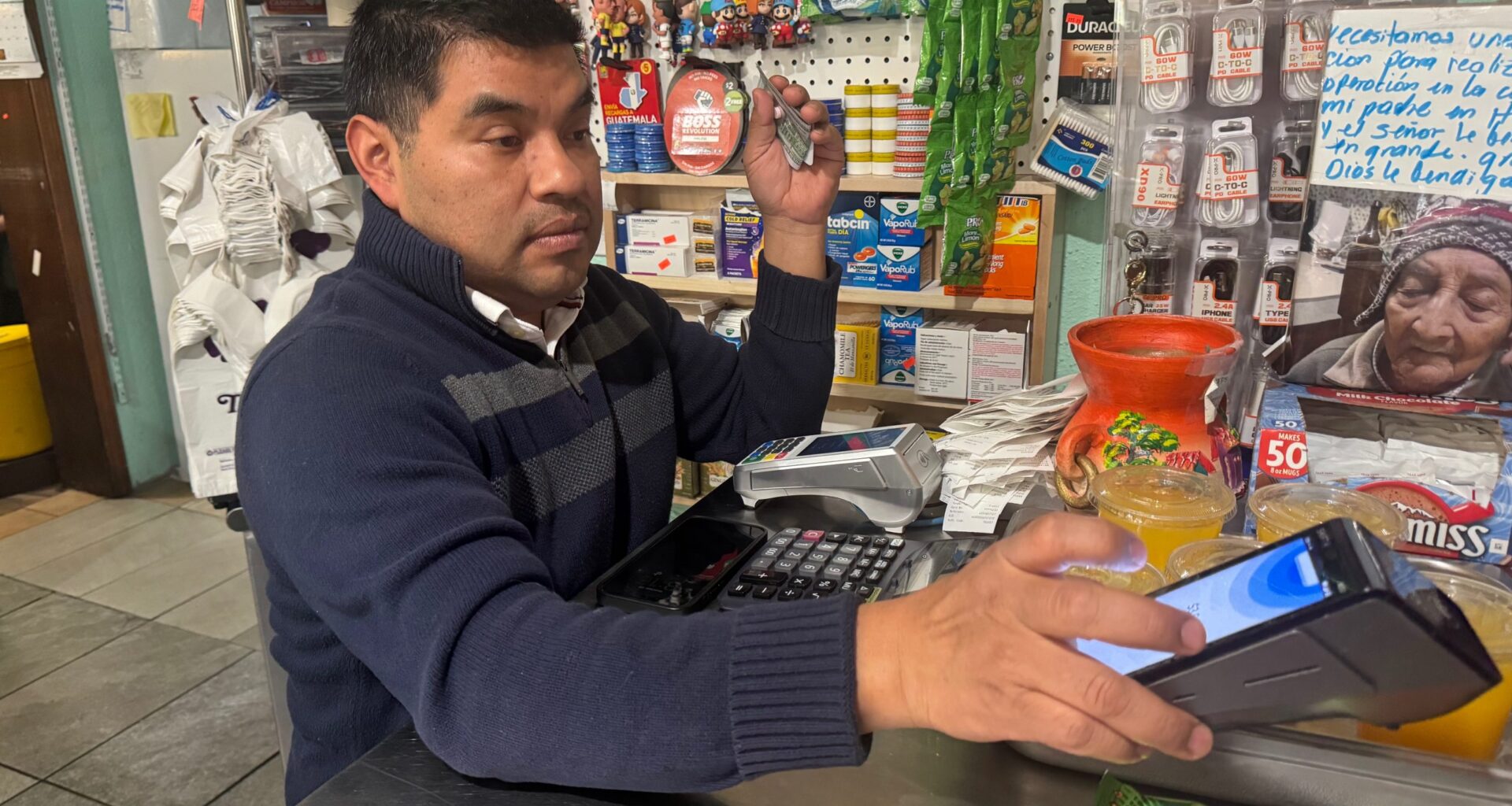
NEW BEDFORD — A card reader dinged in Martin Ordóñez’s hand, prompting the young man who just purchased a bag of chips at Restaurante y Tortillería Guatemalteco to leave with a quick buenas tardes.
Ordóñez stood behind, and contemplated his business. How the chips he just sold for $3.50 cost only $3 about a month ago. How the rising prices of meats, coconut water, and other products have forced him to raise prices as well.
Those price increases, partly due to the war with Iran he theorized, have compounded an already challenging business climate. He also noted that business at his restaurant has dropped an estimated 35% since January 2025, when President Donald Trump took office and a mass deportation campaign began.
“Everyone is scared,” Ordóñez said in Spanish. “Nobody wants to go out. So people aren’t spending.”
The story falls in line with a report compiled by the Democratic staff of the U.S. Senate Committee on Small Business and Entrepreneurship that was published in March. Massachusetts Sen. Ed Markey serves as the ranking member on the committee.
“I have a responsibility to document and expose what the Trump administration is doing to the small business economy, and the findings are devastating,” Markey told The Light. “And New Bedford is exactly the kind of community where Trump’s damage is deepest.”
The report showed damaging economic trends in areas hard hit by immigration enforcement operations. Dine-in restaurant sales fell by as much as 60% in Chicago during Operation Midway Blitz. Small businesses lost $81 million in revenue in Minneapolis after Operation Metro Surge. And federal immigration enforcement operations in Orange County, California, resulted in approximately $58.9 million in lost economic output over an eight-week period.
“In Massachusetts at large, 31% of small businesses say that immigration enforcement has impacted them,” Markey said. “Over 40% of Latino owned businesses in the state say that they have been impacted, and ICE presence has made the staff afraid to go to work, causing labor shortages and lost revenue.
“But that damage isn’t just limited to New Bedford or the South Coast.”
The impact of uncertainty
Immigration enforcement operations that have detained at least 70 people in New Bedford have recently eased, a result of the less aggressive stance taken by the administration after the deaths of Renee Nicole Good and Alex Pretti in Minneapolis at the hands of ICE and U.S. Customs and Border Protection agents. Most local immigration arrests in recent months have occurred at New Bedford District Court as people attend their civil or criminal hearings.
But Massachusetts was also the first state to experience surges. Nearly 3,000 immigrants were arrested in Operation Patriot in May 2025 and Operation Patriot 2.0 in September 2025. The stochastic nature of the arrests is something immigrant consumers, and the businesses that serve them, have not forgotten.
“The first impact has been the uncertainty,” said Anthony Sapienza, president of the board of directors at the New Bedford Economic Development Council. Business owners have told him that the fear manifests itself in workers suddenly not showing up to work, he said.
He pointed to the dozens of fish processing plants near and in the Port of New Bedford where hundreds of largely Central American workers work. Employers and employees worry that a big raid will happen at such a plant.
“We haven’t had any particularly obnoxious raids at a company but sometimes it’s one or two people not showing up,” Sapienza said. “Sometimes they’ve been picked up, sometimes it’s just they’ve determined they’re at risk and choose not to come in. But the fear that there will be some kind of raid is real.”
Sapienza said that more solid economic data on the local impacts of immigration enforcement have been harder to track with academics, advocates, and business owners relying on anecdotal evidence to gauge conditions. Nonetheless, reporting by The Light has revealed noticeable impacts.
“People are scared. And when they’re scared that affects us. There isn’t as much money on this street these days.”
— Taqueria La Raza owner Tony Cabrera on how his business is impacted
Tony Cabrera, owner of Taqueria La Raza on Acushnet Avenue, told The Light last September that business had dropped 50% due to aggressive immigration enforcement operations throughout the area. Since then, “Things haven’t changed,” he said in Spanish during a recent interview
“People are scared. And when they’re scared that affects us,” Cabrera said. “There isn’t as much money on this street these days.”
The U.S. Senate business report also found that job creation is being impacted, citing an Economic Policy Institute paper which found that, if the administration reached its 4 million deportation goal, there would be 3.3 million fewer employed immigrants and 2.6 million fewer employed U.S. citizens.
“In Massachusetts, only 2% of those arrested during the September 2025 surge had violent criminal convictions,” Markey said. “They’re not rounding up dangerous criminals. They’re rounding up nursing assistants, restaurant workers, dishwashers, landscapers, construction workers, home health aides. … The people who keep small businesses open and local economies running.”
A sense of safety
Those closest to the immigrant community said the solution to the economic anxiety is simple: make communities feel safe.
“We’re talking about working people, not criminals,” Ordóñez said. “These are people working and contributing as much to the community as for their families.
“We need immigration reform,” he said.
Sapienza said governments should focus on creating a sense of safety as a means to help local businesses. Initiatives by the state such as a recent executive order prohibiting the use of state property for immigration enforcement by federal agencies and the PROTECT Act making its way through Beacon Hill came to mind.
“We should hold federal officials accountable about any violent behavior when they’re in town,” he said. “Certainly we should be supportive of what the state has implemented.”
Markey said he supported the PROTECT Act as well. The legislation recently passed by the House would prohibit civil immigration arrests at state courthouses, require employers to notify employees of I-9 audits, and limit the ability of state and local agencies from entering into 287(g) partnerships with ICE.
“It’s absolutely imperative that we move in that direction,” he said, “to lift that chilling effect, that cloud, which has been built over the immigrant community as they comply with the law. Because ultimately, that effect will spread to Main Street.”
Markey also pointed to legislation he has put forward in the U.S. Senate, such as the Small Business ICE Disruption Act, introduced in December. Should it become law, the bill would create a $200 million fund that would provide grants of up to $1 million to small businesses who incurred losses due to federal immigration enforcement actions.
“This is disaster relief for Main Street,” he said.
Recently, Markey also introduced the Securing Help for Immigrants through Education and Legal Development (SHIELD) Act. The legislation would authorize the Attorney General to provide grants to agencies to build a workforce to ensure legal representation for immigrants facing removal proceedings.
Removal proceedings are considered civil matters. Although a person has a right to an attorney in such courts, the government will not cover the cost of one, forcing many defendants to appear without representation. In Massachusetts, the state’s Massachusetts Access to Counsel Initiative, established last year, often provides such counsel.
“We need to make sure that lawyers are available,” he said. “Otherwise innocent people are going to be forced to defend themselves — and that is just intolerable in 2026 in the United States of America.”
Sapienza said he thinks local government action would be helpful. He suggested keeping know-your-rights material accessible in public buildings as an easy way to signal support to immigrants.
He also pointed to other municipalities, such as Worcester, that took the governor’s order and applied it at a local level as models.
“Economically, it would help folks to feel a little safer going out of the house, going to work, applying to jobs,” he said. “The insecurity of going out means people are not entering the labor force. Anything we can do to encourage people to live their normal lives is helpful.”
Contact Kevin G. Andrade at kandrade@newbedfordlight.org
March 18, 2026March 18, 2026
March 16, 2026March 16, 2026