

Forgive Valentin Vacherot if he still can’t wipe the gleaming grin from his face, even when he answers the simplest of questions.
How are you?
“I’m good!” he exclaimed during a video interview from Basel, Switzerland, where he was beginning the first phase of his new life as a top-40 men’s tennis player. “Happy to be here!”
The word “here” was performing many tasks, all of them pretty big.
At the end of September 2025, Vacherot was world No. 204, a 26-year-old from Monaco whose tennis future appeared to hold a lot more toiling in the sport’s minor leagues. By the middle of October, however, he was the world No. 39 and the new ATP Shanghai Masters 1000 champion.
His is the tennis Cinderella story of the decade in the men’s game, and now Vacherot arrives back where his tennis story started: Monaco, the tiny principality on the French Riviera from which Vacherot hails.
He is the star attraction at the 2026 Monte Carlo Masters, but down a set, a break, and break point against Juan Manuel Cerúndolo of Argentina, he appeared to be heading out of his home tournament — at which he became the first Monégasque to qualify without a wild card — far earlier than he or his adoring crowd would have liked.
Instead, he used their energy to wilt Cerúndolo, turning around a 5-7, 6-2, 6-1 win for the right to face last year’s beaten finalist, Lorenzo Musetti, in the second round.
None of this looked likely just a few short months ago.
Had things gone in Shanghai as they had in the past few seasons for Vacherot, he would have spent the rest of October, and perhaps his career, bouncing around some ATP Challenger Tour events. Instead, he went from Basel to Paris, for the last ATP Masters 1000 of 2025, where he faced his cousin, Arthur Rinderknech, for the second time in three tournaments, after they met in the Shanghai Masters final.
Vacherot won then, and he won their rematch in Paris too, continuing a late-season surge that has lasted long enough into 2026 to help him land in Monte Carlo this week as the world No. 23.
“I’m here as if I were a child, and thinking how wonderful it is to be here, so it’s very wonderful,” Vacherot said during his post-match news conference in Paris. That’s how he rolled then and how he rolls now, this talker who is free with his emotions and who is glad to have people asking him about them on and off the tennis court, something that has rarely happened before.
The next part is keeping his nearly out-of-nowhere triumph in perspective, and embracing the work he must do if he has any hope of building on his success.
“For my career, everything changed,” Vacherot said during the video interview, his stringy brown mop of hair falling across his forehead. “Maybe a little bit how people look at me. But I mean, me, myself, nothing is changing.”
Vacherot’s success is not merely his own. It also belongs to Monaco and its population of about 40,000. Most of them are transplants, who have moved there for the weather, the luxurious lifestyle and the tax advantages.
About 10,000 people who live in Monaco are natives, the Monégasques. Before Vacherot, not one of them had won an ATP singles title. As he marched through the qualifying draw in Shanghai, having arrived as an alternate, and then through the main draw to the title, beating 24-time Grand Slam champion Novak Djokovic along the way, it felt like all of Monaco was following his matches from the first ball to the last.
And when he and his family and Monaco’s tennis big-wigs came home, the celebrations kept going. A couple of days before he arrived in Switzerland late last year, Vacherot was celebrating his title at a homecoming reception with Prince Albert. Now he gets to be the toast of the club that started his journey in the sport.
“Not much sleep since this crazy weekend, and it just doesn’t stop,” said Mélanie-Antoinette de Massy, the president of the Monégasque Tennis Federation. “Very good problems to have.”
For De Massy, Vacherot’s win was personal. She has known him since he was a small child. She was close with his half-brother, Benjamin Balleret, who is a former tennis player and now serves as his coach. De Massy’s family was so close to the Ballerets that sometimes, when his parents would travel, they would leave their son with her grandmother for the weekend.
Vacherot’s parents were players as well, and he grew up hanging around the Monte Carlo Country Club, which De Massy oversees, along with the Monte Carlo Masters.
For a tennis-loving kid, it’s not a bad place to grow up. Roughly 25 of the top 50 players live in Monaco. The Monte Carlo Country Club is their home club and training base. A talented junior such as Vacherot got plenty of exposure to pros including Grigor Dimitrov and Daniil Medvedev. Occasionally, he’d warm them up when tournament time rolled around.
That said, Vacherot was hardly a can’t-miss talent in his early years. It was his cousin, Rinderknech, who paved the path into professional tennis that would lead to them standing together on a stage in Shanghai, tears in their eyes and cramps in their legs. To get there, they would go via the U.S. state of Texas.
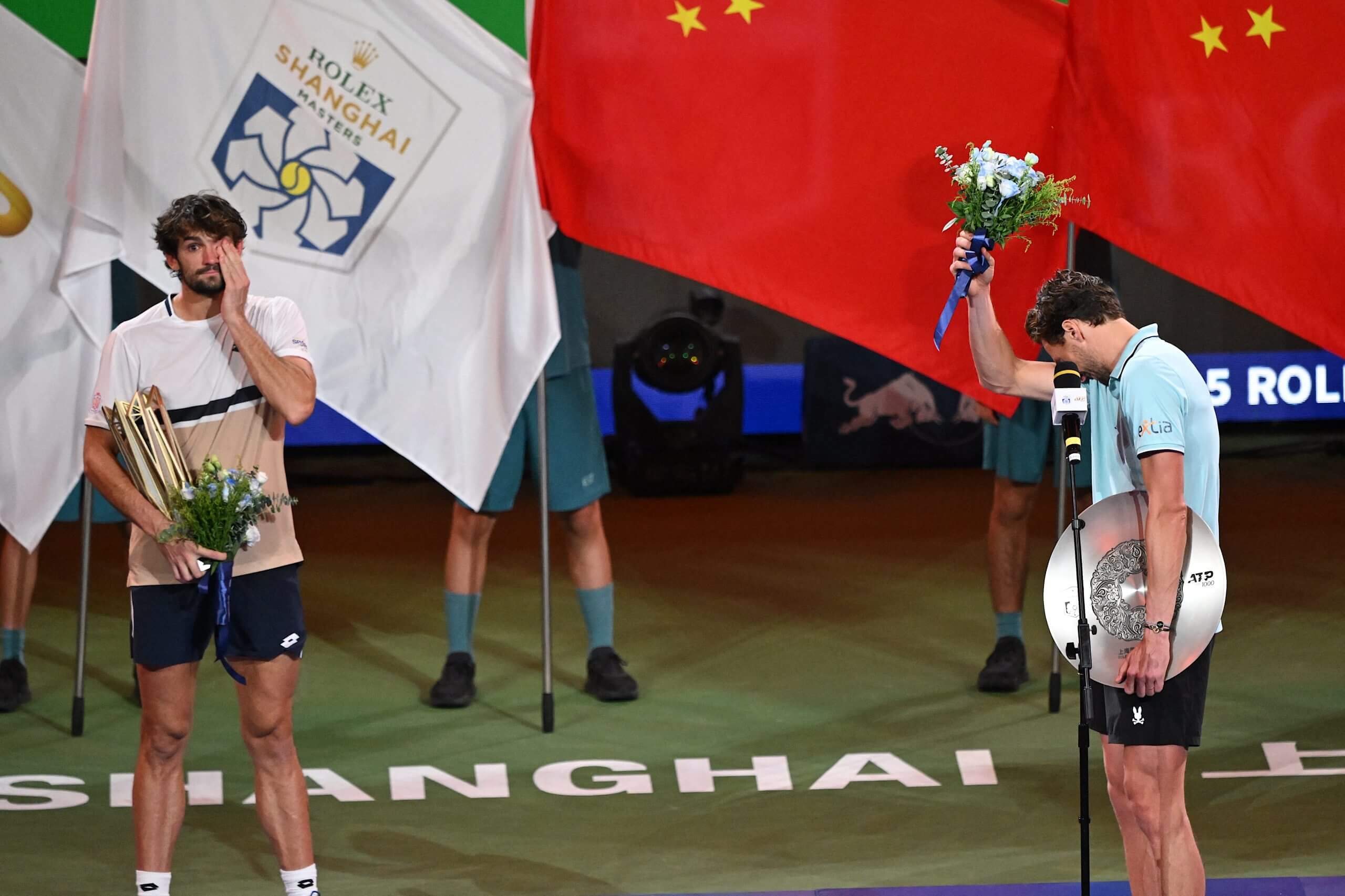
Valentin Vacherot and Arthur Rinderknech were emotional during their trophy presentation at the Shanghai Masters. (Jade Gao / AFP via Getty Images)
Just over a dozen years ago, Steve Denton, a touring pro from the 1970s and 1980s who became the head men’s tennis coach at Texas A&M University in College Station, near Houston, heard about some promising players in France. He traveled across the Atlantic to take a look at them, with a special interest in Rinderknech. He knew his mother, Virginia, who had been a good player herself.
“I watched Arthur for two minutes and I told Virginia, ‘Give him to me. Let me have him and I’ll help him to be a really good player’,” Denton said in an interview from Texas. “I saw how athletic he was. I saw how well he moved, his big game and the potential. And the other thing I saw from him was his flexibility.”
Arthur had been in College Station for about a year when he approached his coach with some useful information.
“‘Steve-O’, he says, ‘I got a cousin that’s just as good as I am, or maybe even better, and he’ll come to A&M’,” Denton recalled.
Back to Europe Denton went, to eyeball Vacherot at the French junior championships in Le Mans.
“Probably the easiest recruit that I’ve ever had,” Denton said. Vacherot said that the decision to move was just as easy. His cousin was there at A&M, and he trusted Denton, who taught him how to play on a hard court after spending most of his childhood on clay.
“I wasn’t an amazing player in juniors,” Vacherot said. “I was already really tall but not developed physically, not developed mentally. I just became an actual athlete and got myself perfectly ready for the tour.”
Still, Vacherot was a project. “A baby giraffe at the beginning,” Denton said. “Tall and lanky but, y’know, not much muscle yet. And so we had to mold his game.”
Vacherot had a typical big serve and forehand, but Denton saw something else: He was never afraid to go for his shots. That fearlessness was a hallmark of his run to the title at the Shanghai Masters, in which he won six of his nine matches from a set down.
“I think that’s his greatest trait,” Denton said. “When he’s gotten into these tournaments, he’s gone after it and obviously that’s paid great dividends.”
That second part about tournaments is key. Balleret outlined that Vacherot had spent longer than he might have done in the lower reaches of the tennis world because he could not go after it all the time.
“Val basically is better against the better opponent,” Balleret said in a mixed zone. “I’m with him every week. I know that when he plays, when he enters the court, that’s the big problem he had lately. When he enters the court, and he’s the favorite, he is going less for the ball. ‘Maybe I put the ball in, that’s enough’, y’know.”
Both Rinderknech and Vacherot spent the better part of five years in Texas. Rinderknech majored in business and Vacherot in sports management, all while studying in a second language.
Vacherot became a protégé of assistant coach Kevin O’Shea, who would spend hours on the court working with him, seemingly whenever he needed the individual attention. Their matches for A&M were intense and rowdy, filled with the pressure of winning for the team and the school. “Everything is made so easy for you,” he said. Fitness, tennis, nutrition… everything was just so easy as an athlete over there.”
Finally, the time came to head back to real life.
Vacherot hit the ATP Challenger Tour, slowly making his way to the cusp of the top 100, that barrier separating tour players, who can scratch out a living by getting into the Grand Slam main draws, from everyone else trying simply to break even.
But he suffered a shoulder injury at the 2024 French Open, which set him back for much of the rest of that year. This past summer at Wimbledon, he was up 6-4, 6-5 in his opening qualifying match. But he didn’t really know how to run on grass, and he slipped and hurt his knee.
In retrospect, he thinks his game was ready for playing pro-level players all the time, but his body was not. Those injuries may have provided a silver lining, giving him a chance to improve physically and time to grow even hungrier.
Still, the results weren’t coming.
Then he got to Shanghai, and one win rolled into the next.
“Then you just believe in yourself,” he said of the early victories in China.
He beat Alexander Bublik, the No. 14 seed, then Tomáš Macháč retired in the second set of their match. He beat Tallon Griekspoor, then Holger Rune, then faced a worn-down Djokovic and recorded his only straight-sets win of the whole week. Then came the final against Rinderknech, another three-setter and another comeback… and then the tears.
“I know I’m not going to do it every single tournament — we know how tennis is,” he said ahead of the Basel Swiss Indoors, shortly before losing a three-setter to Taylor Fritz, the world No. 5, in which his whippy forehand’s limited repeatability put him under too much pressure. But he knew things he did not know a few weeks before, and there is plenty to enjoy.
For a player who goes on a run like Vacherot’s in Shanghai, especially near the end of the season, the next one is a land of opportunity, with next-to-no rankings points to defend.
Managing the schedule of his season will be crucial: earn enough points across it to balance the possibility of a first-round loss in Shanghai this October, with 1,000 of them on the line, but without playing so much that by the time that month rolls around, when Vacherot is likely to be as leggy and burnt-out as some of the players he conquered in that tournament last year.
In 2026 so far, he has 450, just under halfway to the cushion he needs come fall.