
Any NHL team with Stanley Cup contention aspirations needs its top players to be firing on all cylinders. If a contender has an elite top line and first pair, that foundation can often mask flaws and weaknesses further down the lineup.
Four weeks ago, we analyzed how every NHL team’s top line was producing. This time, we’re turning our attention to each club’s first pairs. The goal is the same as it was with the forwards: Identify which teams have top pairs that are dominating and which ones are significantly trailing the competition.
Let’s begin by laying out our criteria for defining a “top pair” and then explaining our methodology for tracking performance.
My initial thought was to take each team’s No. 1 defenseman and then look at that player’s results with their most frequent partner (e.g., Cale Makar is the Avalanche’s No. 1 defender and his most common partner is Devon Toews, so let’s break down the Toews-Makar pair’s numbers). That approach is great in theory, but the problem is that many teams haven’t had a consistent two-man top pair this season. Many teams have a No. 1 defender as the anchor of the top pair, with a rotating cast of partners.
The next-best thing we can do is use the defenseman who has most consistently played on the first pair as a proxy for the top-pair results. Here’s a chart showing which top-pair defender was used as each team’s proxy (injuries and games played affected who was picked), plus a breakdown of who their partner(s) have been this season. Note that because Carolina has been hammered by blue-line injuries, it hasn’t had a defender consistently on the top pair, so we combined the results for when Jaccob Slavin’s been healthy, with K’Andre Miller’s numbers for the games where Slavin was hurt (Miller stepped up onto the top pair when Slavin was out).
Team
Top Pair Defenseman
Partner(s) with more than 200 mins together
Jackson LaCombe
Jacob Trouba (740 mins), Drew Helleson (316 mins)
Charlie McAvoy
Jonathan Aspirot (433 mins), Nikita Zadorov (316 mins)
Rasmus Dahlin
Mattias Samuelsson (797 mins)
Jaccob Slavin/K’Andre Miller
Jalen Chatfield (506 mins)
Zach Werenski
Damon Severson (394 mins), Ivan Provorov (381 mins), Denton Mateychuk (321 mins), Dante Fabbro (239 mins)
Kevin Bahl
Rasmus Andersson (702 mins), Zach Whitecloud (344 mins)
Alex Vlasic
Louis Crevier (716 mins), Sam Rinzel (227 mins), Artyom Levshunov (217 mins)
Cale Makar
Devon Toews (754 mins), Sam Malinski (203 mins)
Miro Heiskanen
Esa Lindell (978 mins)
Moritz Seider
Simon Edvinsson (966 mins)
Evan Bouchard
Mattias Ekholm (1148 mins)
Gustav Forsling
Aaron Ekblad (1042 mins)
Drew Doughty
Mikey Anderson (820 mins)
Brock Faber
Quinn Hughes (759 mins), Jonas Brodin (545 mins)
Lane Hutson
Jayden Struble (393 mins), Alexandre Carrier (342 mins), Noah Dobson (290 mins)
Jonas Siegenthaler
Dougie Hamilton (832 mins)
Roman Josi
Brady Skjei (451 mins), Nick Perbix (255 mins)
Matthew Schaefer
Ryan Pulock (779 mins), Scott Mayfield (278 mins)
Vladislav Gavrikov
Adam Fox (811 mins), Braden Schneider (506 mins)
Jake Sanderson
Artem Zub (824 mins)
Travis Sanheim
Cam York (650 mins), Rasmus Ristolainen (392 mins)
Erik Karlsson
Parker Wotherspoon (1004 minutes)
Vince Dunn
Adam Larsson (1128 mins)
Dmitry Orlov
John Klingberg (521 mins), Timothy Liljegren (340 mins)
Philip Broberg
Colton Parayko (761 mins), Logan Mailloux (279 mins)
J.J. Moser
Darren Raddysh (863 mins)
Morgan Rielly
Brandon Carlo (468 mins), Oliver Ekman-Larsson (365 mins)
Mikhail Sergachev
Sean Durzi (489 mins)
Filip Hronek
Elias Pettersson (377 mins), Marcus Pettersson (372 mins), Quinn Hughes (348 mins), Zeev Buium (269 mins)
Shea Theodore
Brayden McNabb (761 mins), Jeremy Lauzon (276 mins)
Josh Morrissey
Dylan DeMelo (924 mins)
Martin Fehervary
John Carlson (498 mins), Matt Roy (245 mins), Rasmus Sandin (200 mins)
We’ll look at the goals for and against differential when that top pair is on the ice as a simple measure of performance. Goal differential obviously isn’t a perfect instrument because of environmental factors (it can be skewed by the quality of the forwards that the pair shares the ice with, shooting/goaltending luck and overall team quality). But if we apply context by also looking at the pair’s play-driving numbers (which we’ll mention for a team if it’s particularly relevant), we’ll get a decent 200-foot view.
Here are the numbers so far, sorted by each pair’s five-on-five goal differential rate. Note that all stats were compiled via Natural Stat Trick on April 6.
NHL First Pairs’ 5v5 Goal Differential
Team
GF/60
GA/60
GD/60
3.41
1.94
1.47
3.69
2.25
1.44
3.14
1.82
1.32
3.5
2.43
1.07
3.1
2.19
0.91
3.41
2.54
0.87
3.11
2.32
0.79
3.25
2.5
0.75
3.58
2.88
0.7
2.75
2.06
0.69
2.89
2.22
0.67
2.67
2.07
0.6
2.66
2.07
0.59
2.7
2.15
0.55
2.97
2.7
0.27
2.7
2.45
0.25
2.42
2.2
0.22
2.53
2.39
0.14
2.12
2.12
0
2.39
2.48
-0.09
2.68
2.83
-0.15
2.74
2.91
-0.17
2.3
2.61
-0.31
2.03
2.35
-0.32
2.7
3.06
-0.36
2.23
2.6
-0.37
2.35
2.77
-0.42
2.71
3.16
-0.45
3.04
3.58
-0.54
2.08
2.8
-0.72
1.73
2.6
-0.87
2.3
3.24
-0.94
Colorado Avalanche
Cale Makar and Devon Toews driving elite results together is the most predictable outcome possible. They’re a well-oiled machine that transitions play up the ice, generates offense and shuts the door defensively (1.94 goals against per 60 rate, which is the second-best mark among all first pairs) like no other duo in the NHL.
We’ve also seen Makar and Toews forced to drive their own pairs for brief stretches this season because of each player’s respective injuries — Toews missed 13 games earlier in the season, and Makar has been absent recently — and the small sample size numbers are very fascinating. Lately, Toews has been playing with the underrated Sam Malinski, and together, they’ve earned a whopping 68 percent of high-danger chances and outscored opponents 16-8 in 184 five-on-five minutes together.
When Makar returns and the playoffs begin, you’d imagine Colorado will turn back to the tried and true Toews-Makar combination. However, the recent success of the new-look Toews-Malinski pair gives Jared Bednar some interesting Plan B or C options for the playoffs if he ever needs to throw a curveball to counter an opposing team’s game plan against the default Toews-Makar combo.
Montreal Canadiens
Lane Hutson has followed up an exceptional Calder Trophy-winning campaign by solidifying himself as a bona fide superstar in Year 2. Winning the Norris seems like a long shot because of how ridiculously stacked the competition is this year, but Hutson probably deserves some down-ballot votes.
Hutson ranks second among all defensemen in five-on-five points, and the evolution of his defensive game is an underrated storyline, as his 2.57 expected goals against per 60 rate ranks No. 1 among all Canadiens defensemen. I see similarities to Quinn Hughes in how Hutson leverages his quickness and agility to defend the rush well. While he isn’t going to outmuscle players down low defensively, Hutson has a knack for quick, timely stick lifts to snatch possession back.
It’s important to note that the Mike Matheson-Noah Dobson second pair takes on the toughest defensive matchups, which frees Hutson’s assignments up to some degree. However, that advantage is probably offset by the rotating carousel of partners he’s played with, including all the time he’s spent on his off side playing with a subpar partner in Jayden Struble.
Hutson dominates away from Struble
TOIHigh-Danger ChancesGoals
With Jayden Struble
426 mins
49.3%
50.0%
Without Jayden Struble
987 ins
54.3%
66.7%
Tampa Bay Lightning
Is J.J. Moser the most underrated defenseman in the NHL right now? It’s a fair question to ask because, quietly, there’s been a change of guard on Tampa Bay’s blue line.
Victor Hedman has been a shell of himself this year — he’s been limited to 33 games because of injuries, and his performance when healthy has significantly deteriorated. He’s averaged just 18:52 per game this season and was even lining up for some games on the third pair before his most recent injury in mid-March.
Tampa Bay’s top pair has been dominant despite Hedman’s fall-off, thanks to Moser’s emergence as an elite shutdown defenseman. Moser’s pair has earned almost 59 percent of scoring chances and surrendered only 1.82 goals against per 60 at five-on-five, which is the best mark in the NHL. He doesn’t have many flashy elements in his game, but his IQ is off the charts, and he’s been exceptional at breaking up plays. This breakout has also likely been aided by a shift back to his strong side (in previous years, he often played the right side because Tampa had many left-side defensive options).
Darren Raddysh, meanwhile, has been the perfect complement to Moser’s pair, adding offensive spice. Raddysh is top-10 among all NHL defenders in points this season, with his bomb of a shot, in particular, emerging as a terrifying weapon. There’s some evidence that his production is inflated by all the time he’s spent with Nikita Kucherov, but no one can deny that the club has found lightning in a bottle with this Moser-Raddysh combination.
Pittsburgh Penguins
Erik Karlsson has looked like a completely different player under Dan Muse this year. The 35-year-old future Hall of Famer has clicked at a 72-point pace, and his play-driving numbers are the best they’ve ever been in Pittsburgh.
Parker Wotherspoon deserves his flowers as the underappreciated defensive safety net of this pair as well. Wotherspoon, a journeyman defender, has been an outstanding bargain-bin acquisition, as he’s been a lock next to Karlsson all season long. He doesn’t show up on the scoresheet often and isn’t going to end up on many highlight reels, but his steady, mistake-free presence has been invaluable.
Winnipeg Jets
Josh Morrissey’s pair isn’t driving play as decisively as last year — they’re controlling 50.5 percent of high-danger chances, compared to 57.8 percent in 2024-25 — and they are benefitting from an overheated 12.3 on-ice shooting percentage that is inflating their goal differential. Still, it’s impressive that Winnipeg’s top pair is handily winning its minutes, given how difficult the team’s season has been overall.
Morrissey should get more credit for driving these kinds of results without a true top-pair caliber partner; Dylan DeMelo is a solid player, but he’d probably be a No. 4/5 on most good teams.
Boston Bruins
Charlie McAvoy has put together a strong bounce-back campaign. He’s notched a career-high 58 points in just 66 games, and he’s one of only two Bruins’ defensemen (the other is Hampus Lindholm) who have driven a positive scoring chance differential this season. Boston’s top pair is generating 3.48 goals for per 60, which ranks fourth-best among all first pairs.
Jonathan Aspirot’s unexpected rise to a steady partner for McAvoy should also be mentioned. Aspirot, a 26-year-old undrafted first-year NHLer, doesn’t play big minutes (he’s averaged 17:49 since the Olympic break), but he’s been McAvoy’s most frequent partner this season and has done a serviceable job.
Boston’s top pair does give up a lot of high-danger chances — they’re surrendering 2.93 expected goals against per 60, which ranks 27th among first pairs — but they’ve been bailed out by strong goaltending, which is inflating their overall goal differential.
Buffalo Sabres
Rasmus Dahlin will draw most of the headlines when we think about the success of Buffalo’s top pair, but Mattias Samuelsson’s shocking turnaround is the bigger story. Samuelsson was a promising, up-and-coming defensive stopper early in his career, but injuries and inconsistent play hurt his reputation to the point where he was a buyout candidate last summer and booed by Sabres fans during the home opener.
Samuelsson has completely turned his game around and reached a level we’ve never seen before. Playing next to Dahlin, Samuelsson is tied for 12th among all defensemen in five-on-five points in addition to making an excellent defensive impact. He’s the unsung hero behind Buffalo’s rise this season.
Columbus Blue Jackets
Zach Werenski’s pair is scoring 3.25 goals per 60 minutes, which is the sixth-best mark among all top pairs. Werenski has probably been the best solo offensive driver of all defensemen this season — he narrowly trails Evan Bouchard for most points-per-game, but Werenski has accomplished it without the help of Connor McDavid and Leon Draisaitl. And while Columbus’ top pair doesn’t have elite defensive numbers, they still take care of their own zone pretty well, as they’re suppressing quality scoring chances better than the average first pair.
Columbus’ top-four has also generally hit a higher level this year because of Denton Mateychuk’s breakout and Damon Severson’s bounce back.
Edmonton Oilers
The Oilers’ top pair was outscored 14-6 through the first 16 games of the season, a stretch that featured some ugly defensive sequences for Evan Bouchard. Since then, though, the Bouchard/Mattias Ekholm duo has been one of the best defense pairs in the NHL, earning nearly 60 percent of high-danger chances and driving a plus-23 goal differential.
Bouchard’s pair is bleeding goals against at the sixth-worst rate among first pairs, but it’s fair to wonder how much of that is exacerbated by bad goaltending because their expected goals against rate ranks 16th, which is respectable. When I’ve watched the Oilers in recent months, Darnell Nurse and Jake Walman have been responsible for far more defensive breakdowns than Bouchard or Ekholm.
This pair’s offensive impact is best-in-class. Bouchard has been producing at a 106-point pace since early November, and he’s been on the ice for an impressive 3.32 goals for per hour in his non-McDavid minutes, which is proof that he isn’t just riding McDavid’s coattails.
Detroit Red Wings
Moritz Seider and Simon Edvinsson are arguably the best shutdown pairs in the NHL. It’s a nightmare for opposing forwards to match up against Seider and Edvinsson because they’re athletic beasts with their massive size, strength, wing span and powerful skating ability. They eliminate attackers’ time and space and kill plays so quickly and authoritatively.
Detroit’s top pair has surrendered only 2.24 expected goals against per 60, the second-best rate among all first pairs and their actual goals-against rate ranks third-best. If they had more elite offensive firepower up front to play with and finish off scoring chances, there’s a good chance that the pair would be on the ice for a higher rate of goals offensively, which means their current numbers might even be underestimating how high their ceiling as a pairing could be.
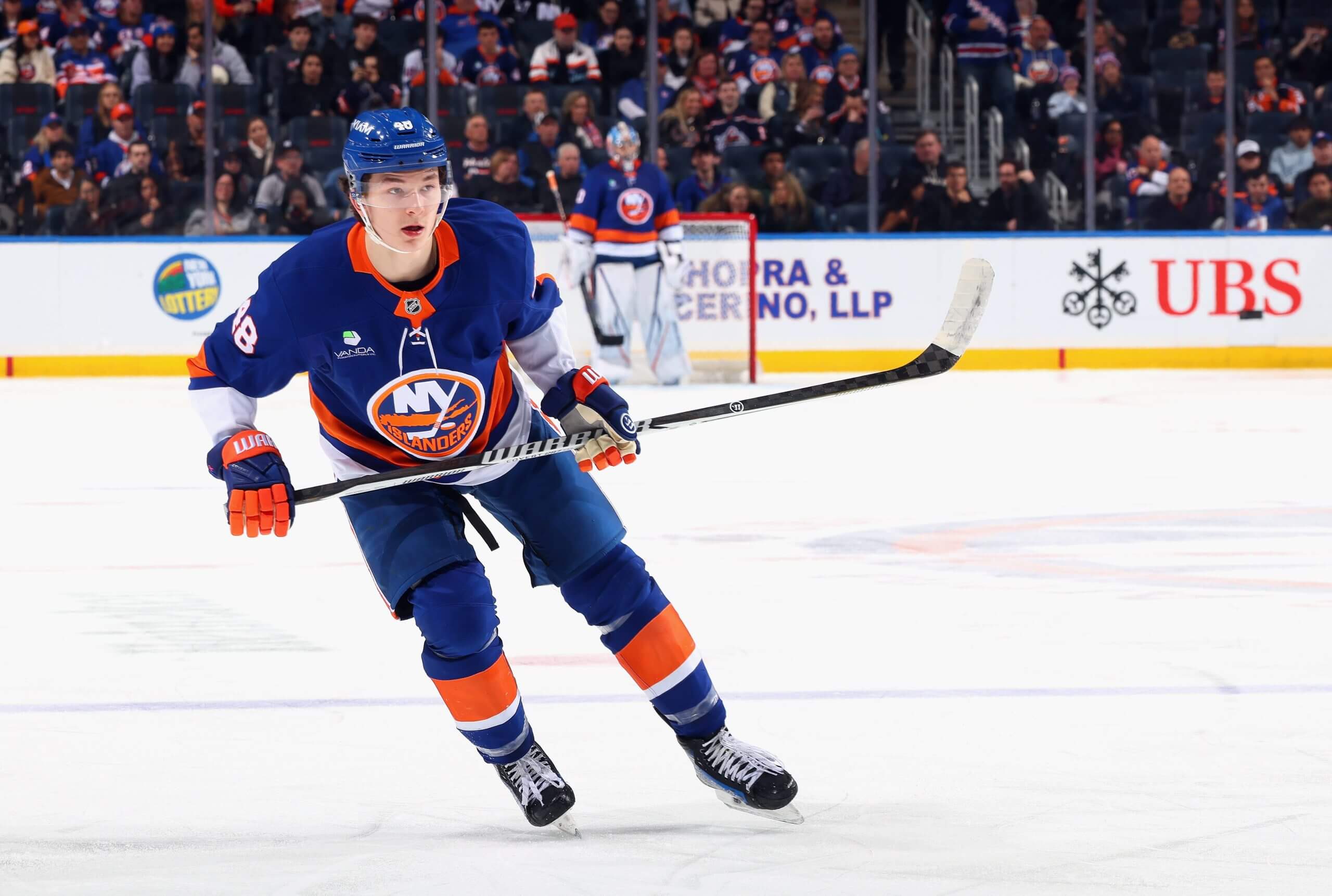
Matthew Schaefer has completely transformed the Islanders’ blue line. (Bruce Bennett / Getty Images)
New York Islanders
What more can you say about Matthew Schaefer? At 18, he’s completely transformed the Islanders’ blue line. Schaefer is elite at breaking out the puck, has had an exceptional offensive impact (22 goals and 58 points in 78 games), and his defensive game is very mature and steady for a teenage defender.
Since the Olympic break, Schaefer has hit a new level with his two-way play-driving, earning nearly 56 percent of expected goals.
Vegas Golden Knights
Vegas’ first pair of Shea Theodore and Brayden McNabb has had tremendous defensive success. They’re giving up only 2.07 goals against per 60, which ranks fourth-best among all first pairs, and their expected goal differential ranks sixth-best. There’s certainly room for them to find a higher gear offensively — the pair has only been on the ice for 2.67 goals for per 60, which ranks 20th — but it’s hard to complain when they’re still decisively winning their minutes.
Dallas Stars
Over the last two years, the Stars weren’t afraid to load up Miro Heiskanen and Thomas Harley together on the same pair at times. Their play together was special: Heiskanen and Harley controlled over 60 percent of scoring chances, and they outscored teams by a margin similar to that of the Makar-Toews duo.
First-year head coach Glen Gulutzan has opted for a more balanced top-four approach this season, though, splitting Heiskanen and Harley for almost the entire season. Heiskanen has been stapled to Esa Lindell in a tough defensive matchups role, and their defensive results are sparkling, as they’ve allowed goals against at the fifth-best rate of all first pairs.
Ottawa Senators
Jake Sanderson and Artem Zub are an excellent lockdown pair defensively. Together, they’ve given the Senators a 57.6 percent control of high-danger chances and are elite at suppressing quality scoring chances, as they own the best expected goals against rate among all NHL first pairs. Ottawa’s first pair is the backbone behind the team’s enviable structure and elite analytical profile.
Minnesota Wild
It’s surprising that Minnesota’s top pair didn’t rank higher, but it reflects a couple of factors.
First, Brock Faber’s underlying numbers early in the season, before the Quinn Hughes acquisition, were underwhelming: Faber controlled only 47 percent of scoring chances and had a minus-one goal differential away from Hughes.
Second, Faber and Hughes had some bad luck defensively. Hughes and Faber are limiting scoring chances well, as their 2.49 expected goals against per 60 is a very respectable rate. They’ve been tagged for a lot of goals against, though (3.23 goals against per 60) in some part because they haven’t been getting enough saves, as their goalies have combined for a poor .888 save percentage when this new-look first pair is on the ice at five-on-five.
Faber and Hughes have dominated puck possession and two-way scoring chance results, earning 57 percent of expected goals. They’re lighting the lamp offensively too, with the Wild scoring 3.97 goals for per 60 during Faber and Hughes’ minutes.
All of this is a long-winded way of saying that Hughes and Faber are one of the best top pairs in the NHL, despite Minnesota’s middle-of-the-pack goal differential for the season.
Philadelphia Flyers
You’d expect the Flyers to rank lower in this exercise when you consider that they lack a true No. 1 defenseman. Philly’s top pair has been anchored by Travis Sanheim, and he’s been caddied by middling partners such as Cam York and Rasmus Ristolainen, which seems underhwhelming on paper.
Defensemen always seem to thrive on Rick Tocchet-coached teams, though, and Philly’s blue line is punching above its talent level: Jamie Drysdale has enjoyed a solid breakout on the second pair, and the top pair has held its own well relative to how weak the personnel looks on paper.
Philly’s top pair predictably struggles to generate offense, but their defensive metrics are sturdy, including a 2.37 expected goals against per 60 rate, which is tied for sixth-best among NHL first pairs.
St. Louis Blues
Philip Broberg’s continued development into a premier top-pair defenseman has been one of the few silver linings in an otherwise disappointing season for the Blues. Sure, St. Louis’ top pair lags a bit offensively, with both its on-ice expected and actual goals scored rate ranking bottom-third among all first pairs, but they’re rock-solid defensively at limiting scoring chances and keeping the puck out of their own net.
Logan Mailloux, who has stabilized his game after an awful start to the season, has been getting some reps next to Broberg lately, with Colton Parayko sliding down to the second pair.
Washington Capitals
The Capitals have iced two balanced top-four pairs this season. Jakob Chychrun is Washington’s No. 1 defenseman and is having a stellar campaign, but for most of the season, the John Carlson/Martin Fehervary duo took line rushes as the team’s “top pair,” so I’ve zeroed in on their results.
Carlson and Fehervary were excellent together, driving 53 percent of scoring chances and a plus-15 goal differential. Washington’s top pair with Fehervary has suffered mightily since Carlson’s trade, though, earning a dreadful 39 percent of expected goals and being outscored 12-7.
Los Angeles Kings
L.A.’s top pair of Drew Doughty and Mikey Anderson is a microcosm of the team as a whole: They’re lackluster offensively, but they’re still competitive because of how well they defend.
This pair doesn’t have enough offensive pop because 36-year-old Doughty, who’s only on pace to hit 27 points, isn’t as dynamic as he once was. They’re manufacturing only 2.12 goals per hour, which ranks in the bottom five among all first pairs. Doughty and Anderson still shine as shutdown options, though, as their expected and actual goals against rates both rank in the top 10.
Seattle Kraken
Seattle has two balanced top-four pairs, one run by Vince Dunn and the other by Brandon Montour. The Dunn/Adam Larsson pair is holding up OK on the scoreboard, but their underlying process is very concerning and has been masked to some degree by strong goaltending. Seattle has been outshot and outchanced by wide margins with its top pair on the ice, earning an ugly 43.3 percent expected goal share that ranks second-worst among all NHL first pairs.
Utah Mammoth
Mikhail Sergachev’s overall game has taken a step back compared to last year.
He isn’t driving play as authoritatively — Sergachev was the only Utah defender who didn’t have an expected goal share of at least 50 percent heading into the Olympic break. He’s been leaky defensively, as the Mammoth’s top pair ranks bottom-10 in both expected and actual goals against rate.
Lately, Sergachev has been paired with newcomer MacKenzie Weegar. So far, the numbers indicate that this new-look combination has been decent but unspectacular, though it’s too early to make a firm judgment.
Anaheim Ducks
Jackson LaCombe has continued his rise as an upper-echelon top-pair defender, but his pair’s goal differential has lagged slightly for a couple of reasons.
For starters, LaCombe hasn’t had a true first-pairing caliber partner all year. Jacob Trouba has had a solid, respectable season, but he’s closer to a second-pairing quality player than he is a bona fide first-pair solution. John Carlson, acquired ahead of the trade deadline, has been a terrific fit on Anaheim’s blue line, but he’s played on a separate pairing from LaCombe, which makes sense as the Ducks try to spread out their two marquee puck-moving offensive defensemen.
LaCombe’s pair is high-event: It ranks top-10 at generating expected goals offensively, but bottom-10 at suppressing expected goals defensively. Anaheim’s top pair has been a little bit unlucky finishing-wise, otherwise their actual goal differential would be closer to ranking middle of the pack.
Calgary Flames
With the Flames trading away both MacKenzie Weegar and Rasmus Andersson, the organization doesn’t have any established, top-pair caliber defensemen. Calgary will be hoping that Zayne Parekh can take those reins one day, but for now, Kevin Bahl has taken on an even bigger role.
Bahl has developed nicely into a steady, physical defensive defenseman, and his main partner, Zach Whitecloud, has exceeded expectations. They clearly wouldn’t be top-pairing defensemen on contending teams, and the numbers aren’t pretty: Calgary’s top pair ranks 30th in expected goal differential. But overall, they haven’t looked as outmatched as you’d expect, given how heavy and difficult their usage is.
New York Rangers
Adam Fox’s health — he’s only played 51 games this season — is the only reason the Rangers rank this low. When Fox has been healthy, he and Vladislav Gavrikov have been terrific, generating 64 percent of high-danger chances and just shy of 56 percent of goals.
Without Fox, the top pair has catastrophically crumbled: Gavrikov has driven only 40.2 percent of expected goals and had a minus-16 goal differential in nearly 700 minutes away from Fox. Those numbers shouldn’t be viewed as a knock on Gavrikov, who has been a strong fit as a No. 2 option next to Fox. It’s just unfair to expect him to drive play like a No. 1 when Fox is unavailable, especially because his alternative partner, Braden Schneider, was overmatched.
Florida Panthers
Gustav Forsling and Aaron Ekblad have had a down year relative to their elite standards. They’re normally one of the stingiest shutdown pairs in the league, but their defensive numbers have fallen hard this season: Their expected goals against rate has dipped to the middle of the pack, and their 3.06 goals against per 60 rate ranks 29th among all NHL first pairs.
However, their statistical decline probably has more to do with factors outside their control than with their individual play. Aleksander Barkov’s injury was, of course, a crushing blow considering how often he’s matched with the Forsling-Ekblad pair in a tough matchups role.
Second, the Panthers’ top pair was tanked by disappointing goaltending: Florida’s netminders combined for an ugly .882 save percentage with Forsling on the ice, which is a massive drop-off compared to previous seasons.
Forsling’s pair still generated more shots and chances than they gave up this season, so I’d expect them to rebound next year with a healthy Barkov and better goaltending.
Vancouver Canucks
The Canucks had a stretch from 2023 to 2025 in which the Quinn Hughes-Filip Hronek pair drove the NHL’s best goal differential for two seasons. The goal differential for Vancouver’s top pair has deteriorated significantly without Hughes, but it’s important to clarify that this has nothing to do with Hronek’s performance.
Hronek has been the Canucks’ best player this year and his two-way play has stayed remarkably steady despite Hughes’ departure. However, the team’s overall structure/environment and talent level are so bleak, and Hronek’s been partnered with struggling, mistake-prone defenders such as Zeev Buium and Elias Pettersson (the defenseman), so that’s dragging down the first pair’s statistical results.
Carolina Hurricanes
We shouldn’t read too much into Carolina’s disappointing first-pair results because there have been so many moving parts.
The most obvious factor is health, as Jaccob Slavin has only suited up for 37 games this season. K’Andre Miller was forced to handle top-pair duties for large stretches when Slavin was hurt, and while I love Miller as a second-pair driver, the results weren’t pretty with him in a No. 1 role, with the Miller-led first pair outscored 31-22 at five-on-five during the games Slavin missed. The top pair’s results when Slavin was out are the main factor dragging down their goal differential — now that he’s healthy again, those concerns should be assuaged.
When Slavin has been available, Carolina’s top pair has performed well, though there’s still room for them to hit a higher level. Slavin’s pair is still dominating all possession and scoring-chance metrics in classic Hurricanes fashion, including very stingy defensive results. However, Slavin is only driving a modest plus-two goal differential at five-on-five this season because of their sluggish offensive numbers: Slavin’s only been on the ice for 2.37 goals for per 60, which is a low mark, and he’s only scored six points in 37 games.
He and Jalen Chatfield, another defensive-minded player, are new partners this season — Slavin previously played with Brent Burns, and Chatfield with Dmitry Orlov. Slavin and Chatfield are an elite defensive duo, but it’s fair to wonder whether they can drive enough offense together.
Toronto Maple Leafs
The Leafs haven’t really had a true top pair this year.
Chris Tanev, arguably their best all-around defenseman last year, has missed all but 11 games. Jake McCabe has handled the most five-on-five defensive zone starts of all NHL defensemen and the toughest matchups. Some would consider McCabe’s pair as Toronto’s “first pair,” but Morgan Rielly still takes line rushes as the top pair and is their highest-paid defenseman, so others would consider that the “top pair.”
Rielly’s pair — which we’ve counted as the “top pair” for this exercise — has had a much rougher ride than McCabe’s pair, allowing a league-worst 3.58 goals against per 60. That’s especially concerning because they’ve received much more favorable zone starts and matchups compared to McCabe’s pair.
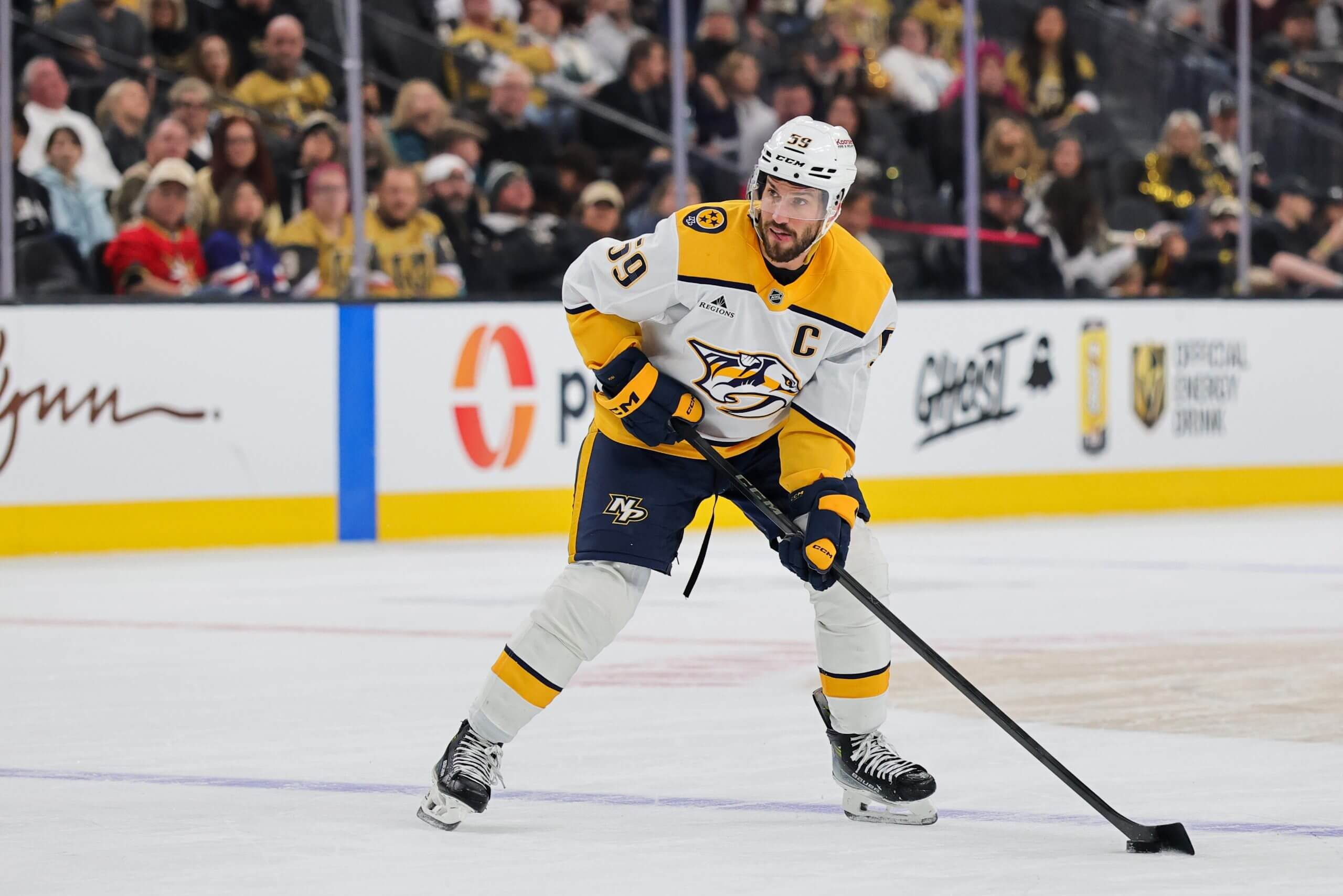
Roman Josi is showing some signs of slowing down. (Ethan Miller / Getty Images)
Nashville Predators
Roman Josi is still an excellent player, but at 35, he’s showing signs of slowing down. Josi can still drive offense at a high level, but his pair concedes many Grade-A scoring chances, which is characteristic of the team as a whole. Nashville’s top pair is giving up 3.16 goals against per 60, the third-worst mark among first pairs.
This is the second year in a row that Josi’s pair has given up more than 3.00 goals against per game, which is notable because, before last season, Josi had an excellent defensive track record, with his pair surrendering fewer than 2.5 goals against per 60 for 10 consecutive seasons.
Chicago Blackhawks
Chicago’s back end is exceptionally young, promising and inexperienced. The Blackhawks will have a nice blue line once some of those high-pedigree defensemen hit their prime, but for now, there isn’t a lot in the way of established, high-end talent.
Alex Vlasic is the de facto No. 1. Vlasic is a legitimately solid player with his size, skating, and shutdown ability, but his pair has been overmatched on most nights, as they’re getting crushed on the shot clock, have the worst expected goal differential among first pairs and have been outscored by a fairly wide margin.
New Jersey Devils
The Devils boast a deep crop of serviceable NHL defensemen, but they lack a true No. 1 to drive a first pairing. Jonas Siegenthaler and Dougie Hamilton have most frequently taken line rushes as the “top pair” and absorb the toughest matchups on the blue line. Together, they’re actually driving a positive share of shots and scoring chances, but they’ve been snakebitten by a low on-ice shooting percentage (6.2 percent), and so they’ve only scored 1.87 goals per 60.
Where the numbers get really ugly is Siegenthaler’s results away from Hamilton: He’s earned just a 41.9 percent share of shots and 34 percent of goals in just under 500 minutes without Hamilton.
San Jose Sharks
It shouldn’t be a surprise to see the Sharks’ top pair rank this low. San Jose’s forward group is exciting and has a lot of intriguing talent beyond just Macklin Celebrini, but its defensive core from No. 1 to No. 6 is arguably the worst in the NHL.
Dmitry Orlov and John Klingberg have been decent pick-ups on reasonable contracts, and their shot and scoring chance metrics aren’t actually that bad, but they simply aren’t top-pair caliber players at this stage in their careers.
Recently, San Jose has had to use journeyman Vincent Desharnais on the top pair because of Klingberg’s injury, which speaks volumes about the team’s need to bolster its back end this offseason.