
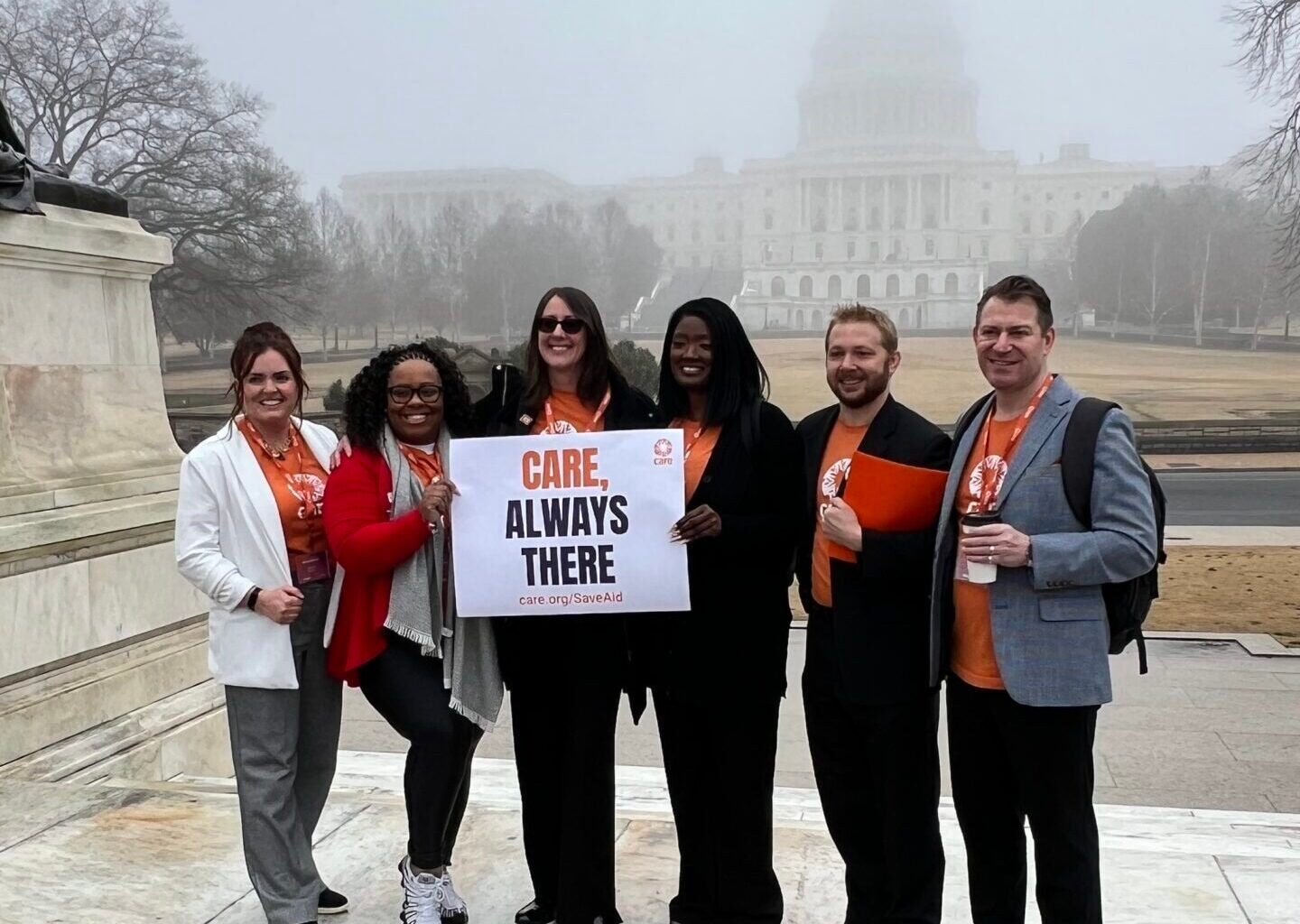
Connecting the local to the global
Issues impacting women and girls in the U.S. often mirror global trends. Women worldwide continue to face persistent wage gaps, unequal access to opportunity, and a disproportionate share of unpaid care work and domestic responsibilities. While more girls are attending school than ever before, disparities widen after primary school, particularly in STEM fields and during times of economic hardships.
The connection between local and global challenges is clear to many of CARE’s volunteer advocates.
For Coffy Davis and Deena Patterson of Little Rock, Arkansas, violence against women and girls is a shared crisis connecting Arkansas to the wider world. “In 2022, our state ranked fourth in the nation for the number of per capita violent murders of Black women and girls,” says Davis. “We are here advocating for all Black girls. This is not an Arkansas problem or a national problem. It is an international problem.”
Mobilized through the Southern Black Girls and Women’s Consortium, a CARE partner, Davis and Patterson emphasized the importance of investing in community-led solutions. They were encouraged by CARE’s growing work in the United States, including programs focused on community resilience, disaster response, and maternal health.
Brian Friedman, a long-time CARE supporter from Tucker, Georgia, has visited CARE programs in various countries. His recent visit to a CARE program in Honduras motivated him to meet with U.S. policymakers. “We must think of foreign aid as an investment, not an expense,” he said. “People I met in Honduras told me that if they had a choice, they would not migrate. When people lack economic opportunities and social safety nets, they will move. Helping them stay seems to me like a smarter investment.”
For 23-year-old University of Pennsylvania student Menna Delva, the CARE on Capitol Hill experience was deeply personal. “As a Black woman and a child of immigrants — my mom is from Ethiopia and my dad is from Haiti — I wanted the opportunity to speak to people in power to make them understand my story, my perspective, and why helping people matters. If you exist in this world as a privileged state, like the United States, you have an obligation to help people who are less fortunate than you. I think it is about basic humanity.”