
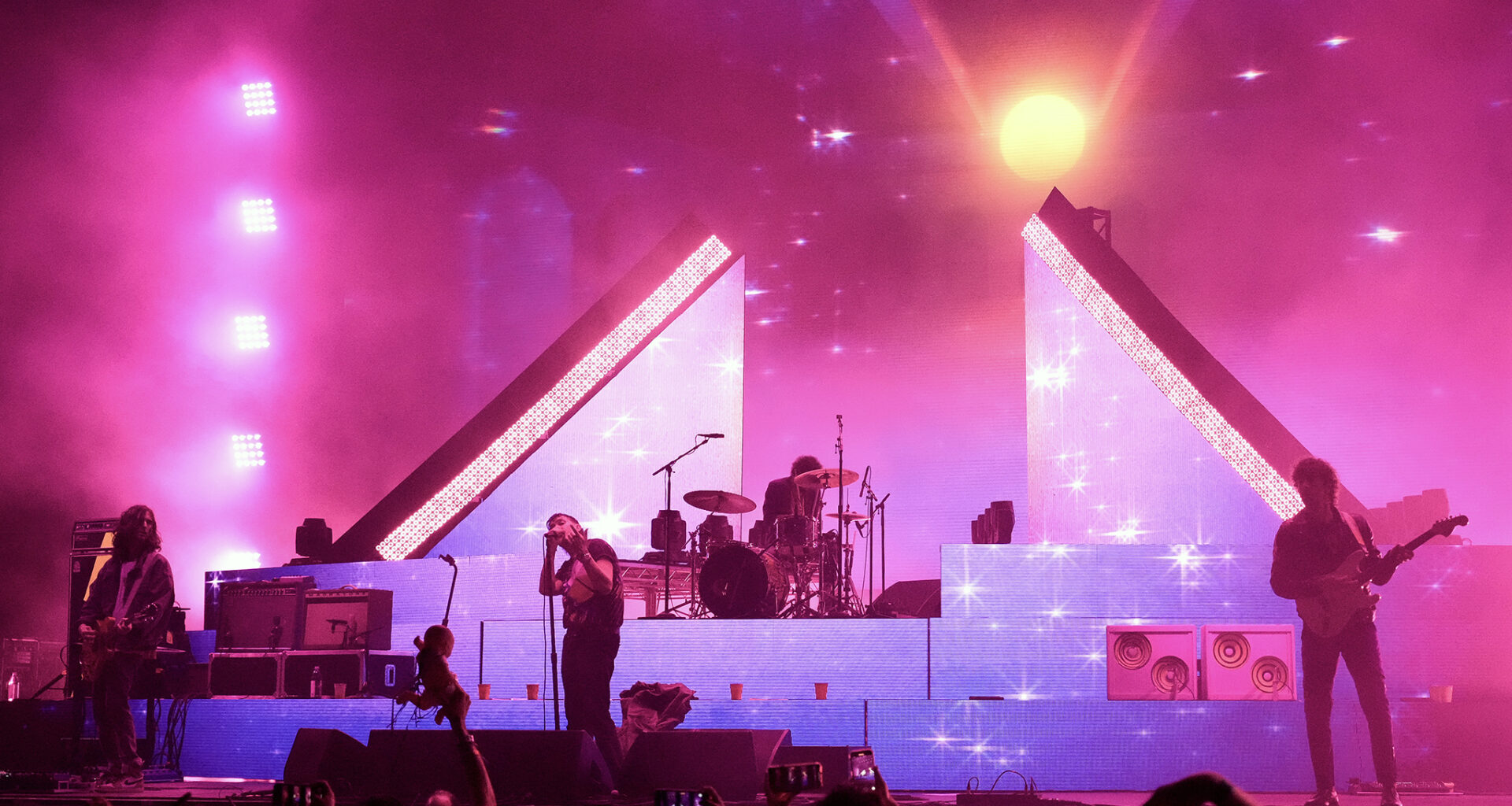
Two decades and half a million performances later, you can still hear the desperation creep into Julian Casablancas’ voice on “Reptilia.” It happened in the chorus. Standing on the stage at San Francisco’s Bill Graham Civic Auditorium, bathed in emerald green light, his voice curled into a snarl as he spat out his lines. “Yeah, the night’s not over / You’re not trying hard enough.”

Pretty much everybody sang along. Near the front, a crowdsurfer rode the canopy of outstretched hands. This moment was the Strokes at their best. It served as a reminder that, when he wants to, Casablancas can move a room of thousands of people.
For most of the band’s Monday concert, though, the Strokes gave a by-the-numbers performance. They checked all the boxes: The group played the old hits faithfully, if a bit stiffly, and saved “Reptilia” for the end. They debuted a song from their forthcoming album, “Reality Awaits,” which had been announced earlier in the day. They mostly avoided their less popular 2010s material.
Article continues below this ad
Monday’s show was solid. The fans had a good time. How couldn’t they? Everyone wants to dance to “Someday.”
Julian Casablancas of the Strokes performs at the Pentaport Rock Festival on Aug. 5, 2023, in Seoul, South Korea.
Justin Shin/Getty Images
Six years after their last album, 2020’s “The New Abnormal,” the Strokes are back on the road. Last weekend, the band played an unusually intimate show at the Warfield, to rave reviews from local fans. After their Bill Graham concert on Monday, the band will head south for Coachella, the first of a string of summer festival performances. In August, the Strokes are slated to return to headline Outside Lands.
Make SFGATE a preferred source so your search results prioritize writing by actual people, not AI.
Add Preferred Source
If the Strokes came across as subdued, it was because of Julian Casablancas. The vocalist, who wore sunglasses for the duration of the concert, was somewhat inexpressive. While singing, he moved little. Instead, he hunched over the microphone, bending forward with his face pointed toward the ground. He sang the words the right way, but the overall effect was a vacuum of energy.
Article continues below this ad
“San Francisco, so cool! Such a cool place,” Casablancas mused between songs at one point. Then, after a pause, he apparently gave up on the monologue: “That’s all I got,” he said, prompting laughter from the crowd.
At other points, he passed the microphone to bandmates and asked them to say something, to predictably awkward results.
Still, the rest of the band pushed onward. Albert Hammond Jr.’s guitar playing is as searing as ever; his solo on “Last Nite,” like the design on his guitar strap, is still a bolt of lighting.
Article continues below this ad
The Strokes perform at the Pentaport Rock Festival on Aug. 5, 2023, in Seoul, South Korea.
Justin Shin/Getty Images
It speaks to Casablancas’ immaculate songwriting, anyway, that these songs still connected with the thousands in attendance. The youngest members of the crowd were not alive in the Strokes’ heyday. During “New York City Cops,” a boy a few heads in front of me tore off his T-shirt and whipped it in the air. When the band played “You Only Live Once,” the girl in front of me grabbed her boyfriend and shook him by the shoulders.
The Strokes perform during the Rock en Seine festival on Aug. 27, 2023, in Saint-Cloud, France.
Kristy Sparow/Getty Images
Twenty-five years ago, the Strokes were the coolest band in the world. They arrived at the exact right time. Every decade or so, rock fans begin to suspect that the genre has hit a dead end. This time, they worry, there will be nowhere new left to go; the bands of the future will be an endless procession of clones and bloodless indie groups.
Article continues below this ad
Sometimes when this happens, a fabulous new band emerges from nowhere, takes a sledgehammer, busts down a wall and shows the others another way. It’s what Nirvana did in 1991, and it’s what the Strokes did, 10 years later, with their debut album, “Is This It,” kicking off the 2000s garage rock revival.
Fans watch the Strokes perform on the NOS stage during the NOS Alive festival on July 6, 2022, in Lisbon, Portugal.
Pedro Gomes/Redferns
In many respects, the Strokes weren’t particularly novel. Their sound borrowed liberally from the Velvet Underground and the Stooges. But they were very, very good and very, very cool — New York cool, the sort of cool that makes you curse your luck for not having been born the son of a model agency executive, like singer Casablancas. The members of the Strokes met at private schools, shared apartments, practiced relentlessly and went out drinking in the East Village. The bands’ first songs were brief, flawless bursts of energy, propelled forward by Casablancas’ detached drawl. Within a few months, New York City was full of Strokes look-alikes.
“People that weren’t interested in rock’n’roll — who, in fact, hated it, because it was their parent’s music — got into it,” Gordon Raphael, the producer of “Is This It,” told Vice in an interview. “There were people that told me ‘We love techno. But as soon as we heard The Strokes, I got a leather jacket and a guitar — and now I have a band.’”
Article continues below this ad
The band’s second album, “Room on Fire,” was excellent but retread the same ground as “Is This It.” The third, 2006’s “First Impressions of Earth,” arrived to less fanfare, and the band spent some years on hiatus.
The Strokes perform at the Pentaport Rock Festival on Aug. 5, 2023, in Seoul, South Korea.
Justin Shin/Getty Images
Casablancas drank heavily and sparred with interviewers. The Guardian cites a former Strokes manager who referred to Casablancas as “a drunken nightmare to society as a whole.” In the middle of a 2003 interview with Neil Strauss for Rolling Stone, Casablancas, apparently frustrated, switched off the tape deck and walked away. After a few minutes, he returned, sat on Strauss’ lap and kissed him on the neck seven times.
“Before I can wipe dry, he is out the door, rolling himself home in a discarded wheelchair he finds abandoned outside,” Strauss wrote.
Article continues below this ad
In later years, the band’s output and touring turned sporadic. Casablancas started a second project, the Voidz. As he explained to the Times in a 2020 interview, he was tired of playing the same old hits.
“When you’re growing up and imagining playing music, it is for the excitement, but the one aspect of doing it for a living that is a sadness you don’t anticipate is that you play songs so much, you become sick of them,” Casablancas said. “… To some extent, that’s why I play with [side-project] Voidz. I couldn’t care less about playing ‘Last Nite.’”
The Strokes perform during the Rock en Seine festival on Aug. 27, 2023, in Saint-Cloud, France.
Kristy Sparow/Getty Images
No wonder, then, that the highlight of Monday’s show was the final song before the encore, “Ode to the Mets.” The five-minute power ballad is from “The New Abnormal.” It’s one of the group’s best, definite proof that the Strokes aren’t just a nostalgia act.
Article continues below this ad
At the song’s opening guitar line, several audience members screamed. Casablancas, clutching his side with one arm, sounded genuinely mournful as he sang the first verse: “Hope that you find it, hope that it’s good / Hope that you read it, think that you should.”
Over five minutes, the song built slowly. The guitars started steady, growing louder and more insistent. By the time he reached his last verses, Casablancas was howling. His fans howled with him.
Then it ended, and the colored lights went out. Casablancas held up a peace sign and walked offstage.
Article continues below this ad