
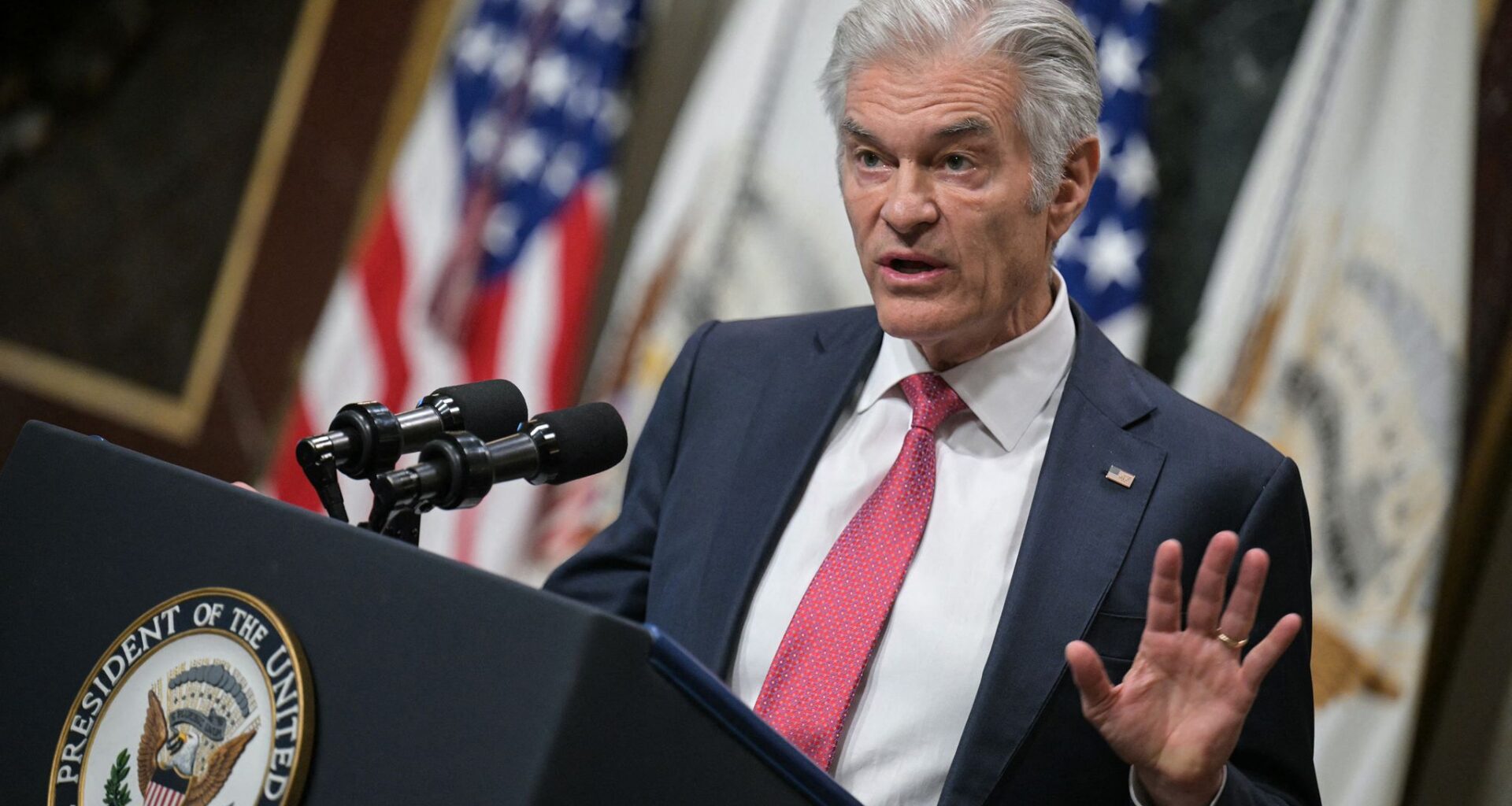
Medicare and Medicaid Administrator Mehmet Oz speaks about combating fraud at the Eisenhower Executive Office Buildingin Washington, D.C., on Feb. 25, 2026.
Oliver Contreras/AFP/TNS
State officials conducted a sweep of a three-story Los Angeles office building Tuesday as part of its continued efforts to push back against claims by right-wing influencers and President Donald Trump’s administration that fraud is rampant in the state, particularly among hospice businesses.
California agents said most of the businesses housed at the site can’t access state Medicaid funds, and argued that most potential fraud is happening at the federal level, which is under Trump’s purview.
Tuesday’s sweep is the latest chapter in a long-running dispute between the state and federal government over how California is run. But the fight over hospice fraud is relatively unique among the many tensions between the state and the White House, because both parties actually agree fraud is taking place. They don’t agree, however, on who’s at fault: California, which licenses the hospices, or the federal government, which runs Medicare.
Article continues below this ad
Investigators have a history with the office building at 14545 Friar St. in Van Nuys going back several years, which coincided with a state moratorium on issuing new hospice licenses as part of its own fraud crackdown. On Tuesday, a fleet of 80 investigators and state employees visited the tenants again — this time following viral videos from right-wing YouTuber Nick Shirley and Assembly Member Alexandra Macedo, R-Tulare, who pointed to 197 businesses using the same address.
“This ‘ground zero’ for hospice fraud is not an isolated anomaly,” Macedo wrote in a letter to a congressional oversight committee. “It is a symptom of a systemic collapse in oversight.”
San Francisco Chronicle Logo
Make us a Preferred Source to get more of our news when you search.
Add Preferred Source
But the state says a business tying itself to an address in pursuit of a license doesn’t mean it ever received one. State officials said 48 businesses — not 197 — hold a hospice license at the complex, which is zoned for 60 office spaces. Of those, 19 are eligible to bill the state’s Medicaid program, known as Medi-Cal, for reimbursements. The other businesses use Medicare — which is a federally managed program that handles the majority of hospice spending — or bill private insurers for reimbursements.
“This is ongoing work that we have been doing way before any of the media attention has been on us,” said Susan Fanelli, a deputy director with California Department of Public Health, which issues hospice licenses. “We believe California has taken a lot of action … to combat fraud and to reduce the number of fraudulent actors that get into the system.”
Article continues below this ad
State investigators conduct hospice compliance reviews in Los Angeles County on April 7, 2026.
California Department of Public Health
Trump put a spotlight on Medicaid and Medicare fraud in March when he announced a federal task force led by Vice President JD Vance to develop stricter eligibility verification requirements for welfare programs and to stomp out fraud networks across the country.
Trump said the task force was “not a Republican-Democrat thing,” but largely aimed his remarks at Democrat-led Minnesota, which has been enveloped in a welfare funds scandal, and California, where the president claimed without evidence that fraud is “10 times worse.”
“I think they’re going to find numbers that are far higher than you even think,” he said in March.
While California agencies don’t have the ability to investigate Medicare billing, the state health department is responsible for checking the status of hospice business licenses, which are required before a provider can submit claims to Medicare. The purpose of Tuesday’s visit was so health department agents could verify that all 48 license holders’ businesses were legitimate, Fanelli said.
Article continues below this ad
The outcome of the investigations that started Tuesday won’t be available for several weeks, Fanelli said. Agents are checking licensed businesses are operational and abiding by their posted hours; that they have staff hired and present; and have records for the patients they serve.
State and federal agents have done 56 licensing investigations since 2021 at the same Friar Street building, which led the health department to revoke 14 licenses while preventing another 146 from ever being issued, according to the health department. It also issued 144 citations in that time.
“We’ll look at their policies and procedures and we’ll look at patient medical records,” Fanelli said. “We can even interview patients or family members to make sure that what they’re doing is legitimate and that they are delivering good quality patient care.”
Shirley, in his video, spotted vacant offices and luxury vehicles in the parking lots of the Van Nuys office buildings tied to hospice providers. He accused the companies of taking advantage of taxpayers by calling their actions “welfare maxxing” — a reference to popular Gen Z slang.
The allegations made online prompted the investigation in Los Angeles, Fanelli said.
Article continues below this ad
Los Angeles County is a particular point of contention because of its high number of hospice providers, which account for nearly a fifth of all licensed hospices in the nation. Dr. Mehmet Oz, administrator for the Centers for Medicare & Medicaid Services, visited Van Nuys earlier this year, where he filmed a controversial video tying the alleged fraud to the local Armenian community. Shirely’s 40-minute video included some of the same allegations.
After a Los Angeles Times investigation in 2020, California began freezing most new hospice licenses and has since revoked more than 280. The state is still working on stricter laws and regulations. While the new regulations were due to start at the beginning of this year, the state sought an extension to implement them. That’s something Macedo has voiced frustration about, saying the delay is fostering more fraud.
Last week, federal officials arrested eight people they say were involved in health care fraud schemes totaling $50 million in and around Los Angeles. The Department of Justice said those arrested are charged with running sham hospice centers that billed Medicare for patients who were not actually eligible.
Shelia Clark, CEO of the California Hospice and Palliative Care Association, called those arrests a “critical step” in confronting “the hospice fraud crisis” the group says it has long raised. In 2024, the association contributed to a presentation that showed clusters of hospice businesses located within a mile of one another were found in Van Nuys, Glendale, Burbank and North Hollywood. It found no similar clusters in Sacramento, San Diego or the Bay Area.
Article continues below this ad
Fanelli said she wants to see more state and federal collaboration and data-sharing so agents can weed out hospice fraud more quickly.
“The Trump administration should follow our lead — institute a federal moratorium on new Medicare hospice certifications, scrutinize Medicare billing, and remove any providers that violate the rules,” Newsom spokesperson Diana Crofts-Pelayo said in a statement. “We’re doing our part to raise standards, and it’s time for Washington to step up.”