
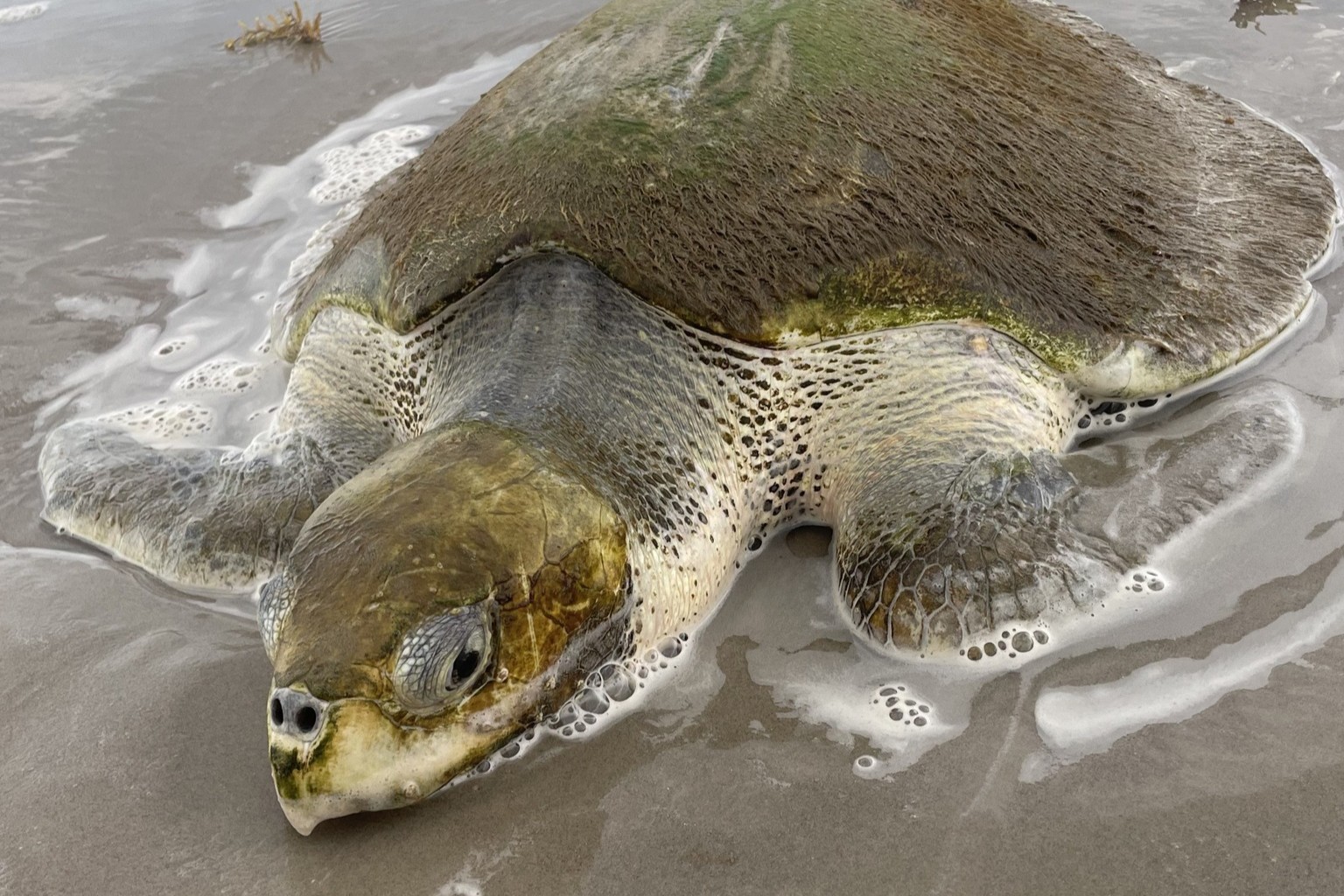
A Kemp’s ridley sea turtle lies along the shoreline on Mustang Island after washing ashore in distress.
Jackie Erbaugh
A South Texas lifeguard scanning the shoreline for swimmers instead found something that barely even looked alive. While patrolling Access 2 beach on Mustang Island late Saturday afternoon, Gulf Beach lifeguard Nevaeh Vela spotted what could have easily been mistaken for a mound of sand at beach marker 85.

It wasn’t. It was one of the rarest sea turtles in the world.
Article continues below this ad
A turtle struggling to breathe
“With the bigger swells and flooding, it’s not entirely uncommon for turtles to wash ashore, especially with it being the beginning of nesting season,” Vela told Chron, but a few details stood out. It was the middle of a busy holiday weekend, she said, and the turtle was easy to miss entirely. She also quickly recognized it as a Kemp’s ridley, an endangered species and the only sea turtle native to Texas.
Scientifically known as Lepidochelys kempii, the species is the smallest and most endangered sea turtle in the world.
That alone was enough for Vela, a marine biology student at Texas A&M University–Corpus Christi, to act. But what she saw up close made the situation more urgent. The turtle barely reacted when she approached. It was sluggish, struggling even to breathe.
Article continues below this ad
“It could barely lift its head for air when the surf broke over it,” she said.
Vela knew not to intervene directly.
“I’m not a certified professional, and it’s a federal crime to touch a protected species,” she said, explaining she instead called several rehabilitation centers. But it was after 5 p.m. on a Saturday, and no one initially picked up.
Article continues below this ad
She left a voicemail for the Amos Rehabilitation Keep, known as ARK. Staff called back within 20 minutes. By then, Vela had left work, but ARK kept her updated by text as they recovered the turtle.
When the staff arrived, its condition was clear.
“The turtle was not moving, lethargic and was taking frequent, raspy breaths with waves coming in onto the turtle,” ARK staff supervisor Andrew Orgill said. He added that algal growth on the shell suggested the animal may have been in poor condition for some time.
It was an adult male, identified by a long tail extending past the shell.
Article continues below this ad
“Adult Kemp’s ridleys are considered to be definitely males if the tail extends at least 5 cm,” Orgill said.
What the X-ray revealed
What they found next explained everything. An exam and X-ray revealed a small piece of a fishing hook lodged in the turtle’s trachea, blocking its airway and causing severe respiratory distress.
An X-ray shows a fishing hook lodged in the sea turtle’s airway after it was rescued from Mustang Island.
Jackie Erbaugh
Vela didn’t know that at the time.
Article continues below this ad
“I felt horrible,” she said, recalling that earlier in the day she had treated someone who stepped on a fishing hook at the same beach. The connection stuck with her. “It goes to show that pollution and carelessness can stretch not only to animals but to humans as well.”
Using endoscopy, ARK staff removed the hook fragment. The turtle, still unnamed, remains in critical condition.
“The turtle is being monitored closely, and he is on antibiotics, pain medication and anti-inflammatories,” Orgill said.
Cases like this are routine for the facility. “Discarded gear is sometimes referred to as ‘ghost gear,'” Orgill said, noting that drowning is a frequent risk when turtles can’t reach the surface to breathe. It’s something their team sees almost weekly.
Article continues below this ad
The damage goes beyond entanglement.
“Other impacts include deep lacerations, flipper amputations, inability to swim properly, ingestion of baits, hooks and line,” Orgill said, adding that heavily fished jetties make the area especially high risk.
If someone accidentally hooks a sea turtle, Orgill said not to cut the line. Instead, call 1-866-TURTLE5 so trained responders can safely retrieve it.
Article continues below this ad
“On piers in Port Aransas, the ARK also partners with Loggerhead MarineLife Center out of Florida to offer the Responsible Pier Initiative,” he said, which equips volunteers with drop nets to safely recover turtles. Cutting the line, he added, can leave hooks embedded and trailing line that increases the risk of entanglement and drowning.