
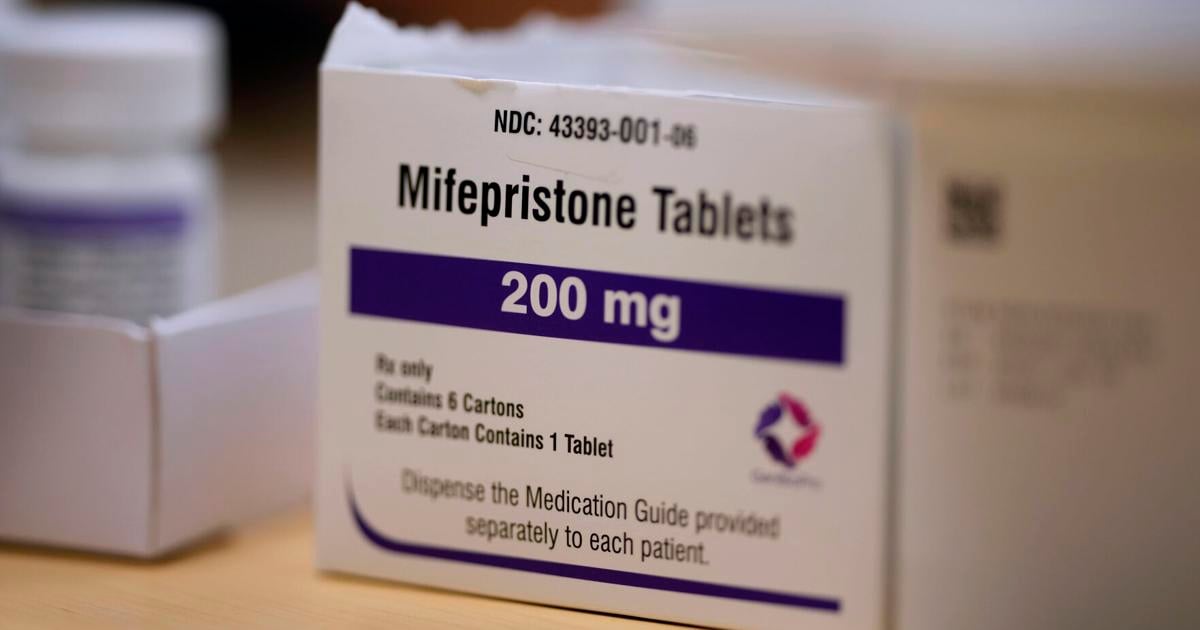
A federal judge in Lafayette declined to block, for now, the practice of accessing abortion pills in Louisiana through the mail following telehealth appointments, but left open the possibility of future restrictions that could change how many of the state’s residents access abortion.
In a 37-page ruling, U.S. District Judge David Joseph on Tuesday denied the state’s request to immediately reinstate in-person requirements for the abortion drug mifepristone and instead put the case on hold while the Food and Drug Administration conducts a safety review.
The drug is regulated under a Risk Evaluation and Mitigation Strategy, or REMS, a program the FDA uses to manage safety risks for some medications while keeping patient access.
The agency is currently conducting a safety review to evaluate those rules. The judge said the case should be put on hold while the FDA conducts a safety review of its abortion pill rules, finding that the agency, not the court, should evaluate the evidence first.

Louisiana Attorney General Liz Murrill takes questions after speaking in Western District Court on Tuesday, February 24, 2026, at the Federal Courthouse in Lafayette.
STAFF PHOTO BY BRAD BOWIE
The case was brought against the FDA in October by Attorney General Liz Murrill and a Louisiana woman who alleged she felt coerced into taking pills that her boyfriend ordered. It argued that the FDA violated the Comstock Act, a 19th-century law that restricts the mailing of items intended for abortion, when it stopped requiring that the pills be distributed in person.
The FDA has said it is conducting a safety review of mifepristone and asked the court to pause the case while that process is underway, but has not indicated whether it plans to change its current rules.
The pause ordered by Joseph, who was appointed in 2020 by President Donald Trump, is temporary. It allows the state to pursue restrictions after the FDA’s safety review is complete. Joseph also left the door open to rule in Louisiana’s favor later, saying the state is “likely to succeed on the merits” of their challenge to the FDA.
Murrill said the state would continue with the case, pointing out that the judge also said Louisiana is unable to enforce its laws, causing “irreparable harm.”
“Accordingly, under binding Fifth Circuit precedent, the only thing left to do is vacate the 2023 REMS pending the outcome of this litigation,” Murrill said in a statement. “We will ask the Fifth Circuit to do so.”
Abortions tied to Louisiana residents are rising, study says
Louisiana’s near-total abortion ban, enacted in 2022 after Dobbs v. Jackson Women’s Health Organization, makes it illegal to perform most abortions in the state with limited exceptions for fetal anomalies or to save the life of the mother.
The law is directed at providers within Louisiana but does not include the people who take the pills themselves or directly reach out-of-state doctors prescribing abortion pills via telehealth, a gap at the center of this legal challenge.
According to the Guttmacher Institute, a research organization that supports abortion rights, abortions tied to Louisiana residents rose from about 7,410 in 2024 to 9,350 in 2025. In 2021, before Louisiana’s ban was in place, 7,444 people received abortions in Louisiana.
All of the 9,350 recorded by the Guttmacher Institute were telehealth abortions — meaning pills sent by doctors in states with shield laws that protect prescribing abortion medication across state lines — and do not include people who traveled from Louisiana to other states for abortions.
The 9,350 figure is the number of prescriptions sent to Louisiana and does not track whether they were used. That number also does not include abortion pills sent from international organizations or received through informal networks.
Despite Louisiana and many other states banning abortion after the Dobbs decision, abortion numbers have remained relatively stable. But how people access care is shifting, especially in states where abortion is largely banned, said Kimya Forouzan, a principal state policy adviser at Guttmacher and author of the report.
“People in this broad swath of states … are fairly far from a state where they can access care,” Forouzan said. “So we have seen people increasingly access care via telehealth.”
Safety review
Mifepristone was approved by the Food and Drug Administration in 2000 and rules over its use have changed over time under the REMS program.
Prior to 2021, mifepristone had to be taken in-person in Louisiana. That rule was suspended during the pandemic and made permanent in 2023. A study published in the Journal of the American Medical Association found the FDA relied on data and its standard review process when evaluating the drug’s safety.
The drug has been a lightning rod for groups that oppose abortion. In 2024, Louisiana classified it as a controlled dangerous substance alongside drugs like Xanax and fentanyl, placing restrictions on how it can be prescribed and dispensed.
In his ruling, Joseph said the FDA’s REMS safety review must be completed by early October. Any changes stemming from the review could determine whether telehealth access remains available or is restricted.
Murrill is pursuing criminal cases against two doctors in California and New York accused of sending pills to patients in Louisiana. Those states have not been willing to have the doctors extradited to face the charges.
Without telehealth, advocates said some may turn to less safe options or face more health risks.