
The only way the U.S. can spend the way it spends — which is to say, more than it earns — is by borrowing. A lot. And who it’s borrowing from makes a difference.
The U.S. is $31 trillion in public debt— that is, for reference, about as much as the entire U.S. economy produces in a year. We owe about 30% of that to other countries and foreign investors. That share has been falling.
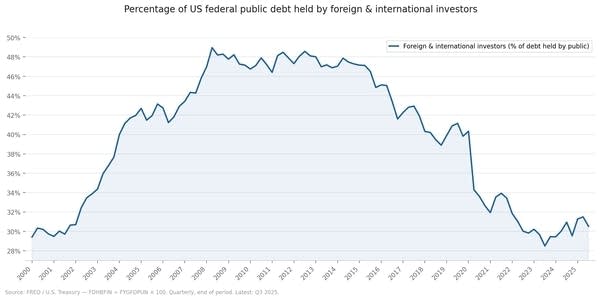
A chart showing the percentage of U.S. federal public debt held by foreign and international investors.
FRED/U.S. Treasury
“It used to be almost half of all publicly held debt,” said Shai Akabas, vice president of economic policy at the Bipartisan Policy Center. The rest of the world is not propping up U.S. spending like it used to.
One reason is that there’s just a lot more of that spending.
“There’s been an explosion in the amount of U.S. government debt outstanding,” said Tony Rodriguez, head of fixed income strategy at Nuveen. “Think about all of the fiscal stimulus and tax cuts that we’ve seen over the last five to ten years.”
The U.S. borrowed to deal with the Great Financial Crisis, then we borrowed to deal with COVID-19. Now we’ll borrow to pay for war. Significant tax cuts across multiple administrations — 2013, 2017, 2020, and 2025 — further engorged the debt.
Foreign governments’ desire to loan money to the U.S. by buying U.S. Treasurys has not kept up for many reasons.
“The U.S. fiscal sustainability has been called into question with debt rising as much as it has,” Rodriguez said. Standard & Poor’s downgraded U.S. debt in 2011, Fitch did so in 2023, and Moody’s and European credit rating agency Scope followed suit in 2025.
Some countries have observed that holding U.S. assets exposes them to financial pressure from the U.S.
“Central banks and non-U.S. investors have looked at the U.S. use of the dollar in terms of imposing sanctions, for example, on different investors. So the ‘weaponization’ of the dollar led central banks to want to insulate themselves from that geopolitical risk,” Rodriguez said.
So foreign governments have been diversifying, asking, “is there anything else we can buy so we don’t have all our risk in the U.S.?” said Daniel Gerard, senior multi-asset strategist at State Street Global Markets. “China has expanded into British debt, into European debt, and into gold a lot more.”
Foreign investors have also been putting money in stocks instead of Treasurys especially when interest rates were low.
And investors both in and out of the U.S. in general have been more reluctant to invest in longer-term debt because of the uncertainty about the long-term economic future, Gerard said.
This raises a question: If foreign investors and foreign central banks have not been bankrolling the U.S. federal budget as much as they used to, and yet the U.S. has continued to spend, where has all the money come from?
“We’ve been writing IOUs faster than the rest of the world wants to collect them, and that means that more of those Treasury securities are being purchased domestically,” Akabas said.
America has been borrowing more from America. From banks, from U.S. investors, even recently increasing borrowing from the Federal Reserve.
To get American investors to buy all those Treasurys, the federal government has had to pay up. More than it otherwise would. And when the government has to pay higher interest, so does everyone else.
“Americans in households and businesses across the country are paying more for everything from mortgages to auto loans to credit card debt, because all of those are based on U.S. Treasury rates,” said Akabas.
Basically, somebody’s got to pick up the tab here, and if it isn’t the rest of the world… it’s us.
Related Topics