
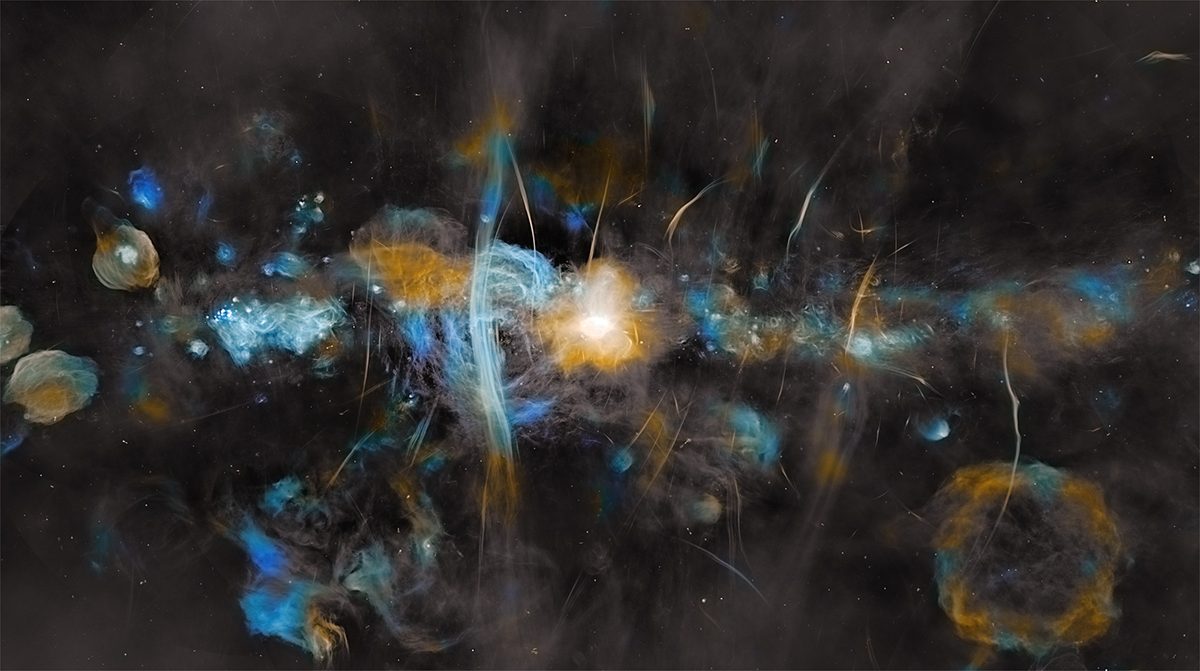
Astronomers have proposed a radical alternative to the long-held belief that a supermassive black hole sits at the centre of the Milky Way, suggesting that instead a dense clump of dark matter could generate the same gravitational effects.
The new study, published in Monthly Notices of the Royal Astronomical Society, argues that an ultra-compact dark matter core can explain both the rapid motions of stars near our galactic centre and the larger-scale rotation of our Galaxy.
 Credit: dottedhippo / Getty Images
A new theory for Sagittarius A*?
For decades, the object known as Sagittarius A* has been interpreted as a black hole more than four million times the mass of the Sun, largely because stars in its vicinity, called S-stars, whirl around
it at enormous speeds.
However, an international team have put forward a fermionic dark matter model that could reproduce the same stellar motions without a black hole.
“This is the first time a dark matter model has successfully bridged these vastly different scales and various object orbits, including modern rotation curve and central stars data,” says the study’s co-author Dr Carlos Argüelles.
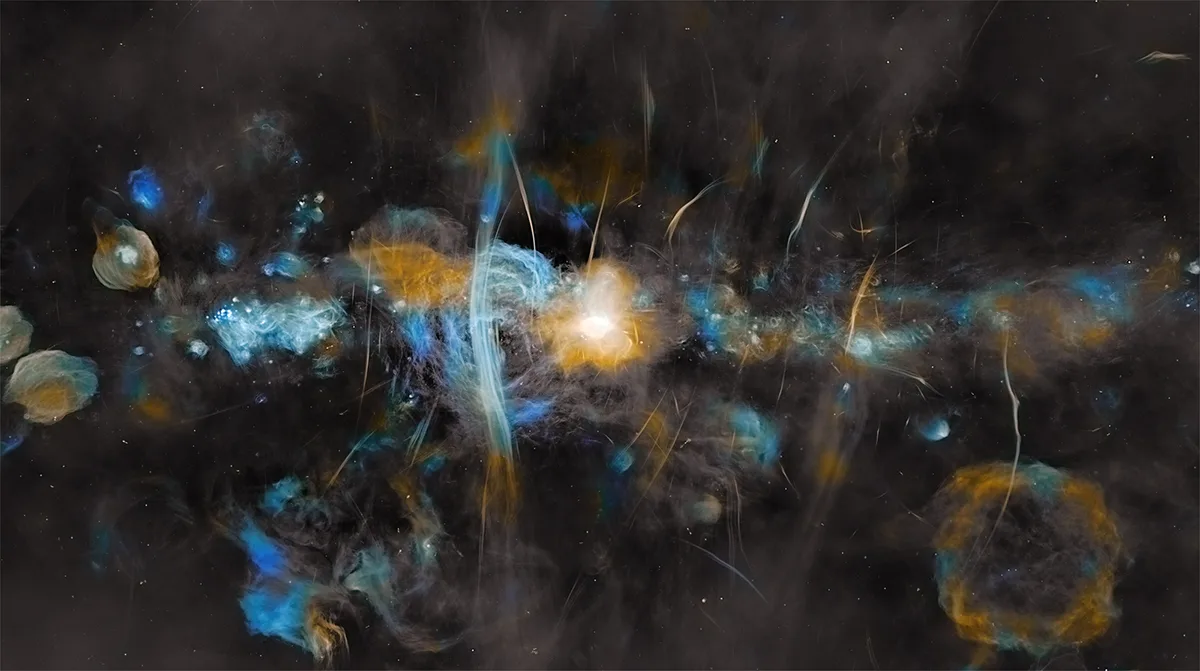 An image of Sagittarius A* at the centre of the Milky Way, captured by the MeerKAT radio telescope. Credit: NASA, ESA, CSA, STScI, SARAO, Samuel Crowe (UVA), John Bally (CU), Ruben Fedriani (IAA-CSIC), Ian Heywood (Oxford)
“We are not just replacing the black hole with a dark object; we are proposing that the supermassive central object and the Galaxy’s dark matter halo are two manifestations of the same substance.”
Their model posits that a type of dark matter made up of fermions can form a dense core nested within a more diffuse halo.
That dense region would exert a gravitational influence strong enough to mimic a black hole’s effects on nearby orbits and could even bend light.
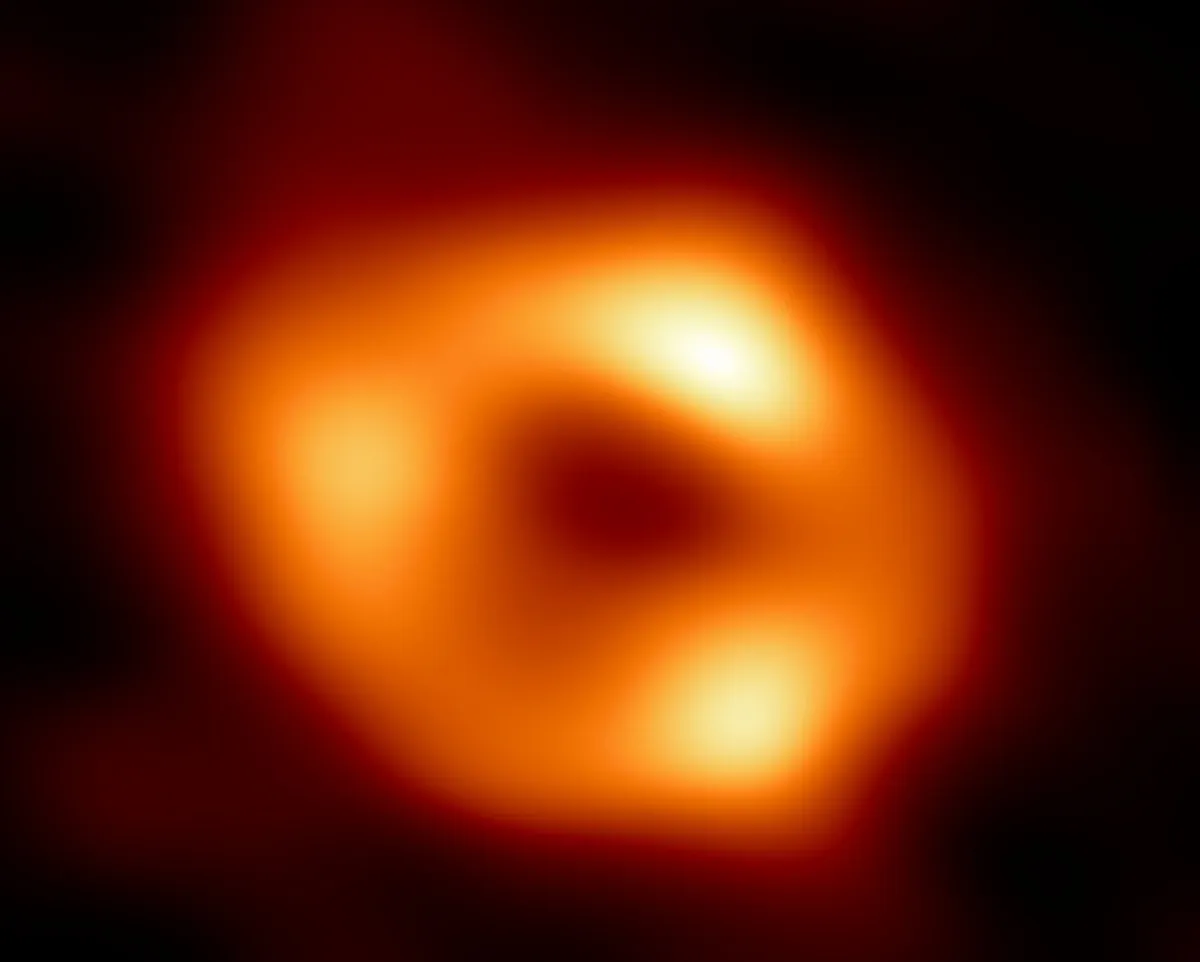 The first ever image of Sagittarius A* at the centre of our Galaxy. Credit: EHT Collaboration
That would create a ‘shadow’ surrounded by a bright ring, like the one captured by the Event Horizon Telescope in 2022.
Lead author Valentina Crespi explains: “The dense dark matter core can mimic the shadow because it bends light so strongly, creating a central darkness surrounded by a bright ring.”
If confirmed, the discovery would force a total rethink of how galaxies form.
Rather than being shaped by a central singularity, the Milky Way might be held together by a continuous ‘skeleton’ of dark matter from its core to its farthest edge.