
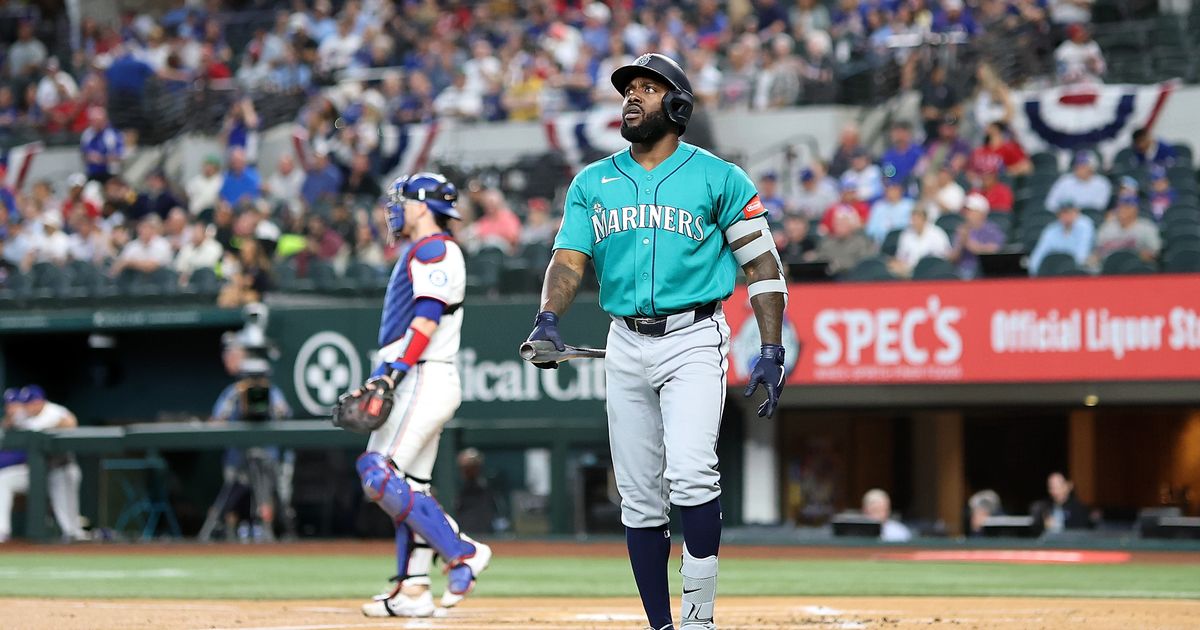
SEATTLE – The Mariners play host to their longtime nemesis, the Houston Astros, for a four-game series this weekend, an early-season showdown between two teams expecting to again contend for the American League West title.
They haven’t looked the part so far.
Both teams are reeling, and for exact opposite reasons.
The Astros (6-7), swept by the Rockies in Colorado this week, have lost four games in a row.
They have lost their staff ace, Hunter Brown, to a shoulder strain, and another starter, Cristian Javier, left Wednesday’s game with shoulder tightness. The Astros’ pitching is depleted enough that they had to turn to Cody Bolton, the former M’s reliever, for a spot start earlier this week.
The Mariners, meanwhile, have flat-out lost their ability to hit a baseball.
On Wednesday, the Mariners (4-9) managed just two hits in a 3-0 loss in Texas. It was their fifth straight loss to complete a dreadful 1-5 road trip. They have been shut out three times in their last eight games.
Among the 30 MLB clubs, the Mariners rank dead last in the three main surface-level statistical categories: batting average (.184), on-base percentage (.280) and slugging percentage (.301). They are averaging a league-worst 3.1 runs per game.
To perform that poorly, a lot of things have to go wrong. And just about everything is for the Mariners’ offense, save for early-season surges from Cole Young and Brendan Donovan.
Notably, the Mariners’ 2-3-4 hitters – Cal Raleigh, Julio Rodríguez and Josh Naylor – have combined for 19 hits in 146 at-bats, a .130 batting average, with one home run, 45 strikeouts and 16 walks.
“Right now, offensively, we’re all looking for different things and trying to find the right approach,” M’s manager Dan Wilson said. “… We can all look in the mirror and say that we could be doing things differently.”
Several under-the-hood metrics help to illuminate the offensive issues:
1. They aren’t hitting the fastball: It’s Hitting 101: Be on time for the fastball. Mariners hitters, simply, are not. And, yes, they are struggling against most types of pitches through 13 games. Sliders, by and large, have proved especially difficult for them. But for a lineup that hit as many home runs as they did last season – 238 in all, third-most in MLB – it is surprising to see the persistent failings against fastballs. Collectively, the M’s have a minus-5.8 runs above average value against fastballs, per MLB’s Statcast metrics. That ranks 25th in MLB.
2. The K rate is a concern: The Mariners have a 27.6% strikeout rate, fourth-worst in MLB. After setting the franchise record for strikeouts in 2024, at 26.8%, the M’s made an important improvement in that regard last season, dropping the strikeout rate to 23.3%. Elements of the 2023 and 2024 Mariners offenses have resurfaced – just too much whiff – and that’s hardly an encouraging sign early on for a team that talked so loudly about its World Series dreams this year. (Given all that swing and miss, it’s no surprise that Mariners rank 30th out of 30 teams with a 68.9% contact rate so far. Over a full season in 2025, the M’s ranked 28th out of 30 with a 74.6% contact rate.)
3. A lot of weak contact: The Mariners have an average exit velocity of 87.4 mph that ranks 29th out of 30 clubs (only the White Sox, at 87.2, are lower). In 2025, the M’s exit velocity averaged 89.7 mph over the full season. The obvious conclusion is the Mariners aren’t putting the ball in play enough, and that’s true, And when they do, it’s usually weak contact, which is hardly a winning formula for a team built to hit the ball out of the yard.
There are glass-half-full figures to lean into, if you’re so inclined.
1. When they do put the ball in play, they are getting unlucky: The Mariners’ batting average on balls in play (BABIP) is .238, which ranks last in MLB by a wide margin. (The Angels are 29th at .261). The Mariners had a .287 BABIP in 2025 and the league average BABIP so far this season is .288. There are always outliers, but over the next 149 games that’s a figure that is bound to right itself for the Mariners. (And their “expected” batting average of .216 – while still unseemly – also suggests they have been a little unlucky.)
2. The competition matters: The M’s have faced top-of-the-rotation arms in three of the four series. The Guardians and Yankees were playoff teams in 2025; the Rangers’ starting rotation led the majors in ERA. And against the Angels, Jo Adell turned into the greatest right fielder of all time for one day.
3. Ballparks do matter: It is notable that 10 of the Mariners’ first 13 games were played in MLB’s two most pitcher-friendly ballparks, T-Mobile Park and Texas’ Globe Life Field. The cold weather in Seattle during the opening week was a factor, too. Perhaps the expected warmer weather at home this weekend will help heat up the Mariners’ bats. They can’t get any colder than they’ve been.