
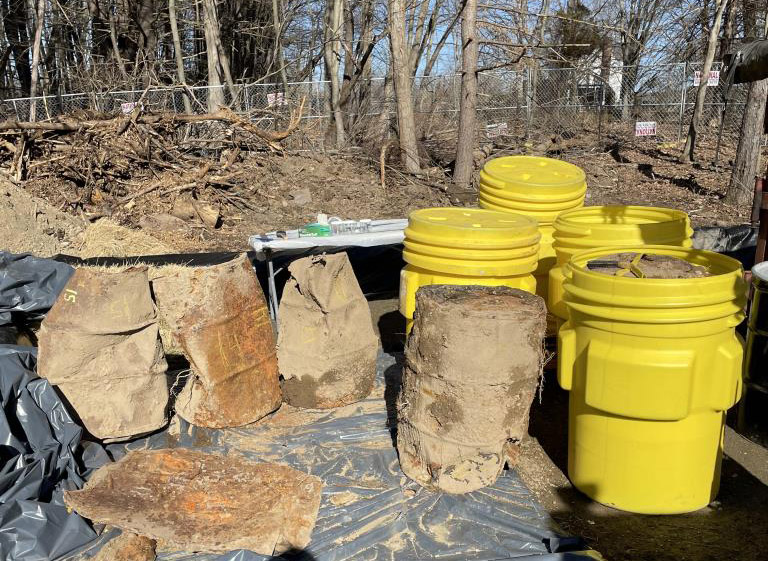
Problems with the 8.4-acre site were confirmed in the late 2010s when EPA investigators, responding to a tip, found a 10,000-gallon chemical tank buried underground, carcinogenic trichloroethylene solvents in the groundwater and a PCB-contaminated pond on-site. Dozens of wells were tested afterwards.
Courtesy Environmental Protection Agency
A new consent order from the state Department of Environmental Conservation requires the past landfill customer to study private wells, groundwater and soil at the toxic County Route 203 property in Nassau, seen here Thursday.
Will Waldron/Times Union
The former General Electric site on Sweets Crossing Road where chemical drums were removed by the U.S. Environmental Protection Agency in 2023.
Will Waldron/Times Union
The former General Electric site on Sweets Crossing Road where chemical drums were removed by the U.S. Environmental Protection Agency in 2023.
Will Waldron/Times Union
The former General Electric site on Sweets Crossing Road where chemical drums were removed by the U.S. Environmental Protection Agency in 2023.
Will Waldron/Times Union
The former General Electric site on Sweets Crossing Road where chemical drums were removed by the U.S. Environmental Protection Agency in 2023.
Will Waldron/Times Union
A new consent order from the state Department of Environmental Conservation requires the past landfill customer to study private wells, groundwater and soil at the toxic County Route 203 property in Nassau.
Courtesy Environmental Protection Agency
NASSAU — GE Aerospace will soon probe an area that includes the former home of a toxic landfill’s late operator, Dewey Loeffel, who kept trucks associated with waste-hauling operations near his residence.

A new consent order from the state Department of Environmental Conservation requires GE Aerospace, a former customer of the landfill, to study private wells, groundwater and soil at the toxic County Route 203 property in Nassau.
Article continues below this ad
DEC will draft a cleanup plan based on the outcome of the study, which is slated to begin in mid-April, according to the state agency.
Problems with the 8.4-acre site were confirmed in the late 2010s when EPA investigators, responding to a tip, found a 10,000-gallon chemical tank buried underground, carcinogenic trichloroethylene solvents in the groundwater and a PCB-contaminated pond at the site. Dozens of wells were tested afterward.
GE Aerospace, then part of General Electric, signed onto a settlement agreement in 2020 to conduct additional sampling and address releases. It submitted three separate plans to address the site between February 2024 and April 2025, according to the consent order. Honeywell and SI Group, then known as Schenectady Chemical, also worked with Loeffel companies, but have not volunteered to take any action on the County Route 203 site in the latest consent order, DEC noted.
Make the Times Union a Preferred Source on Google to see more of our journalism when you search.
Add Preferred Source
“This whole consent agreement process has been dragged out completely inappropriately and not because of DEC efforts,” said Nassau Supervisor David Fleming. “They’ve been really good at communicating with the town. Unfortunately, the responsible parties, the polluters, have dragged their feet, which is not unexpected.”
Article continues below this ad
Starting in 1952 and lasting for nearly two decades, those companies sent about 46,000 tons of toxic chemicals, including solvents and PCBs, to the unlined Dewey Landfill off Mead Road. As a result of neighborhood pressure over dead fish spotted nearby, it was shuttered through a court order in 1970.
Millions in public money have been poured into site maintenance.
Although the state sealed off the dump in the 1980s, toxins have continued to discharge into the local Valatie Kill watershed. Under a collection system overseen by the EPA, contaminated groundwater is treated before being discharged into the Valatie Kill.
EPA regional spokesperson Stephen McBay said in an email that the system works in compliance with state and federal requirements. Furthermore, he said, recent infrastructure upgrades were made to improve structural efficiency.
Article continues below this ad
Fleming doesn’t like that any contaminants are still going into the water there, even with the treatment system.
“Frankly, that’s completely unacceptable,” Fleming said. “EPA has accepted the polluter’s argument that the solution to pollution is dilution, and that is completely unacceptable to the town.”
Last summer, town officials had concerns that the water wasn’t being tested regularly enough at the Loeffel landfill after noticing increasing levels of a chemical called 1,4-dioxane — including results from the late summer that were 3.43 times Rensselaer County’s legal limit.
The county has prohibited levels of 1,4-dioxane over 0.35 parts per billion in water since 2018. This change, signed into law by Rensselaer County Executive Steve McLaughlin, was pursued at the request of Nassau town officials.
Article continues below this ad
In a statement, McLaughlin said the county is “still waiting for meaningful progress on key areas in the town” after decades of dealing with contamination problems.
“There remains a pressing need for a comprehensive solution to remove the toxic shadow placed over Nassau and allow the community the ability to move into the future without the burden of inherited contamination and to ensure health, safety and quality of life are protected,” the county executive said.