
Feral hogs are tearing up Mesquite yards, costing homeowners thousands. The city is partnering with the state as experts warn the population is hard to control.
MESQUITE, Texas — What neighbors describe as a quiet, peaceful neighborhood in Mesquite has turned into a nightly battleground for some residents, as feral hogs tear through yards and leave behind costly damage.
Ted Faulkner has lived in the Falcon Lair neighborhood for 17 years. Recently, he says, the destruction has become impossible to ignore.
“It’s as though they are working for an excavation company,” Faulkner said.
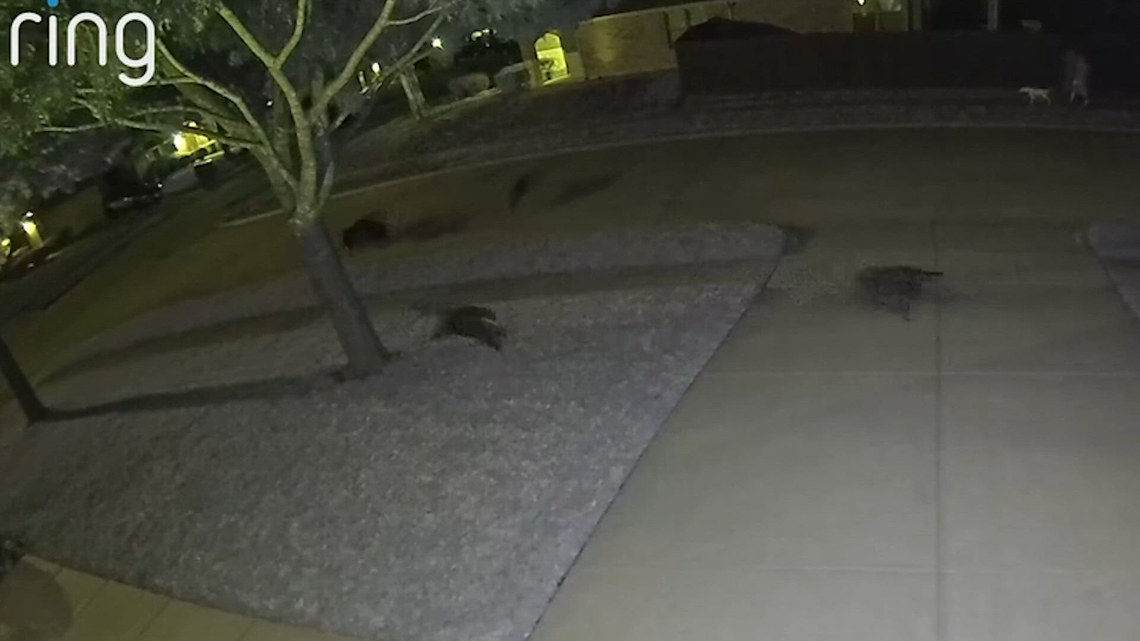
Home surveillance video shows the animals roaming through yards at night — some fully grown, others just piglets — moving in groups and leaving behind deep hoof prints and torn-up grass.
Neighbors say the hogs appear to enter from a nearby wooded area, using it as a shelter before spreading into surrounding properties.
Grady Chandler, who lives by the wooded area, says his entire front yard has been destroyed.
“Thousands of dollars of grass,” Chandler said. “And yes, it’s going to be expensive.”
The damage isn’t limited to private property. City officials say the hogs have also impacted public land, including an area designated as a park pavilion.
Maria Martinez, Neighborhood Service Director with the City of Mesquite, says the city does not have the resources to manage the feral hog population. Instead, it is working with Texas Parks and Wildlife to remove the animals.
“They gave us a wildlife biologist,” Martinez said. “It’s not an easy process. These are pretty smart animals.”
In the meantime, Martinez is urging residents to take preventative steps, including treating lawns for grub worms — a major food source that attracts feral hogs.
According to Texas Parks and Wildlife, the problem is difficult to control. The feral hog population can grow by about 20 percent each year. In Texas, it’s estimated that nearly 70% of the population would need to be removed annually just to keep numbers from increasing, but current efforts only reach about 30%.
As development continues across North Texas, natural habitats are shrinking, pushing hogs into residential areas in search of food.
“I feel bad that they have nowhere to go,” Faulkner said.
Still, he and his neighbors are concerned about safety.
“It can be very dangerous if those hogs feel threatened,” he said. “We don’t need to wait until a fatality occurs.”
For now, residents are left weighing the cost of repairs against the uncertainty of when — or if — the problem will be resolved.