
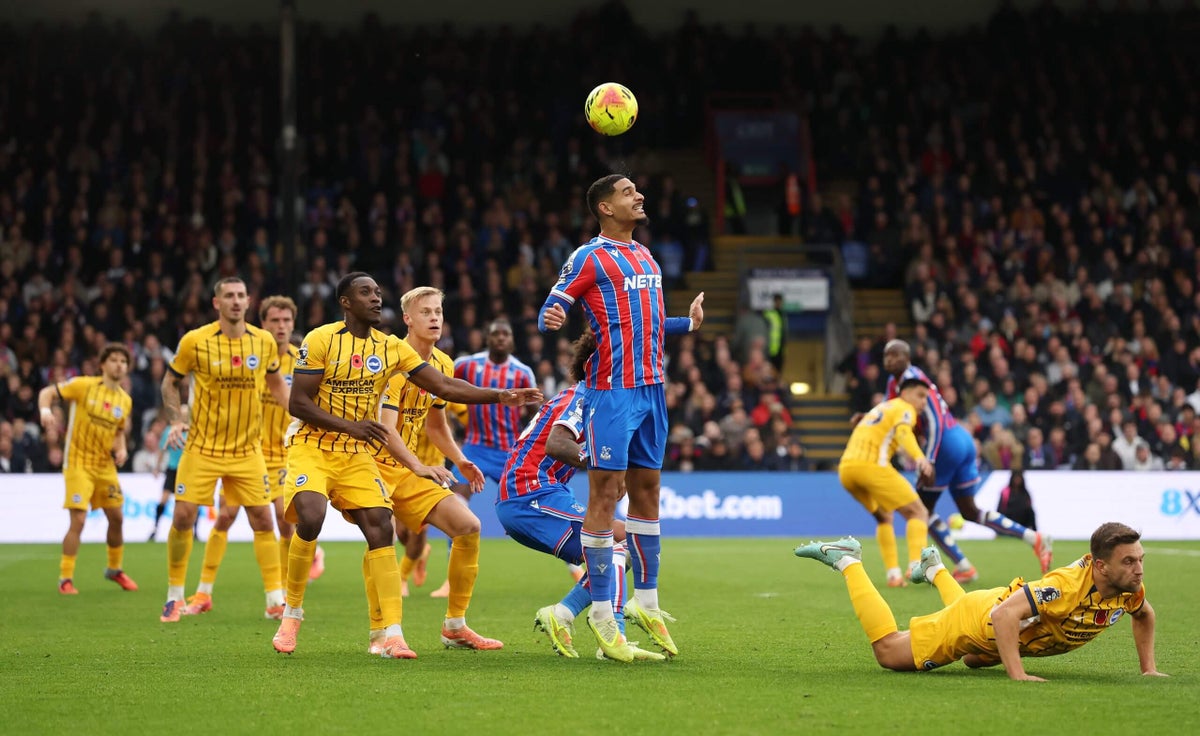
This has been the Premier League season of getting it into the mixer. That has meant a big focus on inswinging corners and on long throws.
The latter concept has become curiously mainstream in the last couple of years. Traditionally, there were only a couple of long-throw specialists in the Premier League, usually playing for bottom-half strugglers who played old-school football and provided an alternative to the style of play of the big clubs. But even the league’s title challengers have become fixated on long throws this season.
When we talk about long-throw specialists, we usually mean the players who are good at hurling the ball into the box — think Michael Kayode (Brentford), Ethan Ampadu (Leeds United) and Chris Richards (Crystal Palace). But that’s only one part of the equation, of course. You cannot score from a throw-in. You very rarely assist from a throw-in — there have been none this season, and just three in the last five campaigns.
So, clearly, every side needs players good at winning the first contact — in attack, this is largely about nodding the ball into a more dangerous position. In a defensive sense, it’s trying to clear the ball. Either way, the ‘first contact’ has become an extremely important concept. So who are the Premier League’s first-contact specialists?
Here are the numbers for first contacts in both boxes.
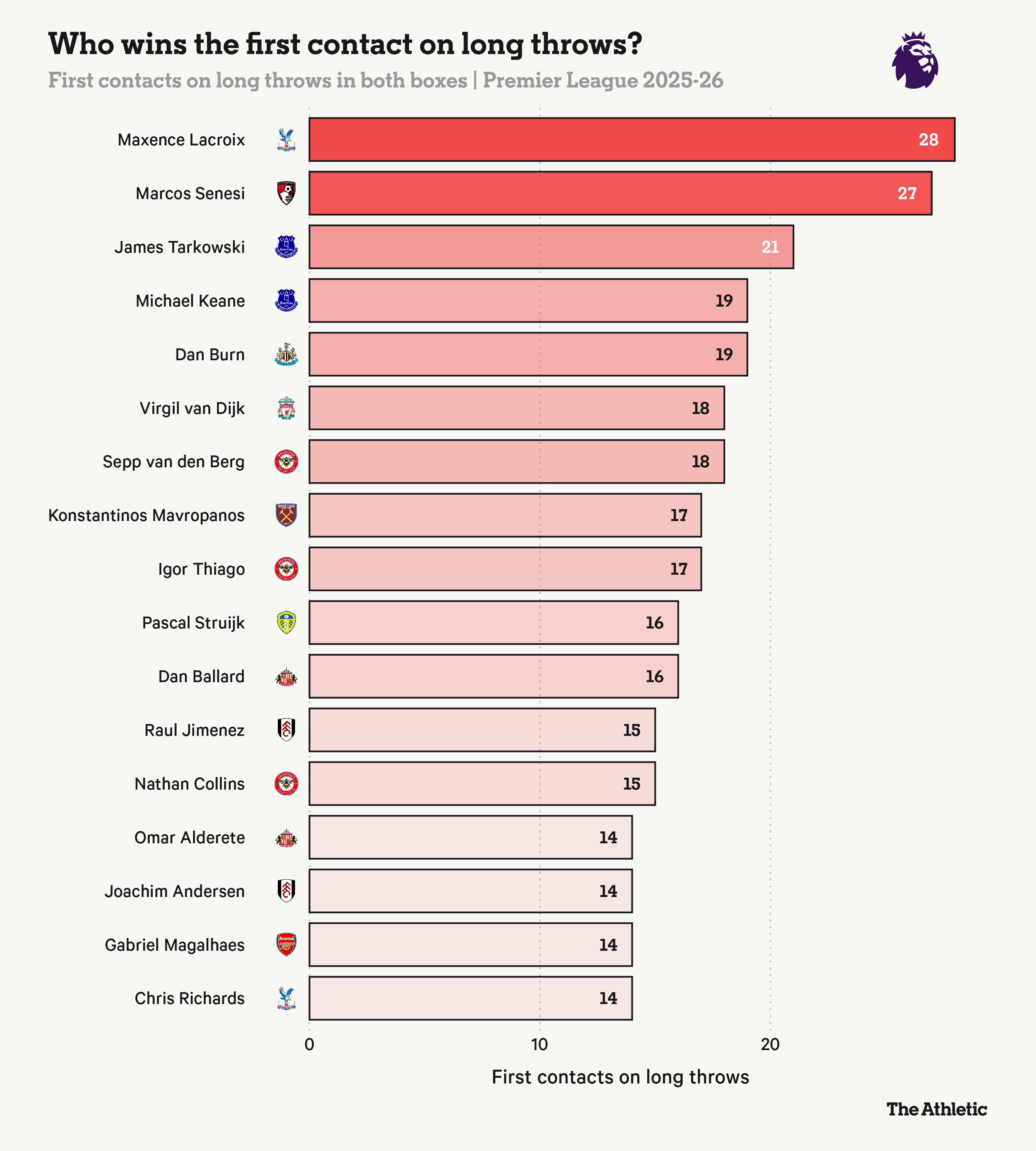
There are two outright leaders. Crystal Palace’s Maxence Lacroix is a towering defender who wins plenty of aerial duels. Marcos Senesi of Bournemouth also (literally) figures highly. Everton’s James Tarkowski is very much the type of player you expect to see here.
These players are almost all defenders. You have to go all the way down to Brentford’s Igor Thiago, in joint-eighth place on 17 first contacts, to find the first centre-forward. Notably, there are no midfielders, wingers or even full-backs (aside from centre-backs who have sometimes played there).
But that’s taking into account defensive and attacking long throws. Things are more interesting if we split them. Here are the numbers for long throws into the opposition box.
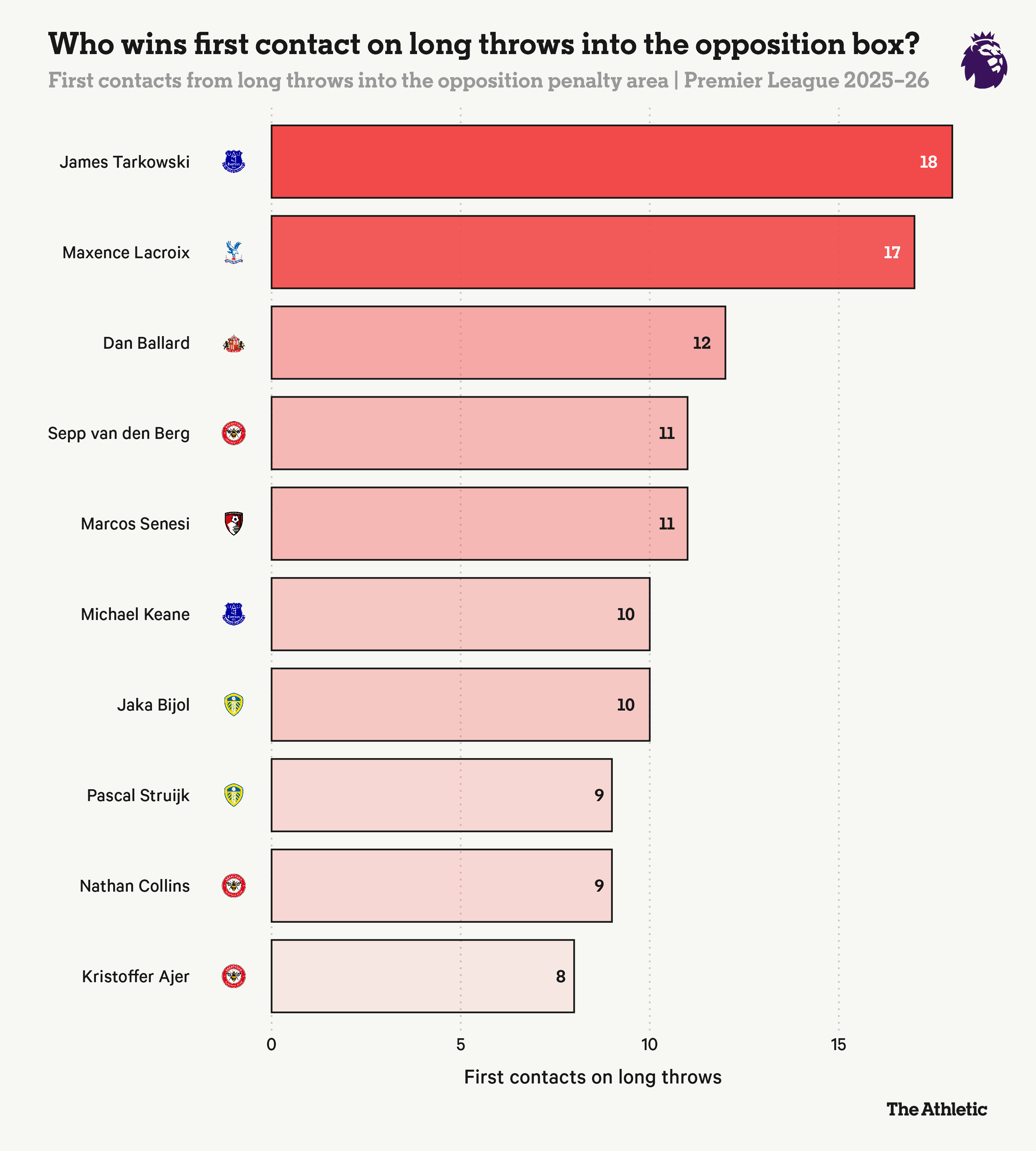
Lacroix is up there again. But the interesting figure is Tarkowski, who has made a career out of being a target for attacking set pieces, particularly under Sean Dyche at Burnley and Everton.
It’s worth pointing out that, on the previous graph, Tarkowski was on 21 first contacts in both boxes — and now, fully 18 are in the opposition box. It’s no surprise to see Sunderland’s Dan Ballard up there too, and no fewer than three Brentford defenders.
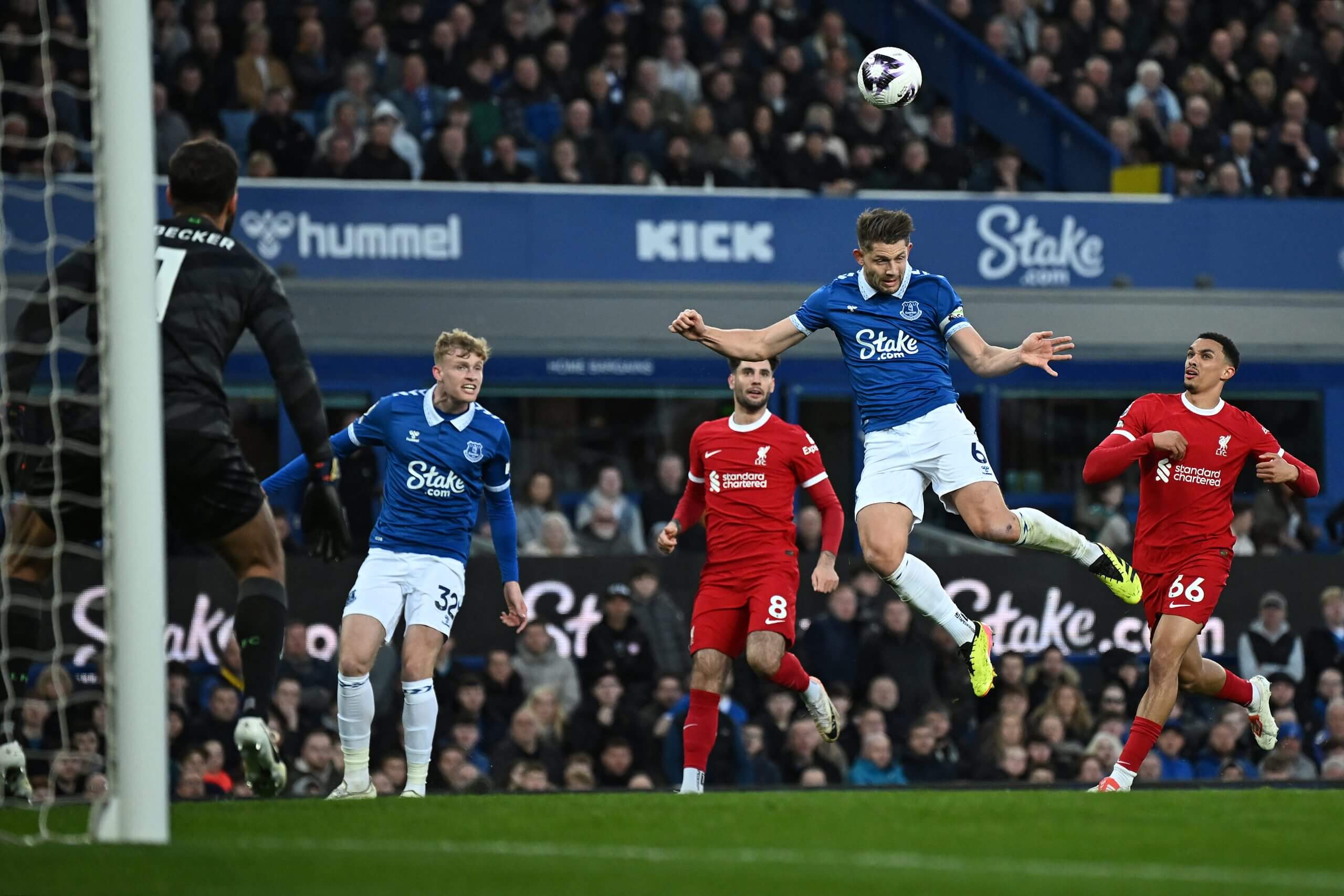
Everton’s James Tarkowski wins the most attacking long throws (Paul Ellis/AFP via Getty Images)
But, on the subject of Brentford, where is Thiago, who has won 17 first contacts overall and was the best-ranked striker in the Premier League in terms of overall first contacts?
Well, let’s look at the defensive numbers.
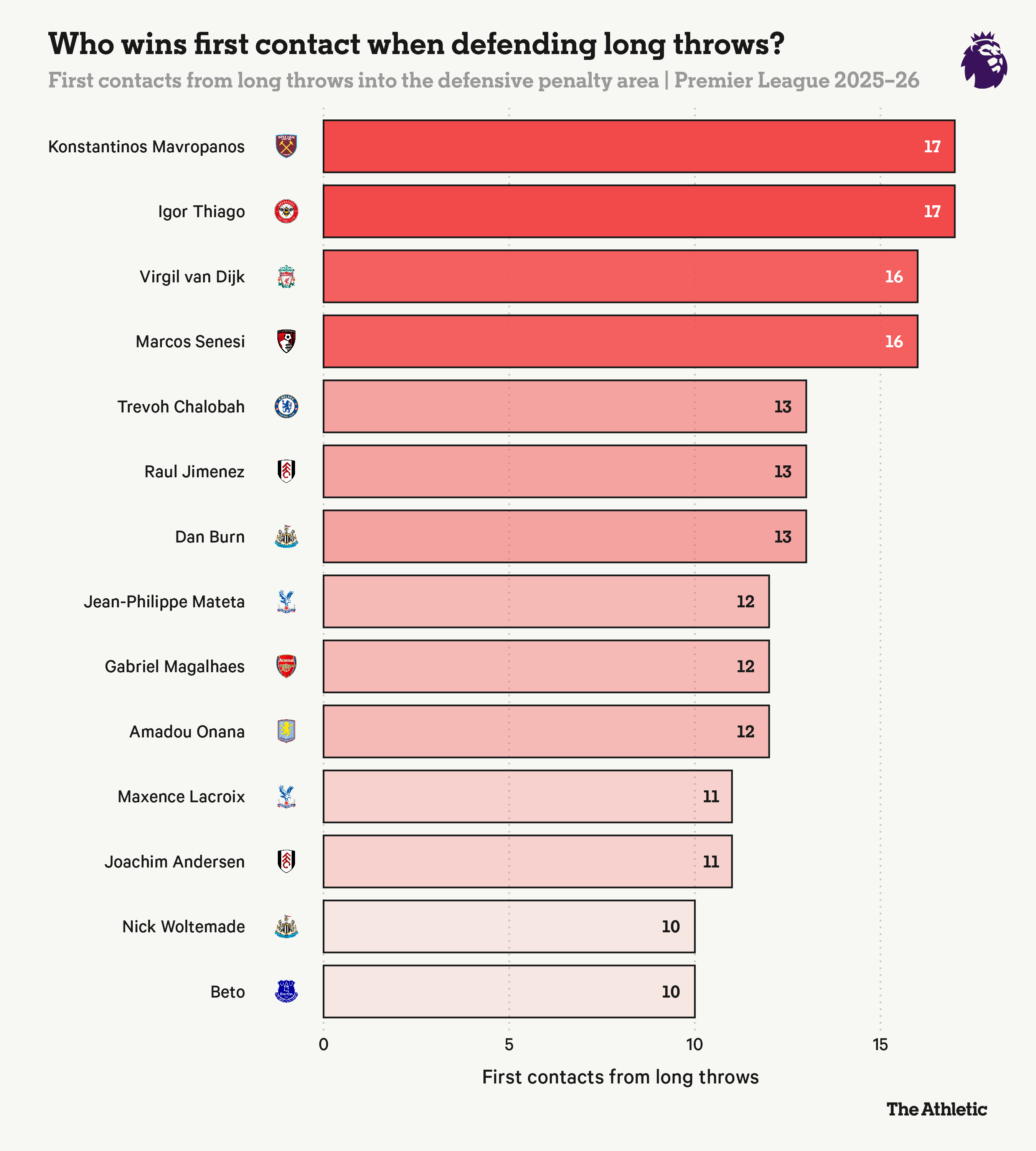
And there he is! Remarkably, despite being such a dangerous striker — the Premier League’s second-top goalscorer this season — all 17 of Thiago’s first contacts from long throws have come inside his own box.
Alongside West Ham’s Konstantinos Mavropanos, who has played a superb battling role at the heart of the Hammers’ defence in recent weeks, the Brazilian is the best in the Premier League, defending the near post diligently.
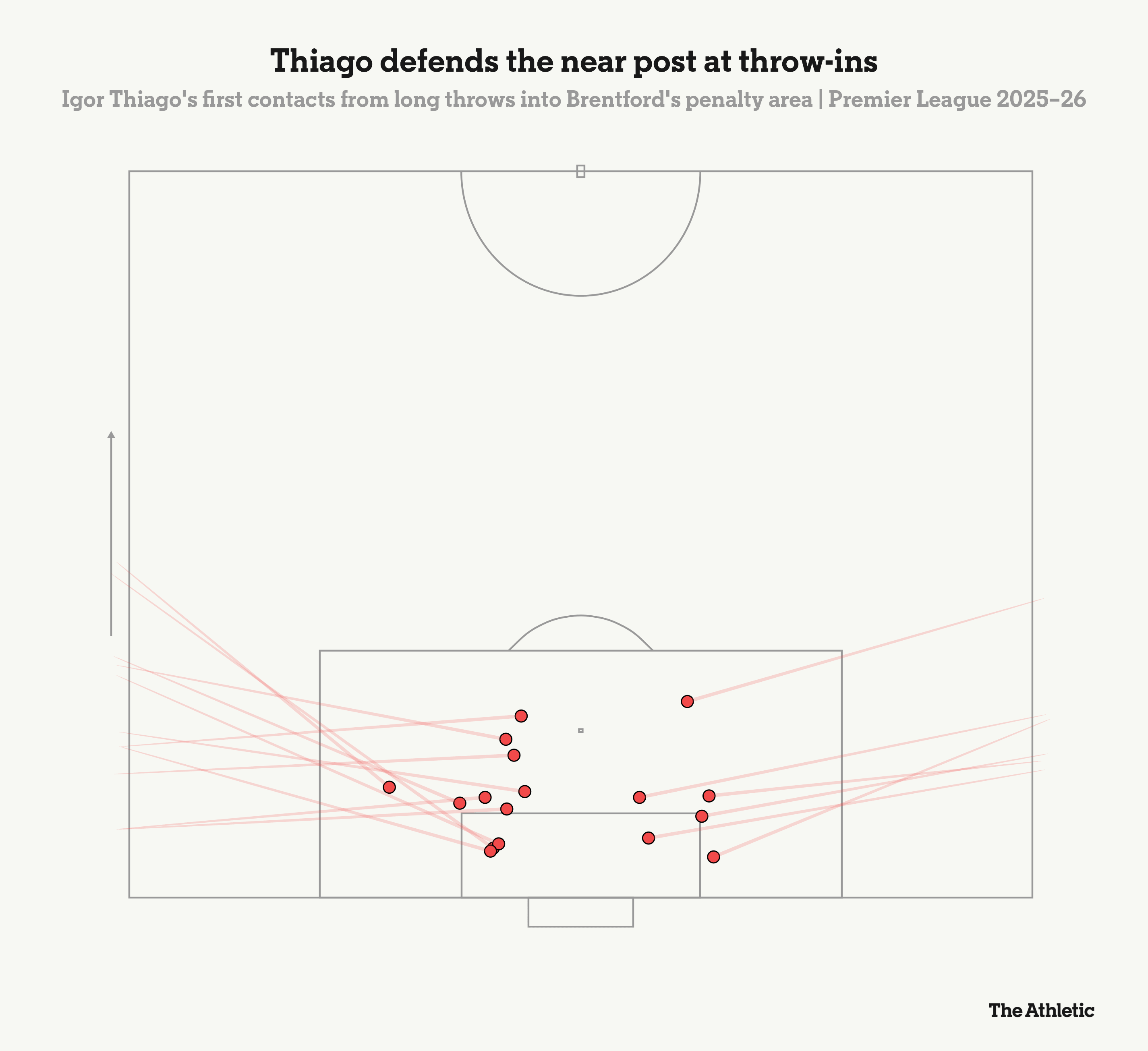
It’s not necessarily strange for a striker to allow team-mates to challenge for the first balls in the opposition box — someone like, say, Jermain Defoe or Michael Owen would have been the same. But they wouldn’t be the league’s best defender at clearing throws. In other words, Brentford’s best attacking players at throws are defenders, and their best defensive player at throws is their main attacker.
It seems likely Brentford put more time into these situations than anyone else in the Premier League — their manager, Keith Andrews, was the club’s set-piece coach last season — so it’s clearly a deliberate tactic.
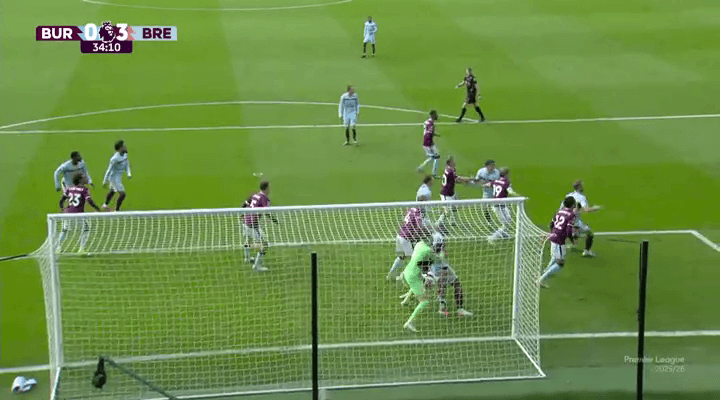
Thiago has specific roles in both situations. The reason he never wins the first ball at attacking throw-ins is that he’s tasked with blocking the opposition goalkeeper, as for this goal against Brentford.
It was a similar situation against Arsenal, when Kayode’s constant long throws caused Arsenal serious problems and eventually brought an equaliser.
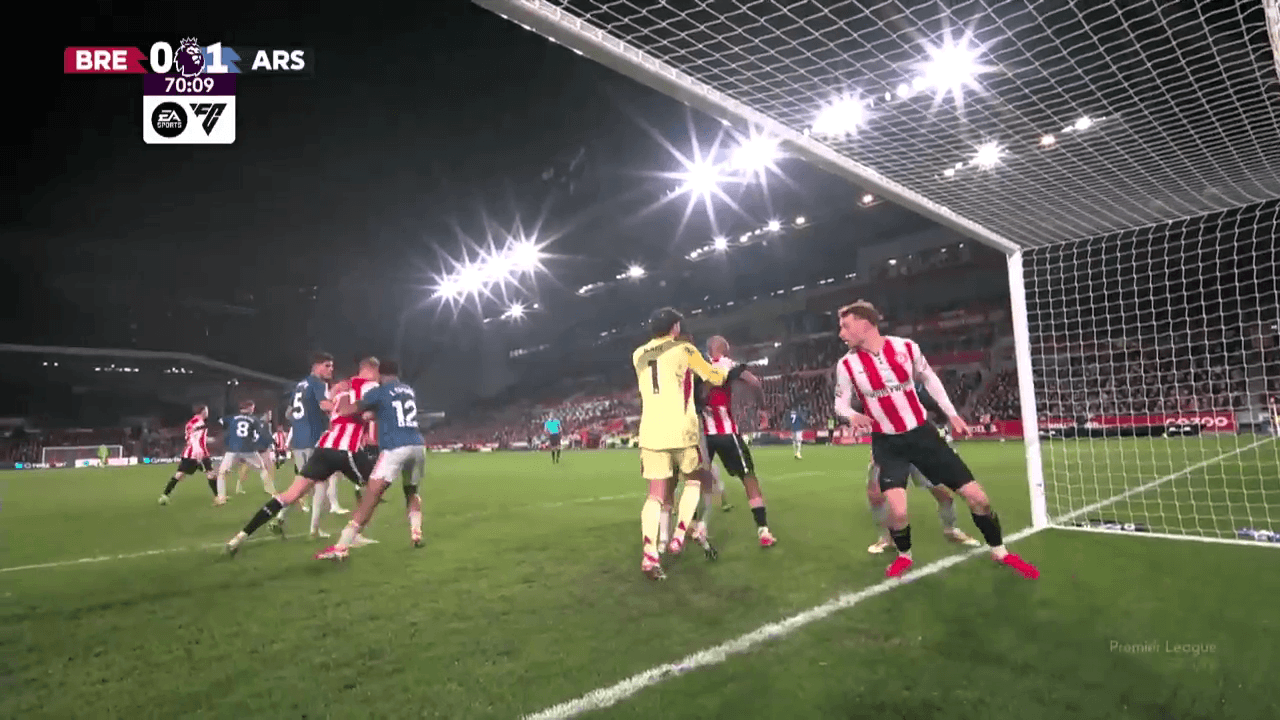
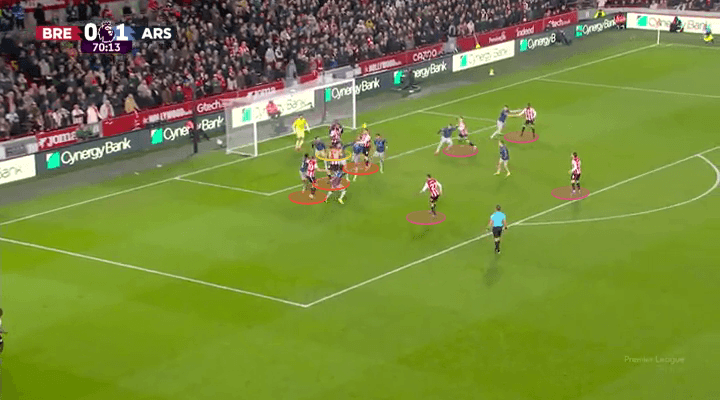
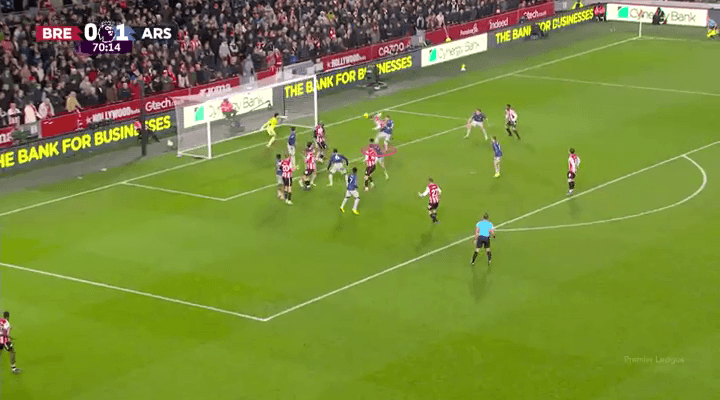
That throw was a good example of Brentford’s approach. Thiago (highlighted in yellow below) is assigned to blocking the goalkeeper, although here he was shepherded away from David Raya by Cristhian Mosquera.
Three players at the near post (highlighted in red) are tasked with winning the first ball, and another four (highlighted in pink) are tasked with winning the second ball. This was textbook: Sepp van den Berg got the first contact, and Keane Lewis-Potter raced in to head home.
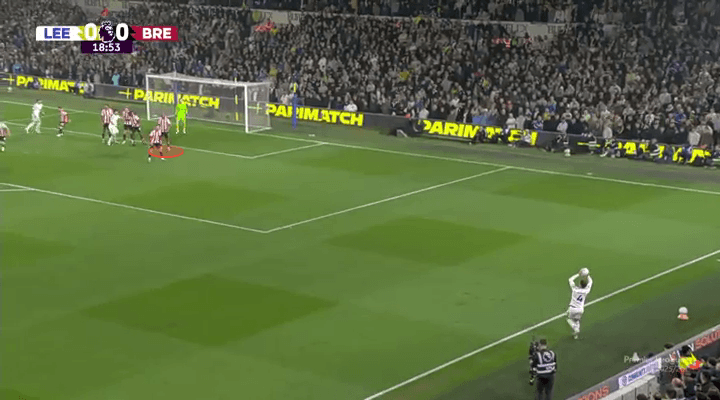
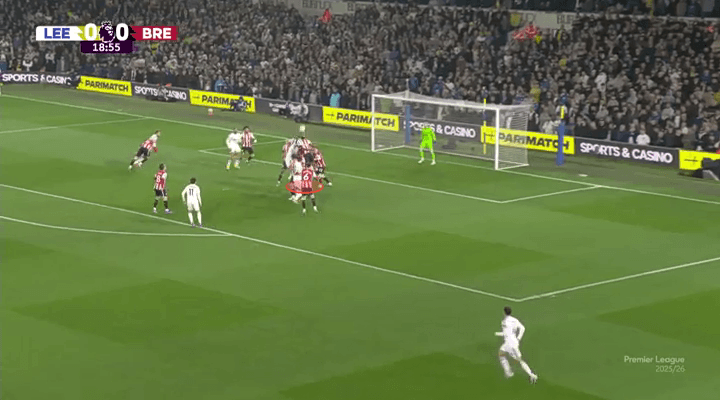
Defensively, Thiago is at the near post and generally free from marking opponents. That gives him a free run to head the ball clear.
He did this so successfully against Leeds in a recent 0-0 — and is clearly the best in the league overall — that it’s probably worth opponents trying to block him off, effectively giving him a taste of his own medicine.
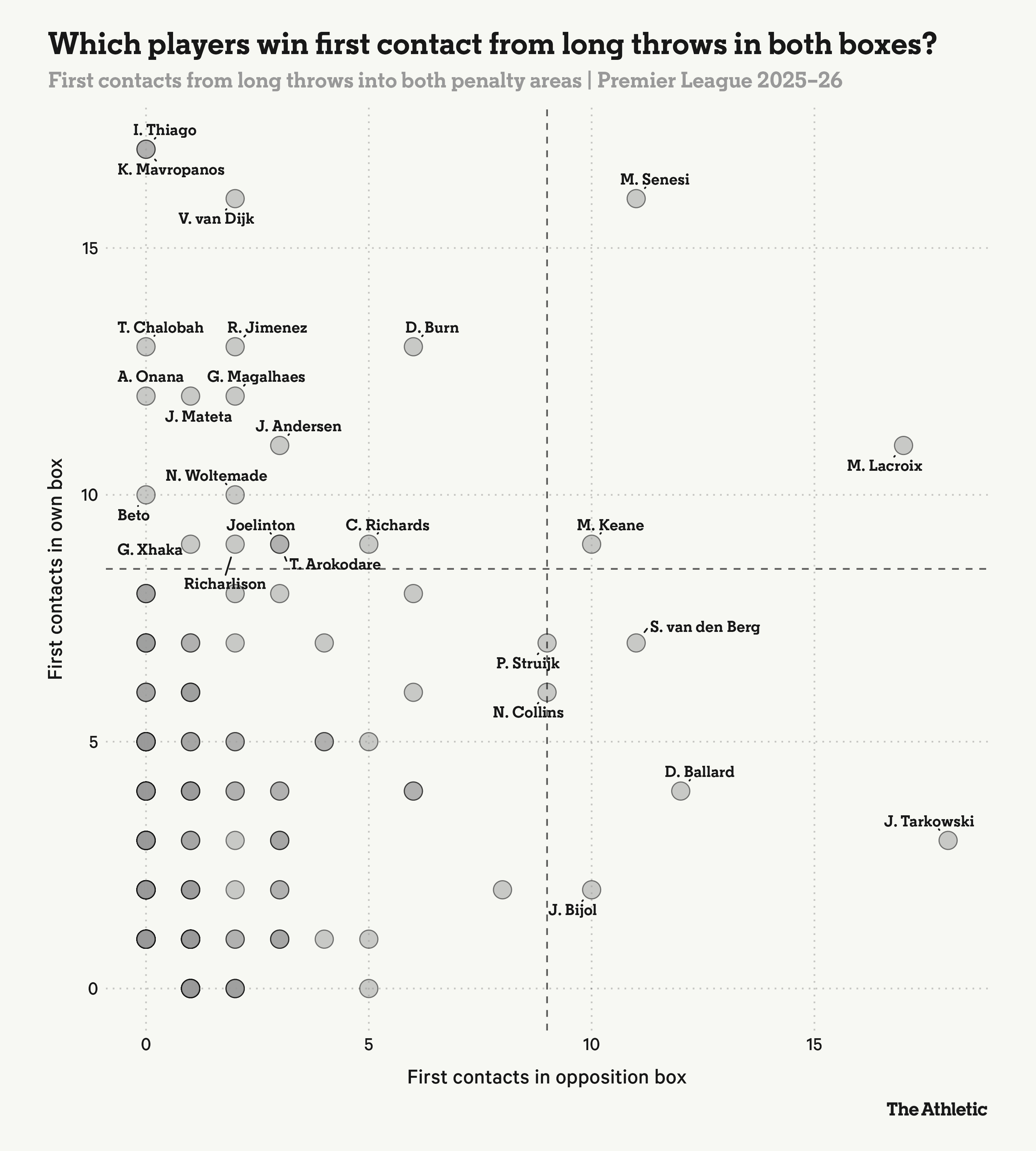
Below is a scatter graph to show the different types of players in these situations.
Senesi, Lacroix and Everton’s Michael Keane contribute at both ends. Tarkowski, Ballard and those in the bottom-right are all about the opposition box. Thiago, Mavropanos and Virgil van Dijk are largely effective inside their own box.
This weekend’s fixture list includes a meeting between Brentford and Everton.
Clearly, Thiago versus Tarkowski is likely to be a key battle at both ends: the centre-forward versus the centre-back in open play, but at throw-ins it’s a role reversal, with Tarkowski the league’s best at winning the first contact in the opposition box, and Thiago the defensive equivalent.