
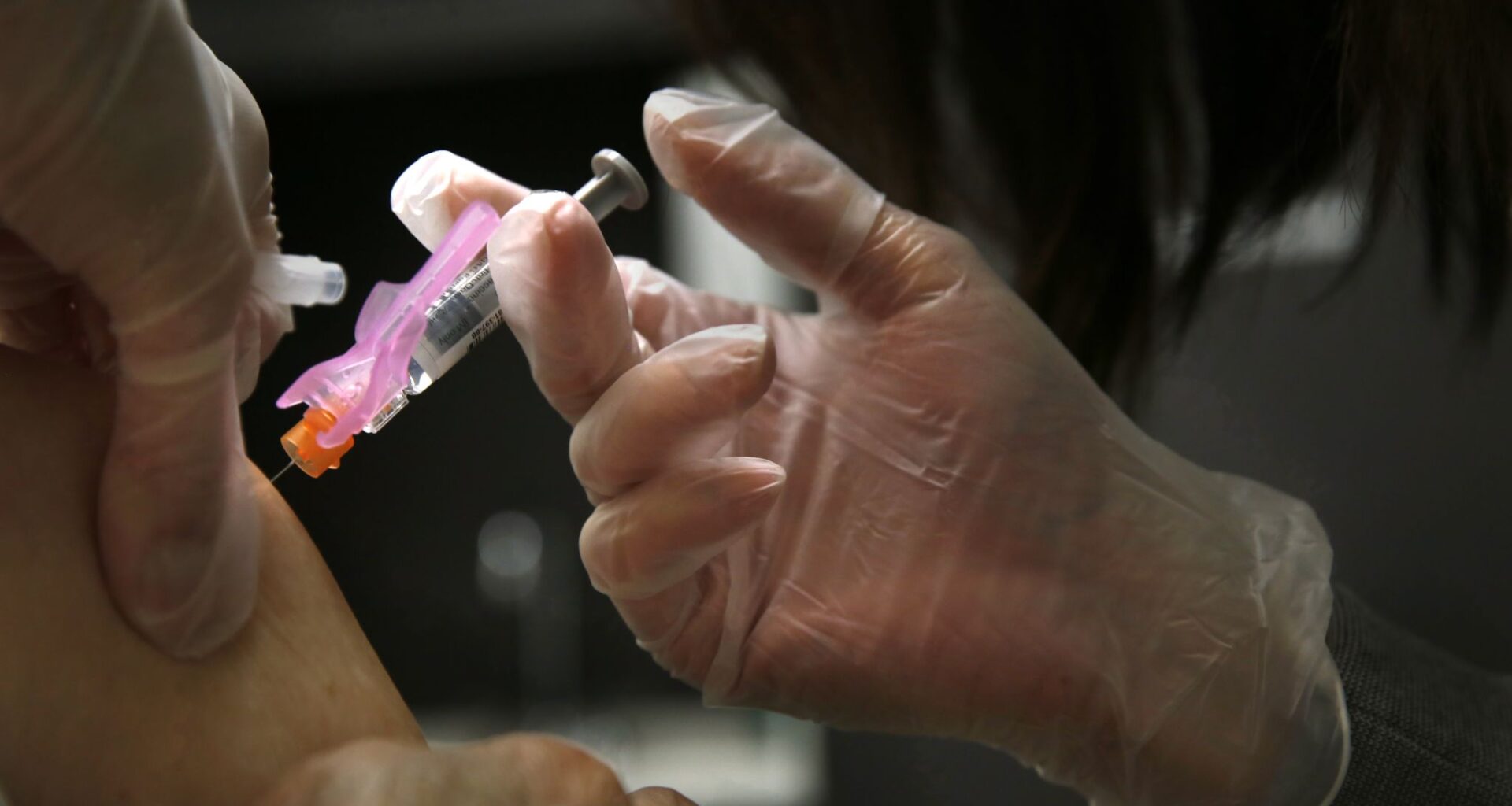
The high dose flu vaccine recommended for people 65 and older may be tied to a reduced risk for Alzheimer’s, new research says.
Liz Hafalia/S.F. ChronicleAdults 65 and older who received the high-dose flu vaccine had a 15% to 20% lower risk of developing Alzheimer’s over about two years compared to those who got the standard-dose vaccine, according to a study of 165,000 people.The study adds to research suggesting some vaccines, including for shingles, may help lower dementia risk in older adults.Experts emphasize that all adults 65 and older should get a flu vaccine, regardless of the dose, to reduce flu-related illness and death.
The high-dose flu vaccine recommended for older adults could come with a bonus, new research shows: It may help lower their Alzheimer’s risk compared to the standard-dose flu vaccine.
Because immune function wanes with age, the high-dose flu vaccine — which has four times the antigens contained in the standard-dose vaccine — is recommended by the CDC for all adults 65 and older, and experts say they should get it if it’s available.
Article continues below this ad
The study, published this month in the journal Neurology, found that adults 65 and older who got the high-dose influenza vaccine had a roughly 15% to 20% lower risk for Alzheimer’s over roughly two years compared to their peers who got the standard-dose vaccine.
The findings are limited, and experts say it’s too soon to recommend the high-dose shot for this purpose alone. But the study adds to the body of research suggesting that some vaccines — particularly for shingles — may help lower dementia risk, potentially by lowering overall inflammation in the body and brain.
The study, led by researchers at McGovern Medical School at the University of Texas Health Science Center at Houston (UTHealth Houston), included about 165,000 adults aged 65 and older. About 121,000 received the high-dose vaccine and 44,000 received the standard-dose vaccine between 2014 and 2019. They were followed for about three years after vaccination.
San Francisco Chronicle Logo
Make us a Preferred Source to get more of our news when you search.
Add Preferred Source
Whether vaccines can reduce dementia risk — in addition to their main function of protecting against infectious diseases — is a topic of intense interest and research.
Article continues below this ad
Several studies show that the shingles vaccine may help reduce dementia risk, including a Stanford-led study published last year that found that older adults who got a shingles vaccine were 20% less likely to develop dementia in the subsequent seven years than those who did not get the vaccine.
• Read more: Getting shingles vaccine can cut risk of dementia, new Stanford-led study says
It’s not clear why the shingles vaccine appears to protect against dementia. But researchers hypothesize that because shingles causes neuroinflammation — which is thought to contribute to dementia — reducing that inflammation could lower dementia risk. A similar effect may apply to the flu vaccine.
“The vaccination turns on your ability to make antibodies against the virus. But we think as a side effect, the activity in the arm has a modulating effect on the brain, on inflammatory cells,” said Dr. Paul Schulz, a professor of neurology at McGovern Medical School at UTHealth Houston who led the study on the high-dose flu vaccine. “If you modulate the immune system in the brain, you could have a beneficial or deleterious effect on Alzheimer’s.”
Schulz led a previous study that found that older adults who received the standard-dose flu vaccine had a 40% lower risk of Alzheimer’s over a four-year period compared to their peers who did not get vaccinated.
Article continues below this ad
The latest study alone is not strong enough evidence to recommend that everyone 65 and older get the high-dose flu vaccine for the purpose of reducing dementia risk, experts said. It’s more important that older adults get the flu vaccine, period, to lower the risk of flu-related illness and death, which is much more common in older adults than younger people.
“There are many other good reasons to take the flu vaccine,” Dr. Ashwin Kotwal, an associate professor of medicine at UCSF Division of Geriatrics who was not involved in the study. “Dementia risk is probably not at the top of the list.”
The study was a type of observational analysis known as a target trial emulation, not a randomized controlled trial, and there could be other confounding factors that impact participants’ dementia risk. People who got the high-dose flu vaccine, for instance, may be more likely to have access to higher quality health care and be more proactive about their health in general.
“(Target trial emulation) studies are useful and helpful and should guide randomized controlled trials, but are not the same thing as a trial, and at this point wouldn’t change my clinical practice,” Kotwal said.
And the three-year follow-up period may have not been long enough to capture those who developed dementia later. Often, people who develop dementia can go years or even decades without showing symptoms, Kotwal said. And other factors that contribute to dementia risk — diet, exercise, social connections — likely must be changed or shaped much earlier in life to have an impact.
Article continues below this ad
“Typically when we think about risk factors, or interventions to reduce the risk of dementia, we’re thinking about having to intervene much, much earlier,” Kotwal said.
The bottom line for older adults is they shouldn’t worry too much if the high-dose version of the flu vaccine is not readily available in their area.
“The high-dose is slightly more effective than the lower dose” for preventing flu deaths, Schulz said, “but they’re both much more effective than not getting it.”