
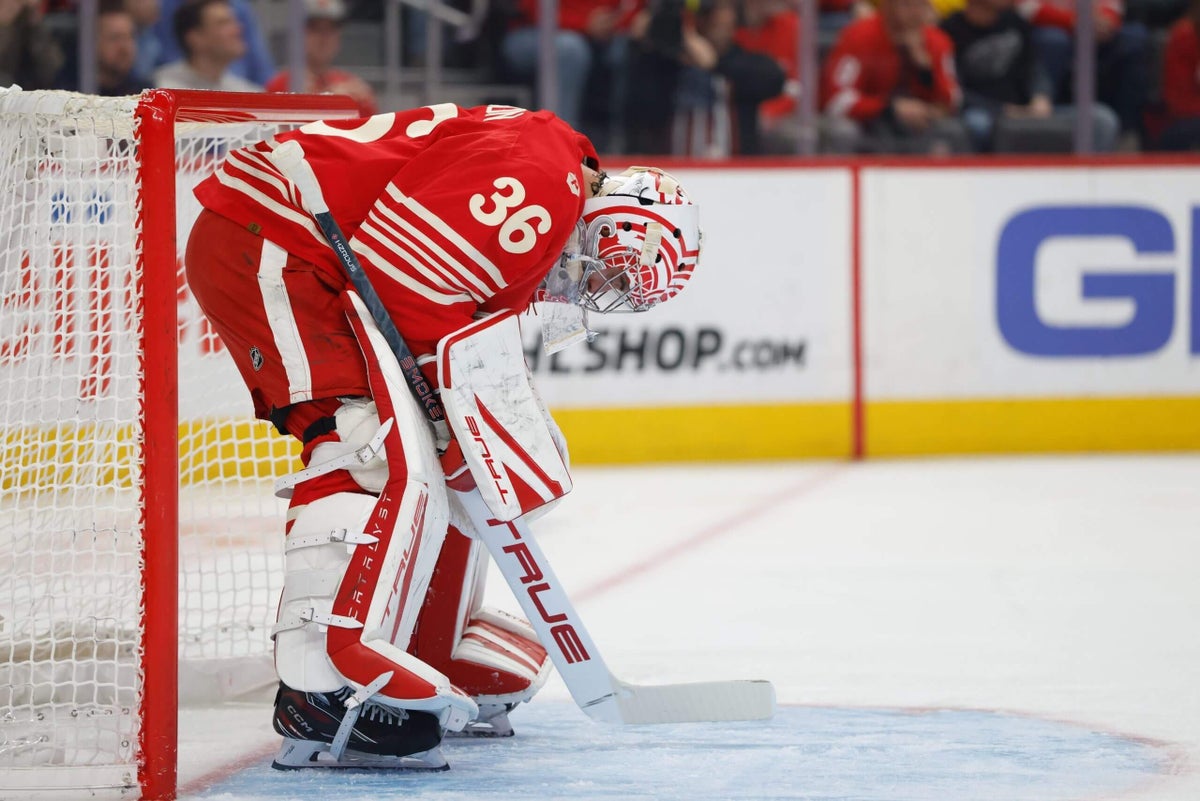
DETROIT — As the 2025-26 Detroit Red Wings skated off the Little Caesars Arena ice for the final time, the last sound they heard was boos.
There had been some cheers moments earlier, as the players gathered at center ice and saluted the crowd (as well as retiring radio analyst Paul Woods). But on a night when the Red Wings officially took over the title of the longest active playoff drought in the NHL, after being mathematically eliminated with a blown lead and a 5-3 loss to the New Jersey Devils, it was 10 years of frustration and disappointment that carried the moment.
“This is Detroit. This is Hockeytown,” Red Wings head coach Todd McLellan said. “I’ve been lucky enough to be on the other side of it, when they couldn’t stop cheering for this team. And they’re dying for that, they crave that. That’s what they want. And I don’t even know if they want a Stanley Cup Championship anymore. They just want a team that’s going to come in and give them something to cheer about.”
The Red Wings want that too, of course. Star defenseman and alternate captain Moritz Seider could be seen fighting back emotion on the ice after the buzzer, and in the locker room, two of the Red Wings’ other leaders — captain Dylan Larkin and alternate captain Lucas Raymond — were left sullen as they tried to process the raw grief of a 10th straight lost season.
“It’s been too many years in a row now where we’ve been right there and just haven’t been able to get it done,” Raymond said. “We’ve got to figure it out, and we’ve got to figure it out fast and take that next step. We’ve got to look ourselves in the mirror, everyone in here in this building, and we’ve got to be better than this.”
The early and middle parts of this decade without the playoffs were inevitable, and some were, in fact, by design. Starting in 2017, the Red Wings paid the price for a quarter-century of playoff hockey, and had little choice but to bottom out to try and kick-start a new competitive cycle. The losing wasn’t enjoyed in those years — it never is — but it was accepted as part of a bigger picture. Even when Detroit hit rock bottom as the NHL’s worst team in 2020, fans understood that it was all in service of a brighter future.
But patience always expires at some point — both for the fans and for the franchise, which fired head coach Jeff Blashill after the 2021-22 season, signaling a shift in how the Red Wings would be judged. It was still about young players and draft picks to an extent, but it also became about progress.
There was some that first year, in 2022-23, going from 74 points to 80 under new head coach Derek Lalonde. Then there was a surge in 2023-24, when Detroit came within a tiebreaker of the playoffs after adding exciting offensive talents Alex DeBrincat and Patrick Kane. More telling, there were consequences when progress stalled: General manager Steve Yzerman fired Lalonde at Christmas after a brutal start in 2024, bringing in McLellan for a shot of adrenaline that revived the season, even though they still came up short.
The Red Wings missed the playoffs all of those years, of course, and were left disappointed every time. But in each case, you could point to something that made it feel like things were still moving forward. Or could be.
That’s what makes this latest miss different. The Red Wings now feel stuck.
Technically, there are still two games left in this season, and if Detroit can manage just one point out of a possible four against the Tampa Bay Lightning and Florida Panthers, it will amount to the highest they’ve achieved during the last decade. And yet, with the way this season ended — with yet another collapse in March, this time after being tied for the conference lead in late January — there is very little solace to be drawn from any of that.
“It does undercut it,” Larkin said. “Progress, yes. It doesn’t feel like it right now, though. That’s for sure.”
The players have heard the frustration. And more than that, they’ve felt it. They know what happened down the stretch, even after desperately trying to change the narratives around their late-season play.
“We all know it, right?” Larkin said. “Marches and late seasons … when it gets tight, we come up short. And we’ve talked about it, we’ve tried different things, and it happened again this year.”
“It all kind of feels the same, to be honest with you,” Raymond said. “You miss it, you miss it. You don’t really care how close you are. The only thing you care about is getting in. We had all the tools to do it.”
This remained a flawed Red Wings roster, particularly when it came to five-on-five scoring, and that will be one of the first places to look when the offseason begins. But this was still almost certainly the best group of players Detroit has had in the last decade, and it was capable of more than it achieved.
Injuries played a role, as some of Detroit’s key players were playing through various injuries down the stretch, but based on where they stood in late January, at the Olympic break, or even at the start of March, the Red Wings should have been able to end the drought this year, through it all. It was within their power, just as it was within their power to stay alive Saturday — when they led 3-2 midway through the third period, only to give up three goals (one an empty-netter) in the final nine minutes to functionally end their season.
Having it in their grasp and letting it slip only adds to the sting.
“Put ourselves in a great spot and a lot of good things,” Larkin said. “But just didn’t do what we set out to do, to make the playoffs and continue to build this thing.”
Now the Red Wings are left with a much tougher task: figuring out where to go from here.
When the story feels so familiar, year after year, the idea of running it all back and hoping for better results is hard to sell. There are young players on the way, yes — and some already on the roster who will get better, too — but can Detroit really continue to bank on that as the main driver for improvement?
After how familiar the team’s undoing this year looked, it hardly seems so.
“When we went to training camp, we had three goals in mind,” McLellan said. “One was to get physically harder to play against. The second was to build up the resilience and the mental toughness. And the third one was game management. And I thought we were making gains in those areas. But since the Olympic break, we didn’t have much of that, and it ended up costing us. So that starts with me, that starts with the coaching staff. That’s on us.”
Really, it’s on everyone — the coaches, the players, and the people who picked both. We will hear from Yzerman soon enough on how he diagnoses these issues and how he wants to proceed from here.
But what is clear right now, as the Red Wings move into sole possession of the distinction no one in the NHL wants, is that where they are isn’t good enough. The pressure is growing, and the players are feeling it.
“I don’t know if I sensed, at training camp, the outside pressure to try and work on the mind and the resilience and the mental toughness — or whatever catchwords you want to use,” McLellan said. “But I felt a little bit of that last year. I’ve lived a year of it now. Yeah, it’s there, but we keep earning that. We earn that pressure and that outside (frustration). But you can accept the pressure as a challenge, or you can succumb to it. And we seem to choose the second one. So, that’s the way it is. And the only way you get out of it is you work your way out of it.”
Now, with another season lost, that work begins again.