


The woman suffered an extreme reaction (Image: Jam Press)
A woman was left with severe blisters and scarring on her face, neck and torso after being prescribed a common drug. The 42-year-old who has not been named, suffered the rare reaction after being given lamotrigine by a doctor to treat depression.
The drug, often used to treat conditions such as epilepsy and bipolar disorder, is issued millions of times a year in the UK with as many as two million people thought to take it in the United States. The woman first developed symptoms around three weeks after taking the drug, before progressively getting worse. She was rushed to hospital in São Paulo, Brazil where she was admitted to intensive care after her face was almost entirely covered in painful blisters and burn-like markings.
READ MORE: BBC’s Louise Minchin told terrifying words by doctor after health battle
READ MORE: Wes Streeting slammed for NHS strike ‘spiral’ – ‘it’s patients who suffer’
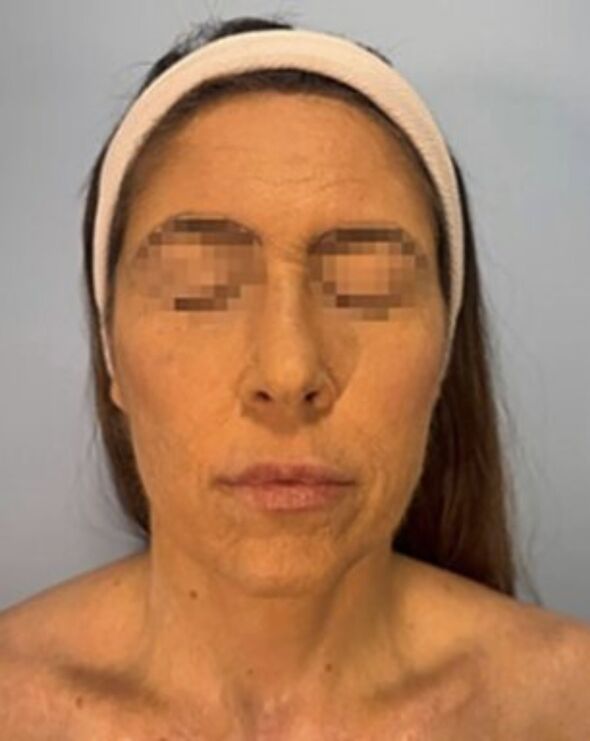
The woman eventually made an ‘excellent’ recovery (Image: Jam Press)
On her first day in hospital, her face was covered in painful, open lesions. Within 24 hours, her skin had turned a deep purple and begun to peel away.
By the fourth day, it had blackened entirely, with severe, burn-like damage concentrated around her mouth.
In the early stages of treatment, her condition appeared to worsen as layers of skin continued to break down.
Doctors administered multiple antibiotics and used an antibacterial biomaterial to help repair the damaged tissue.
After four days, there were the first signs of progress, with her condition slowly beginning to stabilise under close monitoring.
A month later, her face had started to heal — though significant scarring remained.
She spent a total of 66 days in hospital as her skin gradually recovered.
At a follow-up six months after discharge, doctors described the healing of the affected areas as “excellent”.
The NHS website lists a rash as a common side effect of lamotrigine alongside a range of other symptoms.
In extreme cases, a possible serious side effect of lamotrigine can include skin reaction, such as a round, slightly raised rash (erythema multiforme), painful blisters (Stevens-Johnson syndrome), or peeling skin.
In 2016, a man was diagnosed with Stevens-Johnson syndrome (SJS), a form of toxic epidermal necrolysis which causes the skin to peel off the body, after taking the drug lamotrigine.
Christopher Wooll, who was 21 at the time, told how he had to battle a series of complications that at one point stopped him breathing.
He explained how he developed flu-like symptoms which progressed into something worse.
He said: “I did not really think anything of it at first, but the next day at work my face and eyes began to swell up.
“When I got in the car to go home I had blood blisters in my mouth and on my lips. It was pretty scary.”
The next day the family went to Warwick’s A and E department twice, before Mr Wooll was admitted in a deteriorating state.
He was losing his vision and the blisters and burns across his body were spreading, and he was put in the intensive care unit.
Mr Wooll suffered blistering on his entire body with skin peeling off, multiple organ failure, corneal defects, two episodes of sepsis, low blood pressure, and he lost a total of 25 kgs.
He was later released from hospital but was told that his recovery would take months.