
For more than half a century, the Moon has been close enough to haunt the night sky but far enough to feel untouchable.
Artemis II changed that. NASA’s first crewed lunar mission since Apollo didn’t land, but it did something just as important: it proved – out loud, in public, with four human beings riding inside a brand-new spacecraft – that the whole chain still works.

Launch, deep space, a lunar flyby, and a hot, violent return through Earth’s atmosphere, ending with a Pacific splashdown and a cheering homecoming in Houston characterized this epochal mission.
The crew – commander Reid Wiseman, pilot Victor Glover, mission specialist Christina Koch, and Canadian Space Agency astronaut Jeremy Hansen – also made history.
The Artemis team included the first woman, the first person of color, and the first non-U.S. citizen to fly to the Moon.
The lap that pushed past Apollo
Artemis II’s flight profile was designed to be bold but practical: go around the Moon, stress-test Orion in deep space, and come home.
Over the course of the mission, the astronauts voyaged deeper into space than the Moon explorers of decades past, setting a new distance record that surpassed Apollo 13.
At their farthest point from Earth, Orion reached 252,756 miles (406,771 kilometers) away. That distance matters because it reflects the mission’s trajectory and the confidence NASA has in Orion’s systems and navigation.
The mission produced the kind of visceral imagery that makes spaceflight feel real again, including views of the Moon’s far side “never witnessed before by human eyes.”
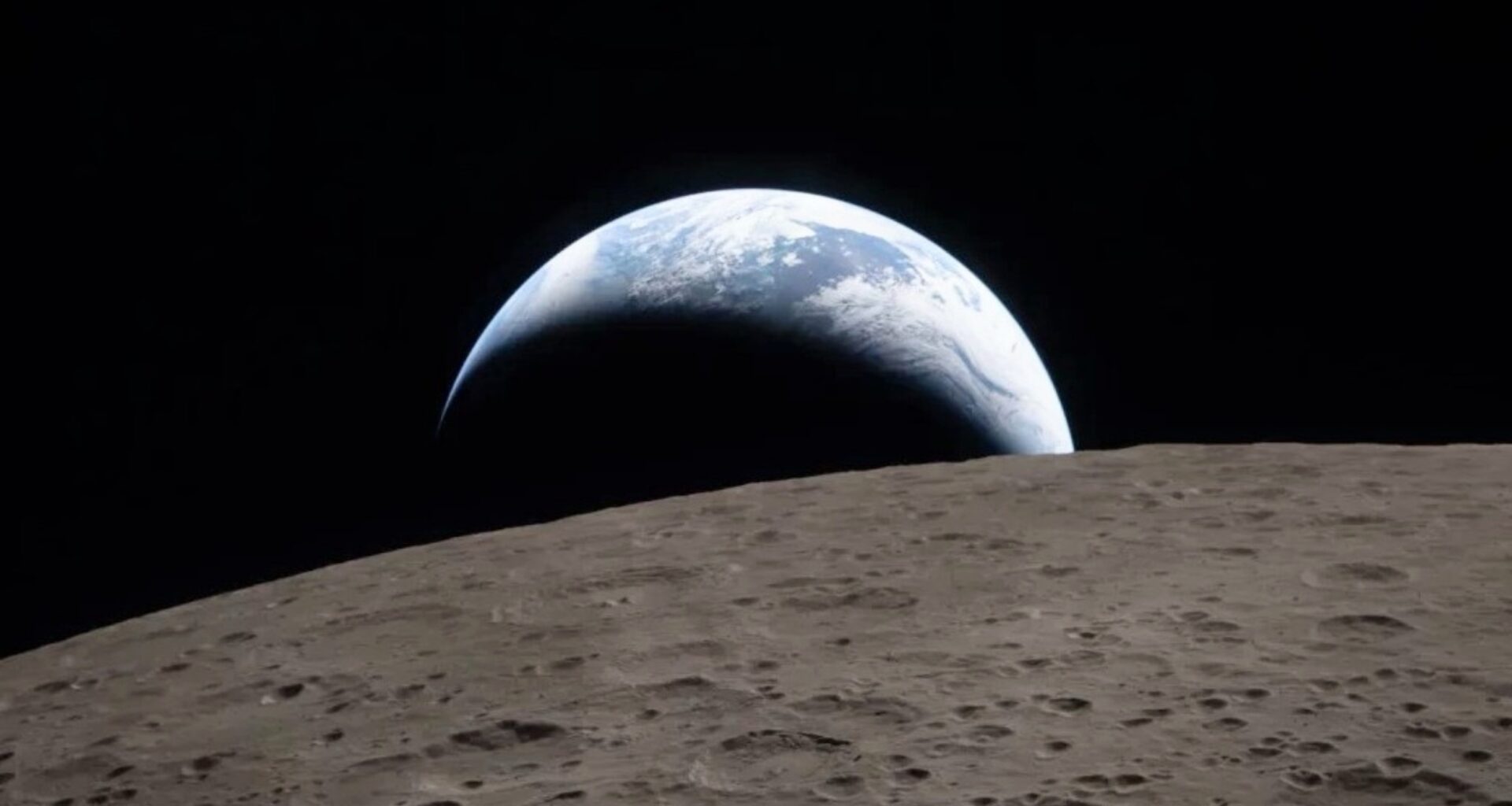
The astronats also delivered a striking “Earthset” photo showing our planet dropping behind the Moon’s gray horizon – an echo of Apollo 8’s legendary Earthrise.
And because space likes to show off when humans visit, Artemis II also caught a total solar eclipse as part of its cosmic scenery.
A deeply emotional experience
A mission can be technically flawless and still feel sterile. Artemis II was not sterile. The astronauts were openly emotional about what they were seeing and what it cost to get there.
“This was not easy,” Wiseman told the crowd in Houston. “Before you launch, it feels like it’s the greatest dream on Earth.”
“And when you’re out there, you just want to get back to your families and your friends. It’s a special thing to be a human, and it’s a special thing to be on planet Earth.”
“I have not processed what we just did and I’m afraid to even start trying,” Glover added.
A lifeboat hanging in the universe
Hansen turned the spotlight outward, away from the four people onstage and toward everyone who built the mission and everyone watching it.
“When you look up here, you’re not looking at us. We are a mirror reflecting you. And if you like what you see, then just look a little deeper. This is you,” he said.
Koch described the view in a way that felt less like a press conference and more like someone trying to explain an emotion they didn’t expect.
“Honestly, what struck me wasn’t necessarily just Earth, it was all the blackness around it. Earth was just this lifeboat hanging undisturbedly in the universe,” she said.
Also: space toilets are still a problem. Artemis II “had to contend with a more mundane problem – a malfunctioning space toilet,” and NASA has said the design will be fixed before longer missions.
The show goes on
The mission ended the old-fashioned way: fire-bright reentry, parachutes, and a splashdown.
From there, the crew headed back to Houston, landing at Ellington Field near Johnson Space Center, where they were greeted by a hangar full of NASA personnel and families.
NASA Administrator Jared Isaacman introduced them to a standing ovation. The timing also carried a hit of space history: the astronauts returned to NASA’s Houston base on the 56th anniversary of Apollo 13’s launch, the mission forever tied to the line “Houston, we’ve had a problem.”
Isaacman leaned into the symbolism. “The long wait is over. After a brief 53-year intermission, the show goes on,” he said.
Implications of the Artemis II mission
Artemis II wasn’t a “touch the Moon” mission. It was a “prove we can get there and get back, repeatedly” mission.
It validated Orion with people onboard, not just test dummies and sensors. It validated long-distance operations, communications, navigation, and recovery – at a time when NASA is trying to shift from one-off hero missions to a sustainable cadence.
It also proved something less technical: you can put a crew in deep space in 2026 and still make the world feel it.
A lot of Apollo-era crews were famously all-business in public. Artemis II was different – more open, more personal, and, as Isaacman put it, “wonderful communicators, almost poets.”
What comes next
The mission’s success immediately turns the spotlight to the next flights. NASA is already preparing for Artemis III next year, envisioned as a docking practice mission closer to home, setting up the later push toward a crewed landing near the lunar south pole with Artemis IV in 2028.
NASA has also said it will announce the Artemis III crew soon. There’s still plenty of uncertainty – hardware timelines, funding, politics, and the reality that exploring space always involves risk.
NASA Associate Administrator Amit Kshatriya captured that tension bluntly: “You know what’s at stake,” he said, adding that exploration requires finding “the right line between being paralyzed by it and being able to manage it.”
But Artemis II changed the emotional math. It didn’t just promise a return to the Moon. It performed one. And after 53 years of waiting, that performance landed with the force of proof.
Image Credit: NASA
—–
Like what you read? Subscribe to our newsletter for engaging articles, exclusive content, and the latest updates.
Check us out on EarthSnap, a free app brought to you by Eric Ralls and Earth.com.
—–