
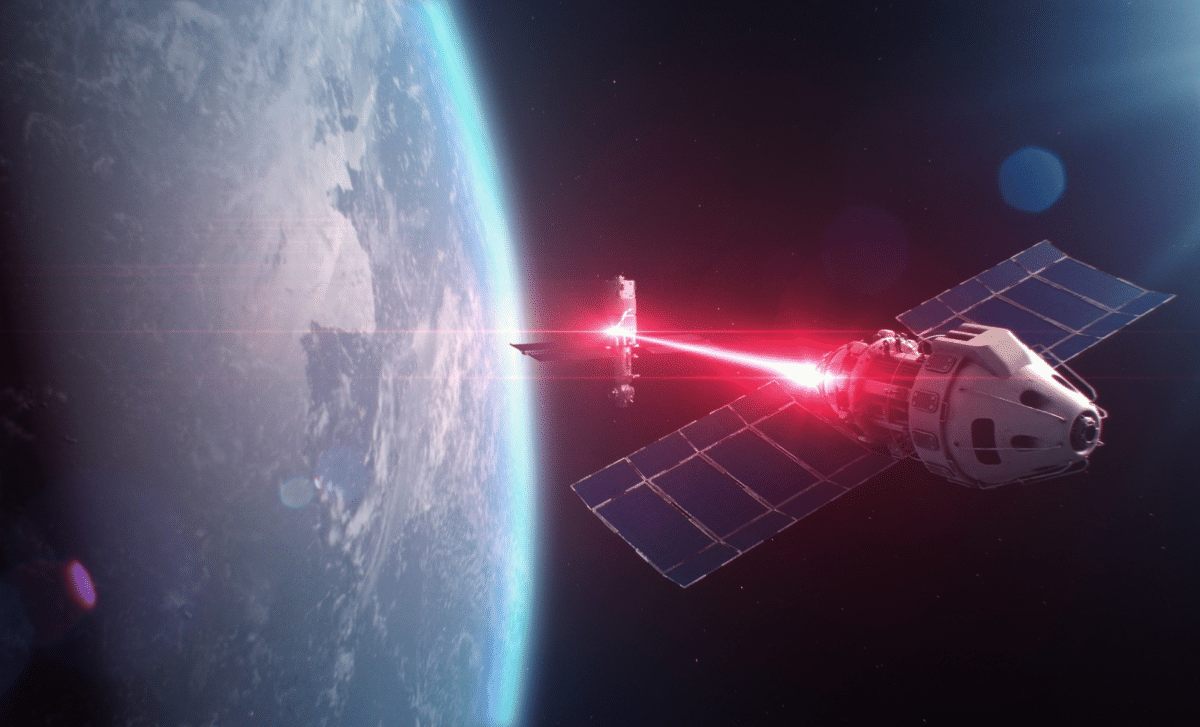
Spacecraft could one day glide through the cosmos without the need for traditional fuel, thanks to a groundbreaking discovery. A new study published in Advanced Science reveals that laser light can propel spacecraft by using graphene, a revolutionary material known for its strength and lightness. This remarkable finding offers a potential pathway to fuel-free propulsion systems, which could drastically reduce the cost and complexity of deep space missions, transforming the future of space exploration.
Revolutionizing Space Travel with Light
The latest study, published in Advanced Science, highlights a stunning breakthrough: laser light can move blocks of graphene aerogel in space. In a series of tests, tiny cubes of graphene foam accelerated under the influence of laser light, a phenomenon that was nearly impossible to replicate under normal gravity on Earth. The material’s response was so pronounced in weightlessness that it offered a glimpse into how light could be harnessed for controlled, precise space travel. This discovery is poised to disrupt traditional propulsion systems, which have long relied on fuel-based technologies.
“We are opening the path to a propellant-free propulsion future,” said Ugo Lafont, materials physics and chemistry engineer at the European Space Agency. The ability to use light to push spacecraft forward without the need for fuel could dramatically reduce the cost and complexity of space exploration.
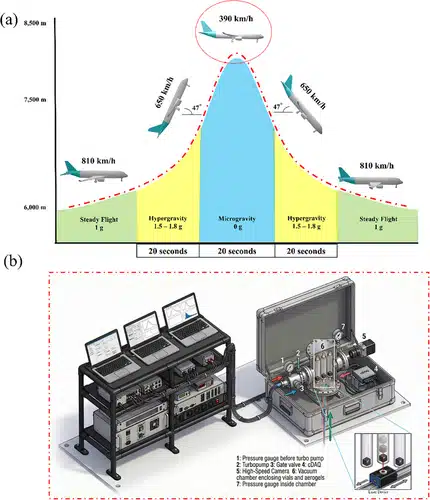 (a) Schematic representation of the parabolic flight. (b) Digital Images of the setup on the plane.
Credit: Advanced Science
The Power of Graphene and Laser Light
Graphene, a wonder material known for its strength and conductivity, plays a key role in this breakthrough. Scientists discovered that graphene aerogels, super-light, porous foams made from graphene sheets, could be moved by laser light when placed in a weightless environment. During a flight experiment in microgravity, graphene cubes accelerated significantly when exposed to laser beams. In contrast, under normal Earth gravity, the same material barely moved.
The tests were conducted in a vacuum tube inside an aircraft designed to simulate microgravity, where the samples were free from the gravitational forces that typically hinder movement. This environment allowed the scientists to measure the material’s response more accurately, revealing how light could be used to move spacecraft with incredible precision.
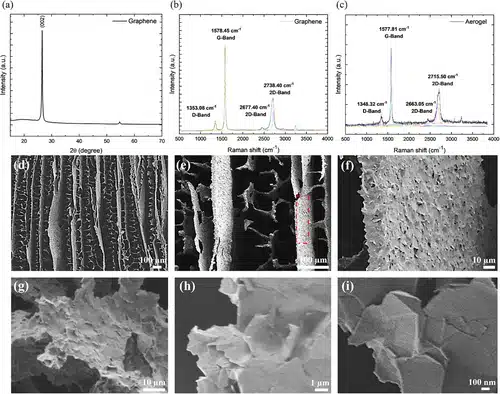 (a) XRD of graphene. (b) Raman of graphene. (c) Raman of graphene aerogels. (d–g) SEM images of AG-20 graphene aerogels. (h, i) SEM of graphene aerogels at higher magnifications.
Credit: Advanced Science
A Step Toward Fuel-Free Space Missions
What makes this discovery even more exciting is the potential it holds for long-term space missions. Traditional propulsion systems rely heavily on fuel, which is expensive and adds significant weight to spacecraft. In deep space exploration, the ability to control spacecraft without needing fuel could greatly increase mission duration and efficiency, all while minimizing costs.
By using light as a propulsion mechanism, spacecraft could potentially adjust their orientation and direction without relying on conventional fuel sources. This could revolutionize how space missions are planned and executed, opening up new possibilities for exploration.