
In Dubai, rows of cars bound for Kyrgyzstan are sitting idle. Aktilik Alipbay uulu, a Kyrgyz importer based in the city, isn’t sure when they’ll move.
“We haven’t received clear information like ‘load now, it will arrive in 35–40 days,'” he says. “So, we are keeping the cars in garages. These are entrusted goods. If something happens at the port, it would mean losses for us.”
Previously, cars shipped by ferry across the Persian Gulf to Iranian ports then traveled overland to Bishkek. With the war in Iran, that supply chain has slowed significantly.
“The strait is not completely closed, cars are still moving, but they are being held in ports for 15–20 days or even up to a month. We are trying to get them out to Kyrgyzstan, but there are serious delays. They are stuck in Iranian ports,” says Alipbay uulu.
“People at the ports are afraid to release shipments because missiles are being fired across the Persian Gulf. That’s why the cargo is being held up. That’s why everything is being held up.”
Shipping Rerouted Over Land
As expected, the launching of US and Israeli air strikes on Iran on February 28 — and subsequent strikes by Tehran on targets around the Middle East — has hit the economies of the region.
Economic shockwaves are also being felt in countries just outside the region, such as those in Central Asia who rely on goods from Iran. And with shipping traffic through the Gulf route slowed, cargo is increasingly rerouted overland, adding time and cost.
Ayzamat Jumabekov, chairman of Kyrgyzstan’s Association of International Freight Carriers, says disruptions from the war in Iran mean that cargo from major distribution centers in places such as Saudi Arabia now takes about an extra 10 days, as shipments are forced onto longer routes to avoid the Strait of Hormuz.
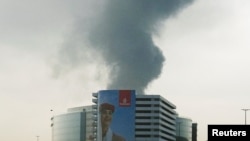
Smoke rises from the Dubai International Airport on March 16, after a Iranian drone hit a fuel tank.
“Previously, we moved goods by sea; now, we are going overland. Saudi Arabia, and then other countries — each has its own rules,” he told RFE/RL.
“A 10-day delay is significant to traders, but it is not our fault. They can see that it depends on the geopolitical situation.”
Those shockwaves reverberate even further as consumers begin to bear the brunt of increase shipping costs through higher prices.
The fighting has blocked overland trade routes, halted the flow of food supplies, and pushed up energy prices for consumers in countries where the average wage rarely rises above $500 a month.
According to the World Bank, Central Asia’s economies grew strongly in 2025, expanding 7 percent thanks to rising household consumption, remittances, and investment.
But the war in Iran is creating new risks. Disruptions to the Strait of Hormuz are driving up energy and trade costs, pushing inflation in Europe and Central Asia (ECA) to 8.1 percent in February 2026 –the highest in the region, according to the Washington-based lending arm of the International Monetary Fund (IMF).
Energy Costs Skyrocketing
Energy-importing countries like Kyrgyzstan and Tajikistan are particularly exposed.
Higher oil prices are straining government budgets, weighing on household spending, and slowing growth. Delays in imports, from cars to food and industrial goods, are adding to inflationary pressures and disrupting supply chains.
The World Bank warns that if the Middle East conflict continues, growth across Europe and Central Asia could slow sharply in 2026, falling to 2.1 percent from earlier projections of 2.4 percent. That would be the slowest pace since 2020.
“Countries like China, India, Japan, and South Korea used to receive much of their oil through the Strait of Hormuz. Now they are turning to Russia, and volumes are increasing day by day,” said Kanatbek Eshatov, president of the Kyrgyz Association of Oil Traders..
“As a result, prices in Russia are rising sharply. We used to buy at $700 per ton; now it is approaching $900.”
Kyrgyzstan depends heavily on imported used cars.
In 2025, around 139,000 vehicles arrived from South Korea, China, Japan, and the United States, often passing through Dubai and Iran’s Bandar Abbas port. Many cars are re-exported to Russia, benefiting Kyrgyz dealers due to favorable tax rules.
Since the Iran conflict started, shipping costs from the UAE have jumped 125–180 percent, from $1,300–$3,000 to $3,500–$6,000+ per car, threatening both domestic sales and re-export profits.
In Tajikistan, ordinary consumers are seeing daily goods become scarcer and more expensive. Food, household items, and construction materials, often transported via the same Iranian corridors, are arriving late.
Zulfiya Sultonova, a resident of Dushanbe, notices the change: “Before, I bought laundry detergent for 50 somoni. ($5) Now it’s 65. It’s been about a week.”
Shopkeepers are struggling to keep their shelves stocked.
Azam Yunusov, the owner of a small store in the Tajik capital, says he has been able to hold the line on prices by selling off goods he had in stock. That has kept prices in check, at least for now, but pressure is building up quickly in the system.
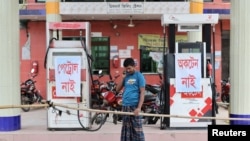
Photo Gallery:
Streets Go Dark, Factories Close As Wartime Energy Crisis Bites
Recent images from around the world show far-reaching impacts of the fuel crisis caused by the war in the Middle East.
“Traders report that prices are beginning to climb as replacements take longer to arrive,” he said.
Before the war, Iran was one of Tajikistan’s top five trading partners, supplying a wide range of industrial and consumer goods and handling nearly $484 million in trade in 2025.
“If the situation does not change, if the war continues, it will drive prices even higher in Tajikistan,” warned Tajik economist Hojimuhammad Umarov.
Some economists also note the flow of goods goes both ways.
Landlocked Central Asia
Landlocked Central Asia has been historically dependent on Soviet-era transport networks that headed north to pass through Russia.
Since the breakup of the Soviet Union, the region has spent the last three decades developing transportation and logistical networks to the south and west. Iranian ports have become a major gateway for goods exported from Central Asia to the rest of the world.
“Efforts to address the impact of the crisis will be needed in many countries, with a focus on targeted measures to protect the most vulnerable,” the World Bank said in its April update of economic forecasts for the region.
“Pressing ahead with policy reforms for firm growth and job creation will also help to mitigate crisis impacts and strengthen economic resilience and dynamism.”
With writing and reporting by Zamira Eshanova