
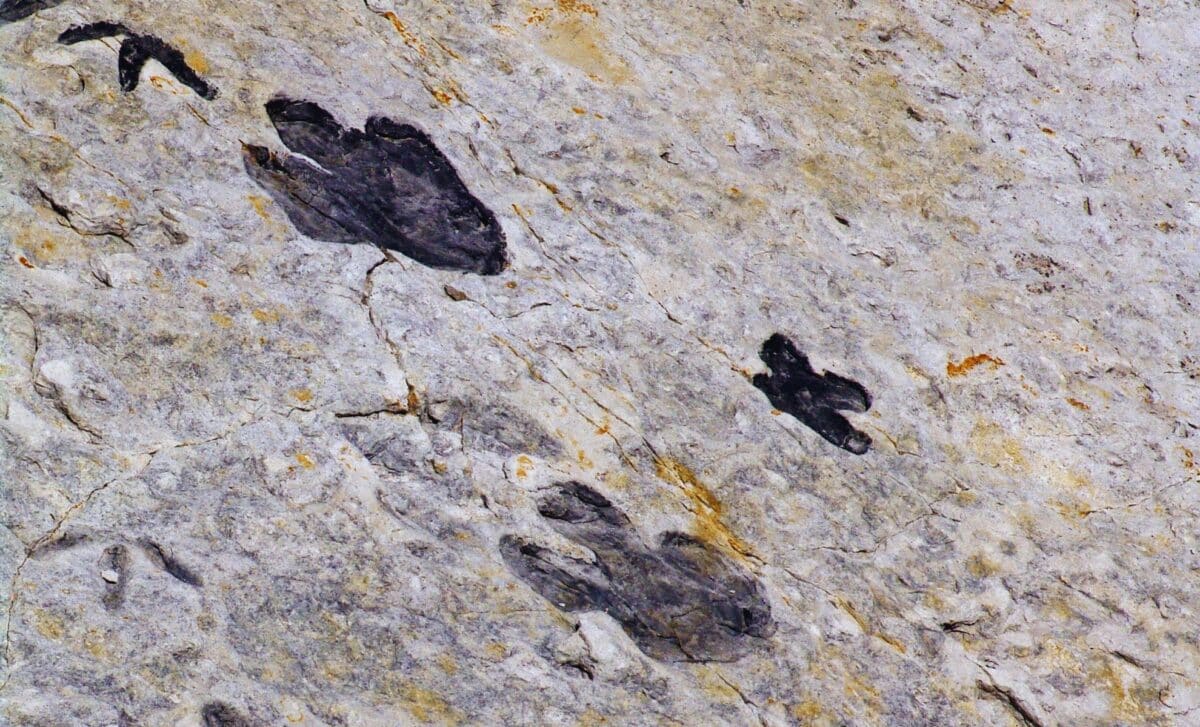
A cluster of 132-million-year-old dinosaur tracks has been uncovered along South Africa’s southern coastline. Found in a small coastal outcrop, these footprints show that dinosaurs were still moving through the area during the early Cretaceous.
Southern Africa is well known for its rich fossil record, especially in the Karoo Basin, where many dinosaur tracks from the Triassic and Jurassic periods have been found. But after massive volcanic eruptions around 182 million years ago covered much of the region in lava, the record becomes much harder to follow.
According to research published in the South African Journal of Science, this event buried earlier track-bearing layers and left very few traces from later periods. That is why evidence from the early Cretaceous has remained so limited until now.
A Small Site Packed With Footprints
The tracks were discovered in the Brenton Formation, near Knysna in the Western Cape. The site is surprisingly small, about 40 meters long and five meters wide, yet it contains more than two dozen probable dinosaur tracks.
As explained in the study led by Charles W. Helm, the find came during fieldwork in early 2025. The team had originally been looking for fossil remains such as a theropod tooth found in the same area years earlier. Instead, Linda Helm, a team member, spotted the first track, leading to a closer inspection and the identification of many more.
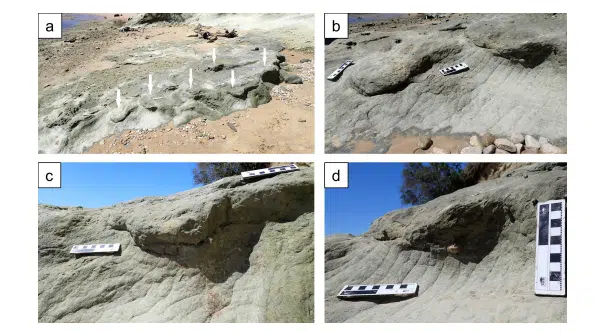 Multi-angle views of Cretaceous dinosaur tracks preserved in the Brenton Formation along South Africa’s coast, showing footprint impressions across flat surfaces and cliff faces. Credit: South African Journal of Science
The number of tracks in such a confined space suggests repeated dinosaur activity. Some prints are visible on flat rock surfaces, while others appear in the cliff face.
The Youngest Tracks Found In The Region
The tracks date back to around 132 million years ago, placing them in the early Cretaceous. According to the researchers, they are the youngest dinosaur tracks ever identified in southern Africa, pushing the known timeline forward by about 50 million years compared to earlier finds in the Karoo Basin.
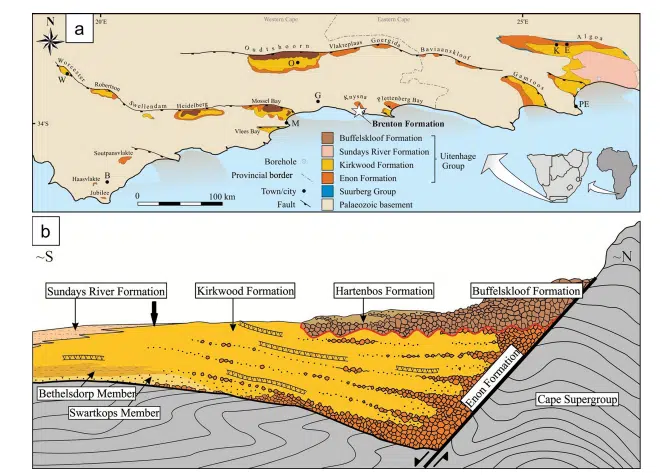 Map showing the location of the Brenton Formation and nearby fossil sites. Credit: South African Journal of Science
This is only the second time Cretaceous dinosaur tracks have been recorded in South Africa, and the second in the Western Cape. Such discoveries remain rare, partly because rocks from that time are not widely exposed. As the research team noted:
“The first dinosaur tracks reported in the province were recently identified in the Robberg Formation, part of the Uitenhage Group, and dated to around 140 million years ago.”
The site lies within today’s intertidal zone, meaning the tracks are covered by water at high tide. This makes them difficult to study and leaves them exposed to gradual erosion.
Footprints Reveal A Mix Of Dinosaur Types
The footprints point to the presence of several types of dinosaurs, including theropods, and possibly ornithopods and sauropods. The research team explained that it is not always easy to tell exactly which dinosaur made which track.
“The trackmaker assemblage is interpreted to include theropods, possibly ornithopods and possibly sauropods. These form the probable youngest reported dinosaur tracks in southern Africa, the second record of dinosaur tracks from the southern African Cretaceous, and the second record from the Western Cape Province,” explained the authors.
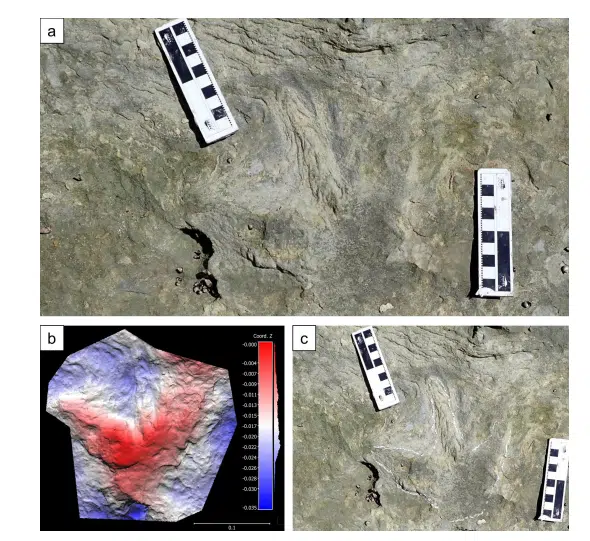 Detailed view and 3D model of a Cretaceous dinosaur track from the Brenton Formation. Credit: South African Journal of Science
Still, the mix of tracks suggests a varied dinosaur population. As reported by the research, the area may once have included river channels or sandy zones where dinosaurs moved regularly, leaving behind the impressions that later turned to stone.
The discovery of tracks in both the Brenton and Robberg Formations suggests that similar finds may exist elsewhere. Other exposures of non-marine Cretaceous rocks have already been identified in the Western and Eastern Cape, pointing to a fossil record that remains incomplete.