
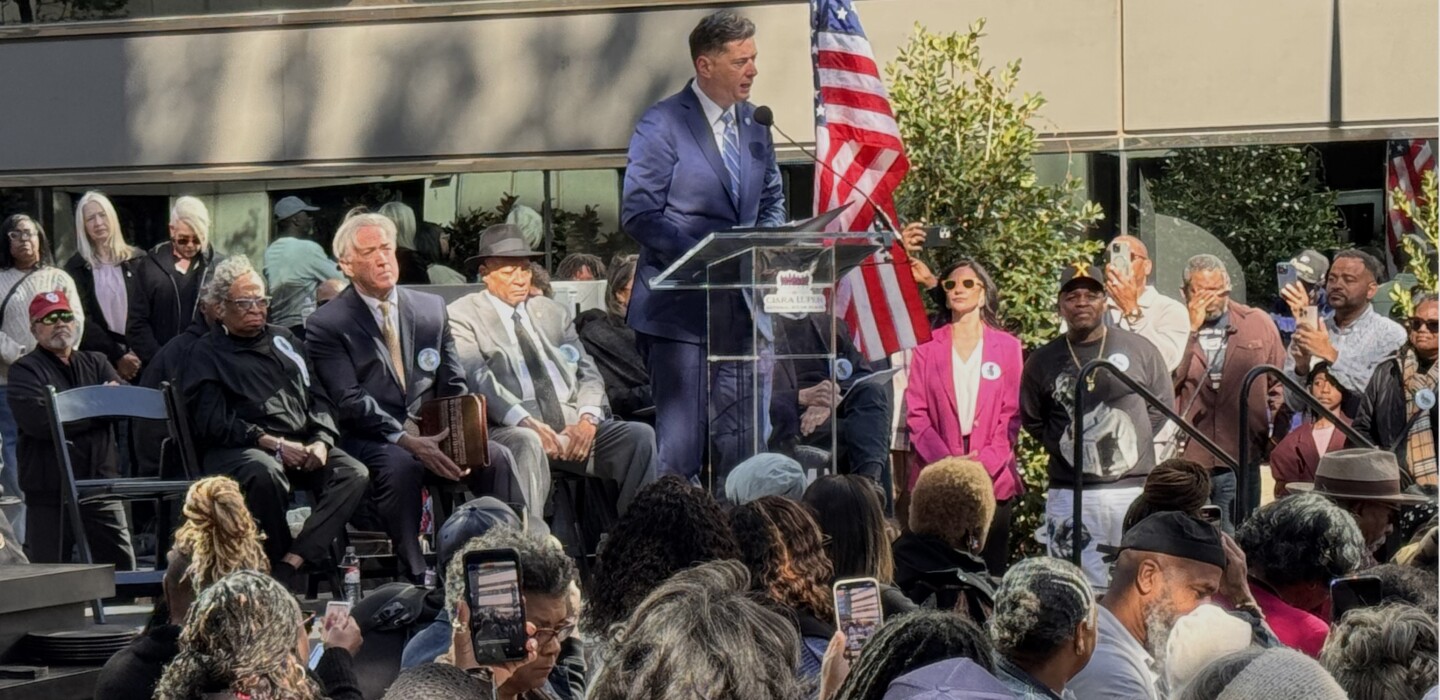
Mayors may be the last level of government to retain a degree of public trust, says Oklahoma City Mayor — and President of the U.S. Conference of Mayors — David Holt.
They share many challenges, notably housing and crime prevention.
Success in addressing these problems depends on bringing residents together, Holt tells Governing, and sharing best practices from city to city across party lines.
The career path of Oklahoma City Mayor David Holt is lined with norm breaking. A member of the Osage Nation, the Republican is the city’s first Native American mayor. When he took office in 2018, he was the youngest mayor of a city of more than 500,000. He received more than 78 percent of the vote, the most ever for a non-incumbent since 1947.
In 2026 he became the fifth mayor in the city’s history to win three consecutive terms, with almost 87 percent of the vote. Since 2023, he has served both as mayor and as dean of the Oklahoma City University School of Law. Since 2025 he has been president of the United States Conference of Mayors, a term that will end in June.
For all these groundbreaking achievements, Holt’s approach to governing is pragmatic and, in many ways, traditional.
In a conversation with Governing, Holt speaks about the challenges he and his colleagues share, their unique position in contemporary politics and the basis of their ability to get things done. The interview has been edited for length and clarity.
These are difficult times for many people in America. You’ve talked about the unique powers mayors have — how do those come into play at this moment?
I think we’re the last level of government that people largely trust. There are a lot of reasons for that. We’re closest to the people, and we have to produce results. Everybody at every level of government should produce results, but if we don’t produce results, people will die.
We have to provide the core city services that you use 25 times a day and you truly rely upon. It forces us to be a little more serious. It forces us to bring people together, because you can’t get things done without bringing people together across partisan lines.
Most mayors are elected in a system that is not a closed partisan primary. It’s a system where all the voters get to see all of the candidates, and all of the candidates have to face all of the voters. That completely changes the incentive structure for everything that you do, the positions that you take and the things that you prioritize.
It means that when I run for mayor, I am incentivized to build a coalition of Republicans, Democrats and independents. I’m working with the 70 percent of people in the middle, and I kind of ignore the far left and the far right.
I think mayors are increasingly relied upon for doing politics the way they were done in America for a couple hundred years. We’re still compromising, we’re still respecting pluralism. We’re casting a vision that is both aspirational and pragmatic.
You’ve been president of the conference of mayors in the past year. Are there challenges all, or most, mayors share?
We all have most of the same challenges, most of the same aspirations for our cities. Housing is the issue that has the most commonality across the United States. We’re all dealing with affordable housing shortages. We’re sharing a lot of best practices on that front, whether it’s regulatory reform or direct investment in affordable housing. We’re also channeling that energy toward Washington as we try to get Congress to pass a comprehensive housing bill for the first time in decades.
Crime and law enforcement is an ongoing top priority for mayors. Largely, we’ve spent the last year celebrating some historic success. Going back two or three years, we have seen dramatic declines in crime. We’re wanting people to know about that and also continuing to study to understand exactly why that happened.
Over the last decade, cities and mayors have better understood how to tackle crime — not at the moment of its occurrence, but to be focused on prevention and intervention. A youth center is a crime prevention strategy. The investments you make in your young people, your economy and a lot of other things can be just as important as your investments in direct law enforcement activity.
How are mayors dealing with a changing relationship to the federal government?
Another major commonality that all mayors have right now is that we have to offset the lack of inclusivity that political leaders at the state and federal level are currently projecting. Unfortunately, you have elected officials today who explicitly divide their constituencies, and explicitly say, “I’m representing this group. I am not representing this group — and in fact, this group is maybe even an enemy to me and my group.”
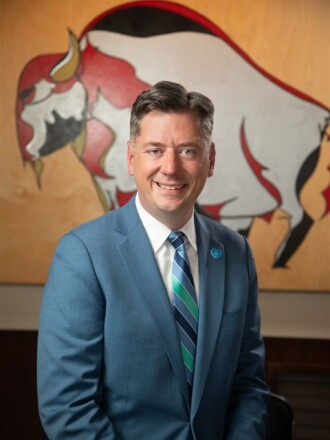
David Holt is nearing the end of a term as president of the United States Conference of Mayors. “We’re dealing with so many of the same challenges and we just want to do what works. We don’t really care whether that policy prescription falls neatly into somebody’s party platform,” he says.
(Oklahoma City)
That flies in the face of how American democracy has worked for centuries. It was always understood that once the election is over, you serve everybody. We’ll have another election and we’ll hash it out then — but in the meantime, you represent everybody, even the people who didn’t vote for you, even the people you think you disagree with.
Mayors still carry that ethos, and now it’s even more of an obligation for us. It’s rhetorical and symbolic, but it’s also material and practical. The activities that we do collectively should meet the needs of people from all perspectives, all backgrounds, all political parties, all socioeconomic levels, genders, ethnicity, religion.
What I’m saying is not groundbreaking, except in the current political environment where you have people withholding disaster relief because of the way a state voted. That kind of othering of your constituency is something we just consider absolutely off the table as mayors.
Is this a bipartisan view among mayors?
It’s very bipartisan, both within our cities and within our organization [Conference of Mayors]. You can go to our mayoral meetings, and you really can’t tell who’s a Republican and who’s a Democrat.
We’re dealing with so many of the same challenges and we just want to do what works. We don’t really care whether that policy prescription falls neatly into somebody’s party platform.
Do you think the public realizes this is the spirit at the local level?
Not necessarily, because the media ecosystem is not incentivized to cover what’s happening in local communities. The cable news networks are hyperfocused on the entertainment politics in Washington that’s not very serious. It’s fueled by conflict, and that makes for good TV. They’re not looking enough at local communities and what is happening there, what is happening in the brother- and sisterhood of mayors across the country, how bipartisan we are.
I wish the public understood how common this is for us.