
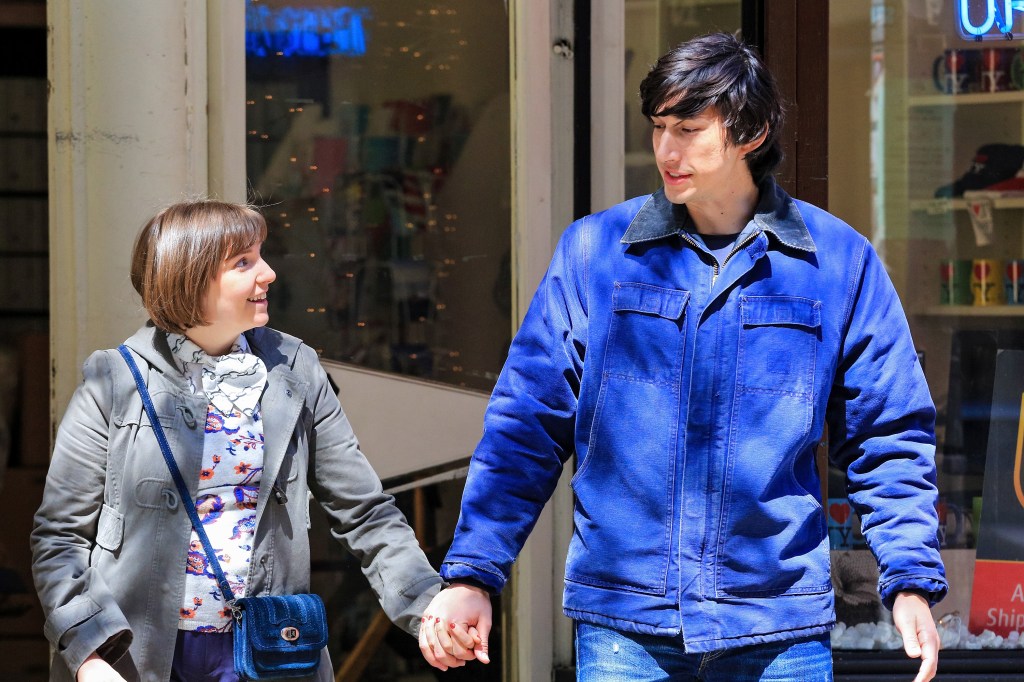
Lena Dunham is addressing her rocky, now-over professional and personal relationships with her former Girls co-star Adam Driver in her new memoir Famesick, and explaining why she wrote about him.
The two played the HBO series’ main romantic, if troubled, couple, and Dunham suggests the turbulent depiction had nothing on real life.
While filming the couple’s first sex scene in Season 1 of the 2012-2017 drama, Dunham, the show’s creator, writer, star and director, says that “careful blocking went out the window” when Driver “hurled me this way and that.”
“Stunned, I couldn’t speak for a moment,” she writes, “unsure of what had happened — had I lost directorial authority, allowed the scene to go off the rails, not given proper instructions? Would I be removed from my command post immediately?”
She continues, “It wasn’t that I felt violated — and I also wouldn’t know if I had, as there was little in my sexual life that I hadn’t allowed to happen, and for no pay. But I felt that something intimate, confusing and primal had played out in a scenario I was meant to control.”
In a new exclusive interview with People, Dunham explains her decision to write about Driver. “It was an attempt to capture that [relationship] in an honest way, and also really talk about how much being around this very talented, charismatic, complex, and powerful person affected me in ways that were really positive and in ways that were a bit harder,” she tells People.
Dunham continues that the “goal was never to make Adam seem like he was in any way the outlier of the show, but just to talk about how complex and confusing those first experiences of trying to be a boss were.”
“For better or worse,” Dunham tells People, “it was all of our first jobs. I think Adam went on a very specific ride because he had the ride of the show and then also the ride of becoming a major movie star at the same time. So he was on these two tracks, and he’s a very, very serious work-focused private person. So I have a lot of empathy for that.”
Dunham, just 24 when Girls began, says in her book that Driver, who went on to considerable film stardom in the Star Wars franchise, would get so impatient with Dunham during rehearsals that he once threw a chain at the wall next to where she was standing.
“I remember doing a fight scene with Adam and how scary it was to meet someone so totally present with such absence,” writes Dunham. “Late one night, as we practiced lines in my trailer, I found that mine were suddenly gone. I knew I’d written them. I’d known them only minutes before. But when I opened my mouth, all that came out was a stammer — until finally, Adam screamed, ‘FUCKING SAY SOMETHING’ and hurled a chair at the wall next to me. ‘WAKE THE FUCK UP,’ he told me. ‘I’M SICK OF WATCHING YOU JUST STARE.’”
Dunham kept quiet at the time about the chair throwing, and rationalized Driver’s behavior as actorly temperament. “I reasoned that the intensity of his anger at me, anger that could make him spit and throw things, was proportionate to the intensity of our creative connection,” Dunham writes. “One day in his dressing room, as I apologized for a perceived slight I couldn’t remember committing, he got close to my face and hissed, ‘Never forget that I know you. I really fucking know you.’ ‘What do you know?’ I yelped. ‘You don’t go to parties. You love animals. And you hate being whispered about.’ And he was right.”
Driver, as Dunham describes him, could be “short-tempered and verbally aggressive, condescending and physically imposing,” and once punched a hole in his dressing room wall because he “hated his new haircut.” Still, she says, he could also “be protective, loving even,” and one week came to her apartment every night when she was feeling particularly anxious. As romantic vibes mounted, Driver said, before his final visit, “I’m warning you, if I come up, I’m not leaving this time,” which Dunham did not take issue with, at least initially.
“I crouched at the window,” she writes, “watching him park his bike, pull out his phone, and dial. But I didn’t answer. It felt as simple as ignoring your doorbell, as pretending to be asleep, as impossible as stopping your blood from flowing. But some part of me knew — some wise part of me, some bold part of me —that if we crossed whatever boundary we were threatening to cross, the return to work would be tinged with humiliation, that I’d be minimizing any authority I still had, and that, however it went, my heart — bruised but improbably not yet broken — would crack.”
When Driver later called to announce his engagement to his now-wife, Dunham says she was heartbroken even though such a feeling was “absurd.”
“I was his scene partner, sure — and so when we were in a scene, his attention was piercing, his presence all-consuming,” she writes. “But in life? It would never be me who kept him in line. I didn’t have the chops. Even at work, I couldn’t do it, in the one place I was meant to make the rules.”
The Girls creator finishes her revelations about Driver by writing that the two cried during their final scene together in the series. “I hope you know I’ll always love you,” Dunham quotes Driver as saying after filming wrapped. “Who knows,” she writes, “maybe I’d write him new parts. We would tell new stories. We would laugh at the way things had been, and smile at the way they were now. But I never heard from him again.”
Driver has not commented on Dunham’s book.