
A recent study published in Astronomy & Astrophysics has provided the most accurate measurement of the universe’s expansion rate, a discovery that not only refines our understanding of cosmology but also deepens an unresolved paradox known as the “Hubble tension.” For decades, scientists have struggled to reconcile different methods of measuring how quickly the universe is expanding. This new research unifies those methods, resulting in a value that solidifies the Hubble tension while raising critical questions about the nature of our cosmos. As the mystery deepens, experts are calling for a reexamination of the foundations of modern cosmological models.
The Hubble Tension: A Persistent Paradox in Cosmology
The universe’s expansion rate is one of the most important measurements in modern astronomy, with far-reaching implications for our understanding of space, time, and the very fabric of the cosmos. At the heart of this measurement is the Hubble constant, a value that determines how fast galaxies move apart as the universe expands. However, for years, astronomers have struggled with a significant discrepancy: two primary methods of measuring the Hubble constant yield different results.
One method involves the cosmic microwave background (CMB), the faint afterglow of the Big Bang, which suggests the expansion rate is about 41 miles (67 kilometers) per second per megaparsec. The second method, which relies on direct observations of nearby galaxies and supernovas, suggests a higher value of 45 miles (73 kilometers) per second per megaparsec. Although these numbers may seem close, the difference is substantial enough to be more than statistical error. This discrepancy has confounded scientists and is referred to as the “Hubble tension.”
The latest study, led by an international team of astronomers, and published in Astronomy & Astrophysics, aims to address this paradox by integrating both methods into a single, unified framework. By combining data from different measurement techniques, the researchers have arrived at a new, highly precise value for the Hubble constant: 45.67 miles (73.50 ± 0.81 km) per second per megaparsec. This breakthrough marks a crucial step in understanding the expansion of the universe.
“Confirming the Hubble tension makes it even more important for us to reexamine the foundations of the current cosmological model and to identify any new phenomena that might modify the evolution of the universe,” said Adam Riess, a co-author of the study from the Space Telescope Science Institute (STScI).
The findings, while providing a clearer measurement, deepen the mystery surrounding this tension and open the door to new scientific possibilities.
Bringing Clarity to the Hubble Constant
This new study doesn’t just offer a refined measurement of the Hubble constant. It introduces a novel “distance network” framework that consolidates decades of independent distance measurements into a cohesive, community-built tool. The team combined data from various sources, including direct measurements of galaxies, supernovas, and other cosmic markers, to develop a more accurate and unified approach to calculating the expansion rate of the universe.
As the researchers explained, this isn’t merely about presenting a new number for the Hubble constant. “This isn’t just a new value of the Hubble constant,” the team stated, “It’s a community-built framework that brings decades of independent distance measurements together, transparently and accessibly.” This collective effort could serve as a standard reference point for future research in cosmology, potentially resolving discrepancies in future studies and paving the way for a more robust understanding of the universe’s expansion.
While the unified constant provides a standard metric for the Hubble constant, it also reinforces the idea that the discrepancy between the early universe’s measurements and the current observations remains unresolved. In other words, the Hubble tension is still very much present, suggesting that something is missing from our current models.
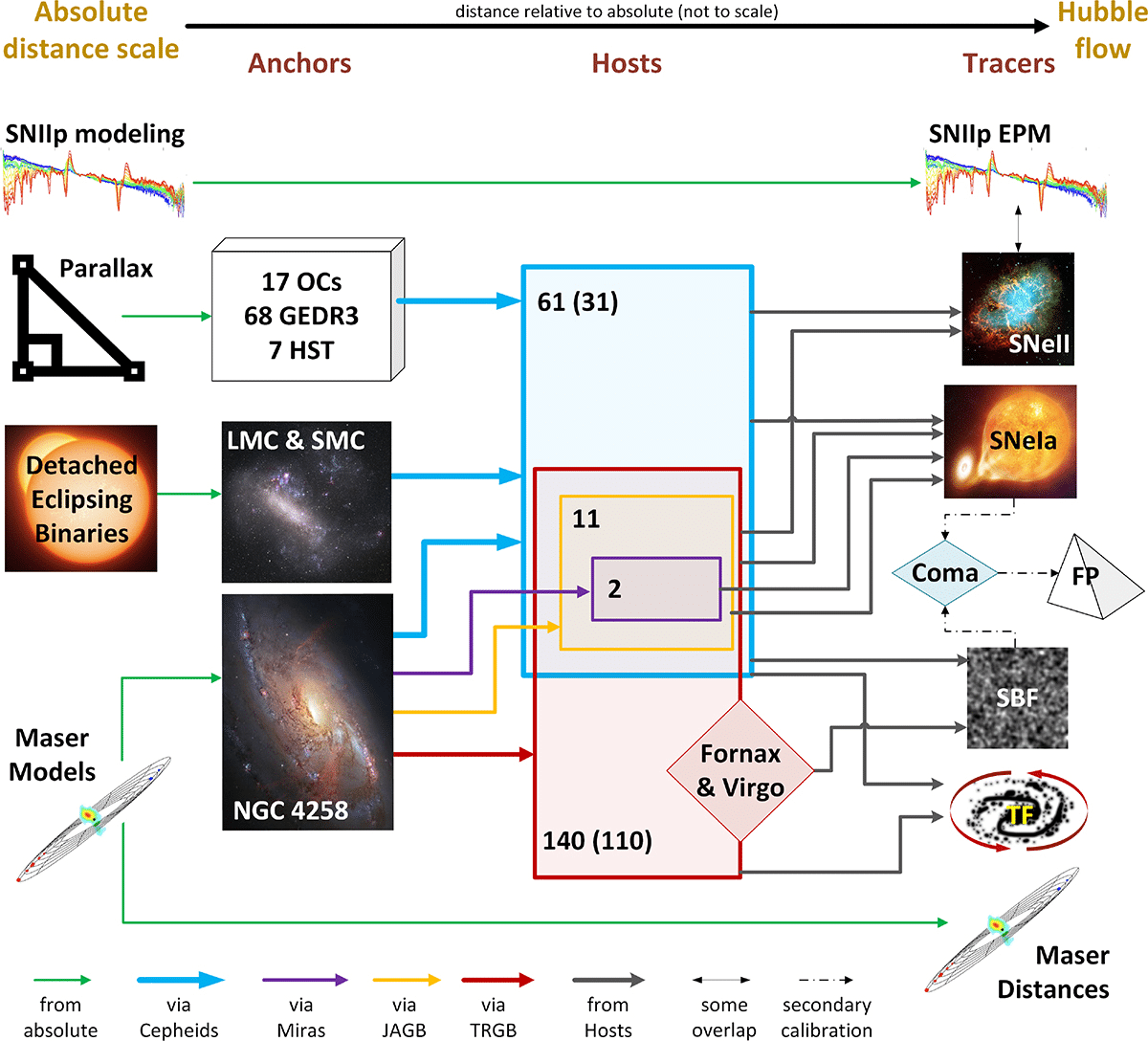 Complete Distance Network, with all possible pathways illustrated. Anchors are objects that establish an absolute scale based on the methods shown to their left. The primary distance indicators (Cepheids, TRGB, Miras, and JAGB) transfer the absolute scale to hosts (i.e., galaxies), the ensemble of which calibrates secondary distance indicators in the Hubble flow (tracers). Exceptions are Megamasers and astrophysically modeled SNe II, both of which serve as primary distance indicators and are capable of reaching the Hubble flow without intermediate steps. Green arrows illustrate direct connections between anchors or tracers and the method used to determine the absolute scale. Blue, violet, yellow, and red arrows show which calibrators constrain host distances; line width qualitatively distinguishes the attainable precision. Among hosts, rectangles qualitatively indicate overlap among objects measured via multiple methods. Diamond shapes represent groups. Dark gray arrows tie subsets of hosts whose distance is constrained by different calibrators to tracers. Any given arrow may represent multiple datasets, for example, HST or JWST photometry of Cepheids or optical versus infrared photometry of SNe Ia. The number of hosts is labeled for Cepheids, TRGB, JAGB, and Miras, with the number of hosts exclusively available to each method shown in parentheses.
Credit: Astronomy & Astrophysics
What Does This Mean for Our Understanding of the Universe?
The confirmation of the Hubble tension has profound implications for the field of cosmology. If the tension is real, and the growing body of evidence suggests it is, it could point to something fundamental missing from our understanding of the universe. Scientists have already proposed several possibilities, including the existence of new particles, dark energy, or even modifications to the laws of gravity.
For example, the role of dark energy, the mysterious force that accelerates the expansion of the universe, could be more complex than previously thought. Similarly, the discovery of unknown particles or interactions could alter our understanding of the universe’s evolution.
“If the tension is real, as the growing body of evidence suggests, it may point to new physics beyond the standard cosmological model,” the team added.
As researchers continue to refine their measurements and theories, next-generation telescopes and observational technologies will play a crucial role in resolving this ongoing mystery. The future of cosmology is bright, with the promise of new discoveries that could reshape our understanding of the universe.