
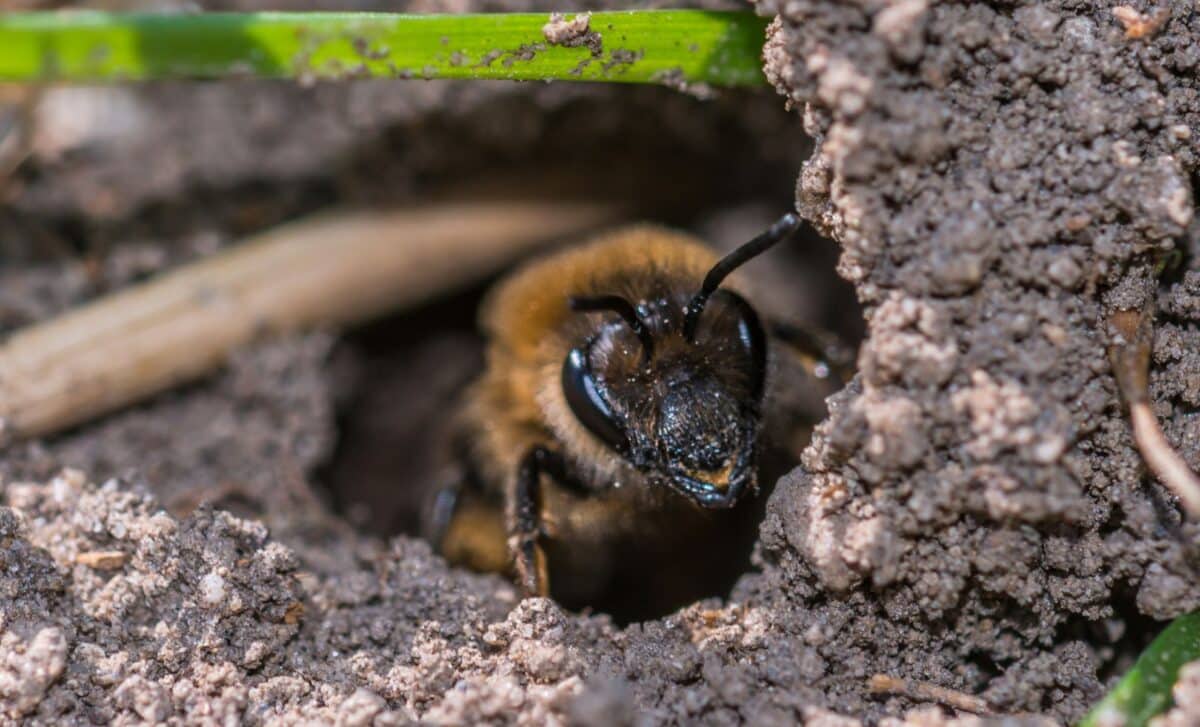
A quiet cemetery in Ithaca, New York is sitting on top of something huge, about 5.6 million ground-nesting bees. Scientists say this is one of the biggest bee aggregations ever recorded. It has likely been there for decades, mostly unnoticed.
Researchers from Cornell University focused on a species called Andrena regularis, known to live in the East Lawn Cemetery since at least 1935. According to their study published in Apidologie, no one had ever tried to measure how many of them were actually there until now.
Most people picture these insects in hives, but that is not the full story. Around 70% of bee species in the U.S. live underground, often alone. According to the researchers, this makes them easy to overlook, even when their numbers are massive.
Millions of Bees Hiding in Plain Sight
A few months ago, a cave revealed a vast “megacity” of spiders settled along the border between Albania and Greece, covering more than 1,040 square feet, nearly half a tennis court, and home to around 111,000 individuals. The comparison gives a sense of scale, but the bee aggregation in Ithaca goes far beyond that.
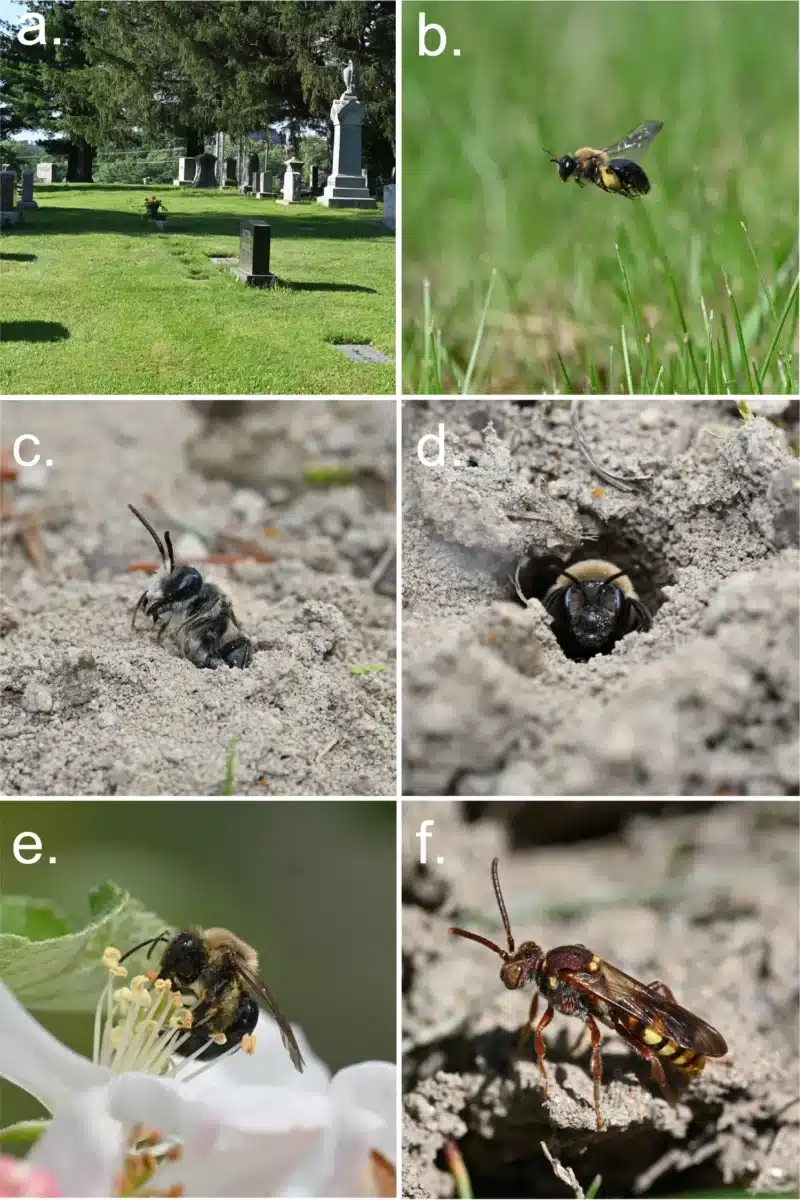 Overview of the East Lawn Cemetery site in Ithaca, New York and the ground-nesting bee species Andrena regularis. Credit: Apidologie
The team spent about six weeks in spring 2023 collecting samples across the cemetery. From that, they estimated that 5.56 million bees emerged over an area of roughly 6,500 square meters. As Bryan Danforth, the study’s lead author, explained that most known bee aggregations top out in the hundreds of thousands. He said that:
“I was completely floored when we did the calculations. I have seen published estimates of bee aggregations in the hundreds of thousands. But I never really imagined that it would be 5.56 million bees.”
To put it in perspective, a typical honeybee colony has around 30,000 pollinators. That makes this underground population unusually dense and difficult to fully grasp.
A Discovery That Breaks Previous Records
Other studies have documented large bee groups, but nothing quite like this. As stated by the research team, one site in Arizona had about 1.6 million bees, while another in New York counted roughly 651,000.
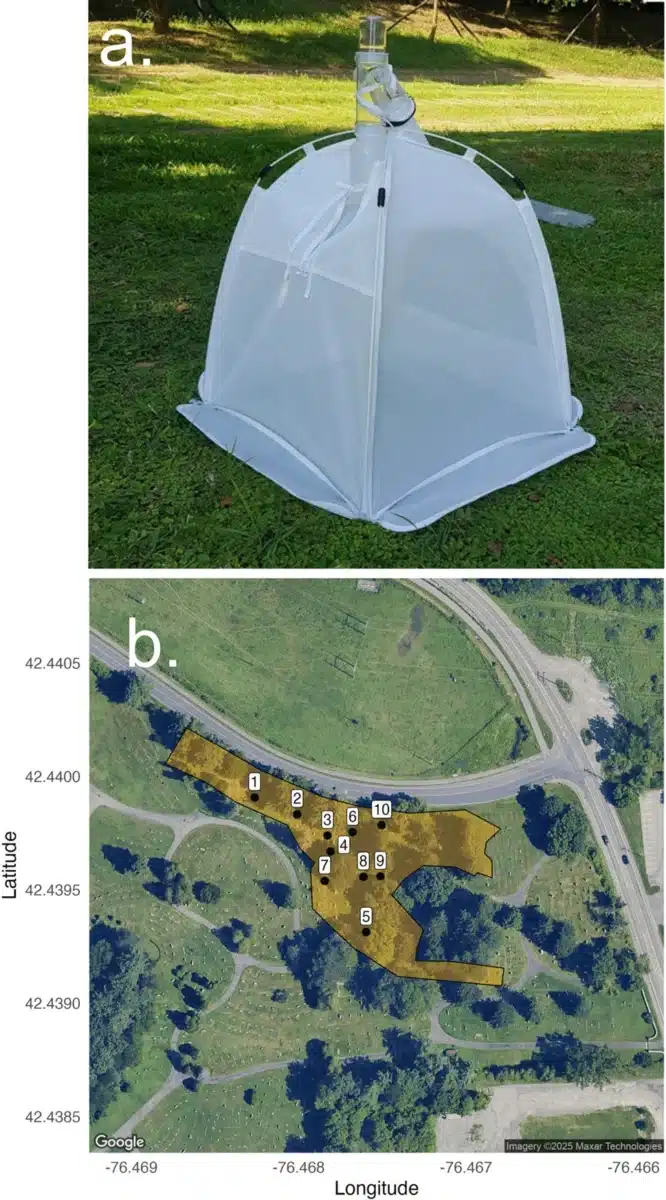 (a) Emergence trap used to capture ground-nesting bees. (b) Map of the surveyed area in East Lawn Cemetery showing sampling locations. Credit: Apidologie
There is also a case in Brazil, where scientists found about 13,500 bees in a much smaller area. These are big numbers on their own, but they do not come close to what has been found in Ithaca.
“I’m sure there are other large bee aggregations that exist around the world that we just haven’t identified, but in terms of what is in the literature, this is one of the largest,” stated Steve Hoge, first author of a new study published in the journal Apidologie.
Why A Cemetery Became The Perfect Home?
It might sound surprising, but cemeteries can be ideal for ground-nesting bees. The soil is usually left undisturbed, and there is not much construction or heavy activity.
As Danforth explained that kind of environment makes them “exceptionally important” habitats for pollinators. Over time, it allows populations like Andrena regularis to settle in and keep growing. These bees do not get much attention compared to hive species, but they still play a key role in pollination. As he pointed out:
“The solitary bees are totally underappreciated. I spend a lot of time trying to encourage people to appreciate the solitary bees, just because they do so much, and they’re kind of under the radar,” He addeed, “but they’re fascinating creatures.”