
What’s the plan for Crozer-Chester Medical Center?
Polack said “size, size and size” played a role in Crozer-Chester Medical Center’s demise.
“You have about a 750,000-to-a-million square-foot inpatient hospital. And today, you could meet the same emergency services demand, giving you all the hospital-based services you need in a tenth of the size,” Polack said.
He argued that contemporary medical care is centered around outpatient treatment rather than overnight stays. This tug of war between inpatient and outpatient care dominated much of the conversation Tuesday night.
Polack said phase one of the company’s vision is to restore services on the main campus where the hospital is located. Phase two involves adding complementary services on the west campus.
While Klein said an emergency room is “absolutely part of the plan,” he underscored his belief that the campus has a robust urgent care setup to strike a balance.
“And the other thing that this community needs, and I feel it in my bones, is good preventive care,” Klein said. “So, if diabetes is taken care of early, the heart disease is taken care of early, and you don’t need to have that many people going to an emergency room because they get good continuous care.”
Klein clarified that the plan is not to shrink the number of beds by 90%. However, he declined to settle on a concrete number. Polack said they may resurrect some semblance of a behavioral health facility on the campus.
“This is not going to be a micro hospital,” he said. “Let me be very clear. That’s not what I’m involved in this for.”
Klein contextualized their plans in what he categorized as a “bad federal environment” for bringing back a dead hospital. He said he doesn’t want perfection “to be the enemy of the good.”
“We are in a health care crisis in this country that’s been unprecedented,” Klein said. “We have a federal government cutting funding to health care, looking to remove $900 billion over the next decade from federal support for health care. The National Bureau of Labor Statistics tells us that by the turn of the next decade, we will be short about 125,000 physicians in this country and almost 300,000 nurses across all nursing specialties.”
There were some tense moments during the town hall. Most of those instances focused on Chariot Allaire Partners’ profit motives. Given the region’s recent history with Prospect, some in attendance accused the new ownership group of being a private equity firm. Following the meeting, Polack denied those claims.
“We are happy to own the real estate,” Polack said. “We’re happy to sell the real estate. We’re happy to partner with that not-for-profit operating system. Whatever will meet the needs of the community is a structure that we are willing to engage in and explore.”
Polack declined to name the suitors interested in running the resuscitated campus. However, he said the operator-to-be will have a final say on which services will be at the facility.
Is Delaware County on board with the vision?
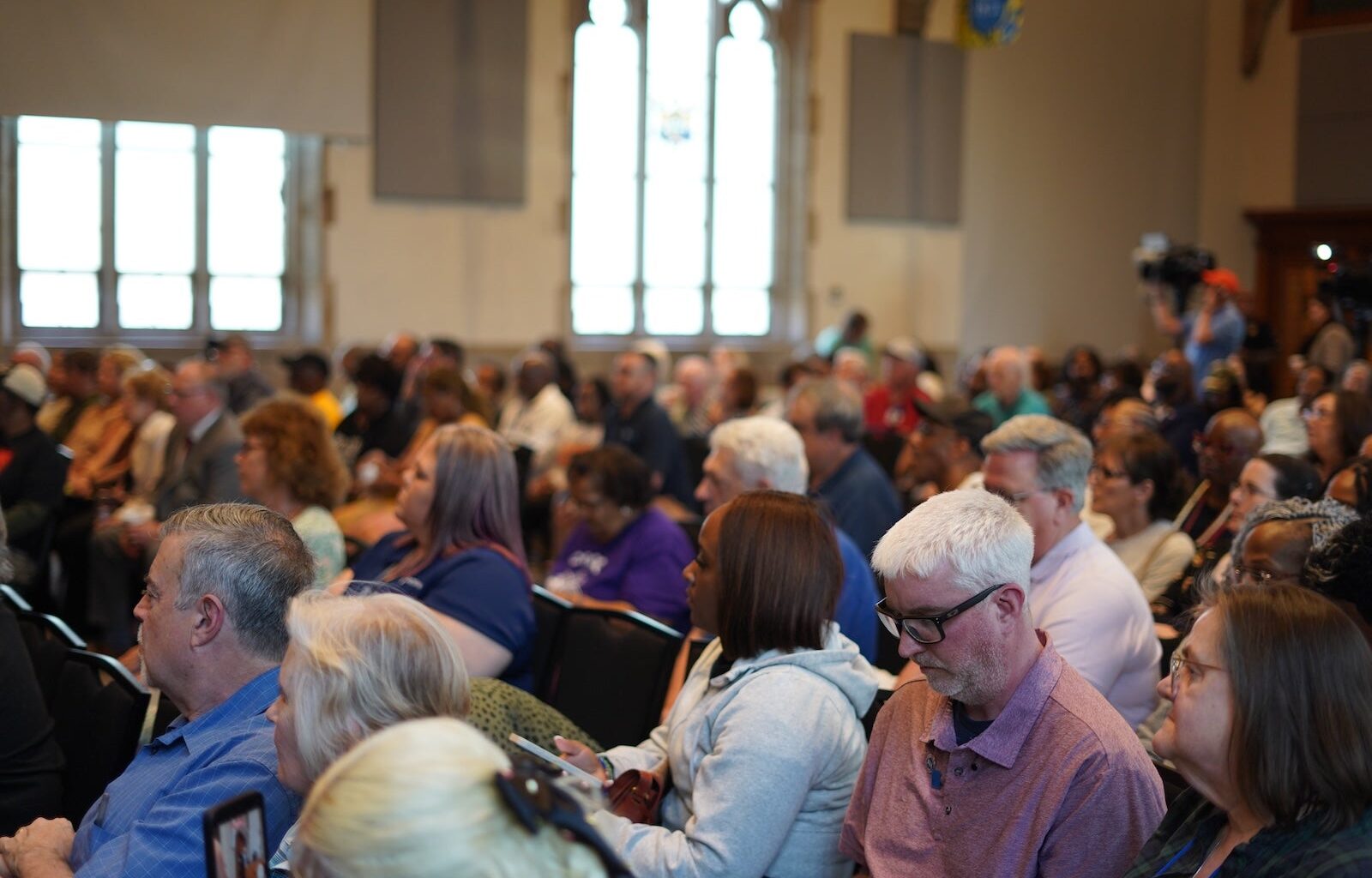
Some attendees said they felt a sense of guarded hopefulness following the presentation.
“This sounds very promising,” Annette Holloway, 66, said. “At least we’re hearing something. This has been going on long enough.”
Holloway, a Chester resident who was employed by Crozer for more than three decades, said she feels bad witnessing ambulances zip past the vacant Crozer-Chester Medical Center to a hospital much farther away.
“We can hopefully bring them back to that facility so they can get their patient care,” Holloway said.
A few community members said they are still in shock that Crozer is gone for good.
“Been a resident of Chester all my life — never would have thought that I’d see Crozer go out. Never would have thought that in a million years,” Blendenna Taylor, 67, said.
Taylor said she had to go to Riddle Hospital in Media since Crozer shut down. She waited nine hours to be seen, but she still expressed gratitude.
“They’re overworked,” Taylor said. “It’s sad that this is where we are today.”
Peggy Malone, a former Crozer-Chester nurse, said Polack has been engaged in dialogue with former employees in recent months. Although she’s not a fan of the timeline to restore services, she’s “very cautiously optimistic.”
“I do believe he has a commitment to restoring health services to this community,” Malone said. “I believe he is committed to making sure that the people who worked at Crozer have jobs again. I think that’s going to be very dependent on the nonprofit operator that comes in and so I don’t think he can promise that.”
Dr. Max Cooper, a former emergency room physician at Crozer-Chester, said the rehabilitated facility should offer psychiatric care and trauma care. Regarding the presentation, Cooper said his opinions are still “in flux.”
“I think they’ll really be heavily influenced by who the clinical partner they bring in is,” he said.
Taylor Hospital could reopen before Crozer-Chester Medical Center — if the right operator comes along
State Sen. Tim Kearney, D-Delaware County, said there has to be a balance between being “as supportive as possible” of the new ownership group and keeping an eye on the minutiae of how the project is financed.
“The fact that this company is a for-profit company, that doesn’t really bother me so much,” Kearney said. “I just want to know how they’re going to raise the money — because it’s not going to be coming from the state. There’ll be some money coming from the state, but it’s certainly not, you know. What their plans are, they’re talking about a $250 million price tag.”
That’s where his concern lies, he said. However, Kearney praised the presentation for its thoroughness, particularly Klein’s answers. Kearney, like Malone, said he’s “cautiously optimistic.” He said legislators have already met with leaders from Chariot Allaire Partners, including Polack.
“He knows that we’re watching him,” Kearney said. “He knows what we went through with Crozer.”
Although Crozer-Chester Medical Center is at least a few years away from receiving new life, Kearney believes that Delaware County might catch a much-needed break a little earlier.
“We’re hopeful that Taylor [Hospital] will be open sooner than any of [the other hospitals], because it’s in pretty good shape and the size and scale are correct already and if they can convince one of the systems to come in and make it work, then that could be the quickest way to get something done,” Kearney said.