
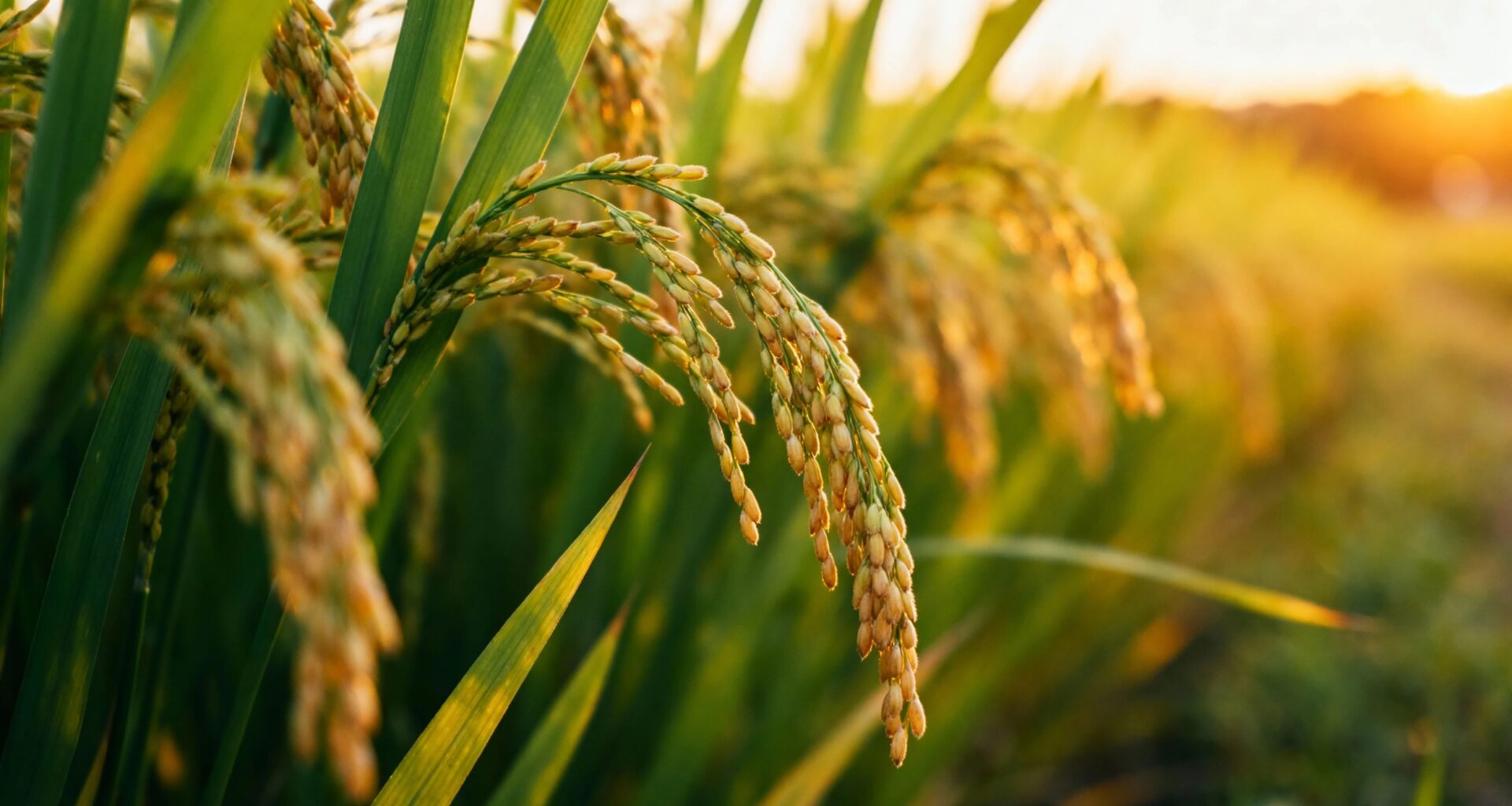
Rice feeds more than half the world. It shapes cultures, economies, and daily life across Asia. Yet this ancient crop now faces a future it has never experienced before.
A new study from the University of Florida brings together archaeology, climate science, and modern crop data to ask a simple question: how much heat can rice really handle? The answer carries serious weight for global food security.
Rice can’t handle extreme heat

Rice has a long history. Farmers have cultivated it for at least 7,000 years, spreading it across diverse climates. But despite this expansion, its tolerance to heat has stayed surprisingly stable.
The study shows that rice rarely thrives when the mean annual temperature rises above about 28°C (82°F). During the growing season, problems begin when temperatures exceed 33°C (91°F).
Beyond this, yields drop as pollen viability declines. At extreme heat near 40°C (104°F), the plant struggles to survive at all.
Too much heat kills rice
These limits are not based on short-term experiments alone. They appear consistently across modern farming data, satellite observations, and even plant physiology studies.
“You don’t see that kind of flexibility on the hot end because at some point, the plant will physically stop working,” said Nicolas Gauthier, the study’s lead author.
Rice never adapted to heat
To test whether rice adapted to higher temperatures in the past, researchers turned to archaeology. They examined more than 800 ancient sites across Asia, covering nearly 9,000 years of rice cultivation.
The result is striking. Even during warmer periods in Earth’s past, rice never moved into hotter climates beyond its known limits.
Instead, when conditions changed, rice shifted locations. It moved toward cooler regions or developed varieties suited to lower temperatures.
For example, rice spread northward into China, Korea, and Japan as cooler-adapted types emerged. But movement into hotter regions did not involve new adaptations.
Farmers simply used existing heat-tolerant varieties, and even those stayed within the same upper temperature range
Future temperatures will exceed limits
That stable boundary now faces a serious test. Climate projections show that large parts of Asia will soon exceed these long-standing limits.
By the end of this century, areas exceeding the 28°C (82°F) threshold could expand by ten to thirty times in major rice-producing countries.
Warming spreads across Asia
Maps in the study show widespread warming across South and Southeast Asia. Regions that currently produce most of the world’s rice are expected to face conditions with no historical parallel.
This is not a gradual shift within familiar limits. It is a move into entirely new thermal territory.
“These changes are going to be disruptive, and the process of adaptation doesn’t come for free. It has to be done with intention and might not be pleasant,” Gauthier said.
Rice may struggle to adapt
The study suggests this will be difficult. Genetic analysis shows that many existing rice varieties may become poorly suited to future climates.
The mismatch between current traits and future conditions is expected to grow stronger under higher emissions scenarios.
Some adaptation options exist. Farmers may adjust planting dates or develop heat-resistant varieties. Scientists may use diverse traditional strains to breed more resilient crops.
But these solutions come with limits. Rice is sensitive not just to daytime heat but also to warm nights. It also depends on specific soils, water systems, and farming practices built over centuries.
Farmers in hot regions at risk
“Regions in the south, such as Indonesia and Malaysia, are the ones that are going to be most heavily impacted, and the process of adapting is going to leave a lot of people out of the loop,” added Gauthier.
“Those who depend on rice for their subsistence today aren’t necessarily the ones who are going to be able to access the new genetic varieties that are developed.”
Moving rice production to cooler regions may help in some areas. However, this shift cannot replace the production lost in densely populated tropical regions, where billions depend on rice for food and income.
Food supply faces serious threat
The implications extend far beyond agriculture. Today, billions of people live in regions that may soon exceed rice’s thermal limits.
If yields decline, the effects will ripple through food systems, economies, and cultures. Rice is not just a crop. It is central to diets, traditions, and livelihoods across Asia.
Urgent need for global action
The study paints a clear picture. For thousands of years, rice has stayed within a narrow thermal window. Climate change is now pushing it beyond that boundary at a pace far faster than natural adaptation.
“On an aggregate scale, it could be that, pound for pound, all the rice that won’t be able to grow in Southeast Asia could be grown in China instead,” said Gauthier.
“But that doesn’t change the impact on the people in Southeast Asia who can’t just start growing a new crop from scratch.”
What happens next will depend on how quickly science, policy, and farming practices respond. The challenge is not just to grow rice in a warmer world, but to sustain the societies that depend on it.
The study is published in the journal Communications Earth & Environment.
—–
Like what you read? Subscribe to our newsletter for engaging articles, exclusive content, and the latest updates.
Check us out on EarthSnap, a free app brought to you by Eric Ralls and Earth.com.
—–