
Illustrations by Matt Rota
The architect’s wife was a real estate agent who’d gotten a tip about a midcentury modern gem on a cul-de-sac north of the city, and they’d wanted it. They’d been able to put in a premarket offer and buy it. After the architect’s tasteful renovation, its several levels were both airy and cozy, an arrangement of rooms unfolding from an entryway two stories tall, like a house in a magazine, so much glass and warmth. His dream house, she whispered on a deck that was a third or fourth living room but outside, shaded by a colossal magnolia tree. An ambiguous number of children ran across the deck to the pool and then back inside without drying off despite the shouts of the adults, who were having cocktails under the magnolia tree and only officially concerned.
They seemed to have everything they needed. Though she’d been eyeing another house. One that had just come on the market. On a corner, with more privacy and a bigger plot, so more land. She glanced at the architect, who looked away at the trunk of the magnolia tree, which was in full bloom, the air lush with its flowers’ creamy scent.
Inside the house, the temperature had no relation to the sun, but what cooled the place was silent. Even the giant refrigerator was silent, only a faint hum if you pressed an ear right up to it. Yards of space between skull and ceiling. If another person was in there or where you might not even know. Most walls with an electrical socket and sometimes two. The distinct sensation of constant internet, and rarely a visible trash can. Beautiful art, many exquisite things displayed, but then, on a glass coffee table in one of the living rooms, a stack of eight or ten books about how to build a tiny home inside a vehicle.
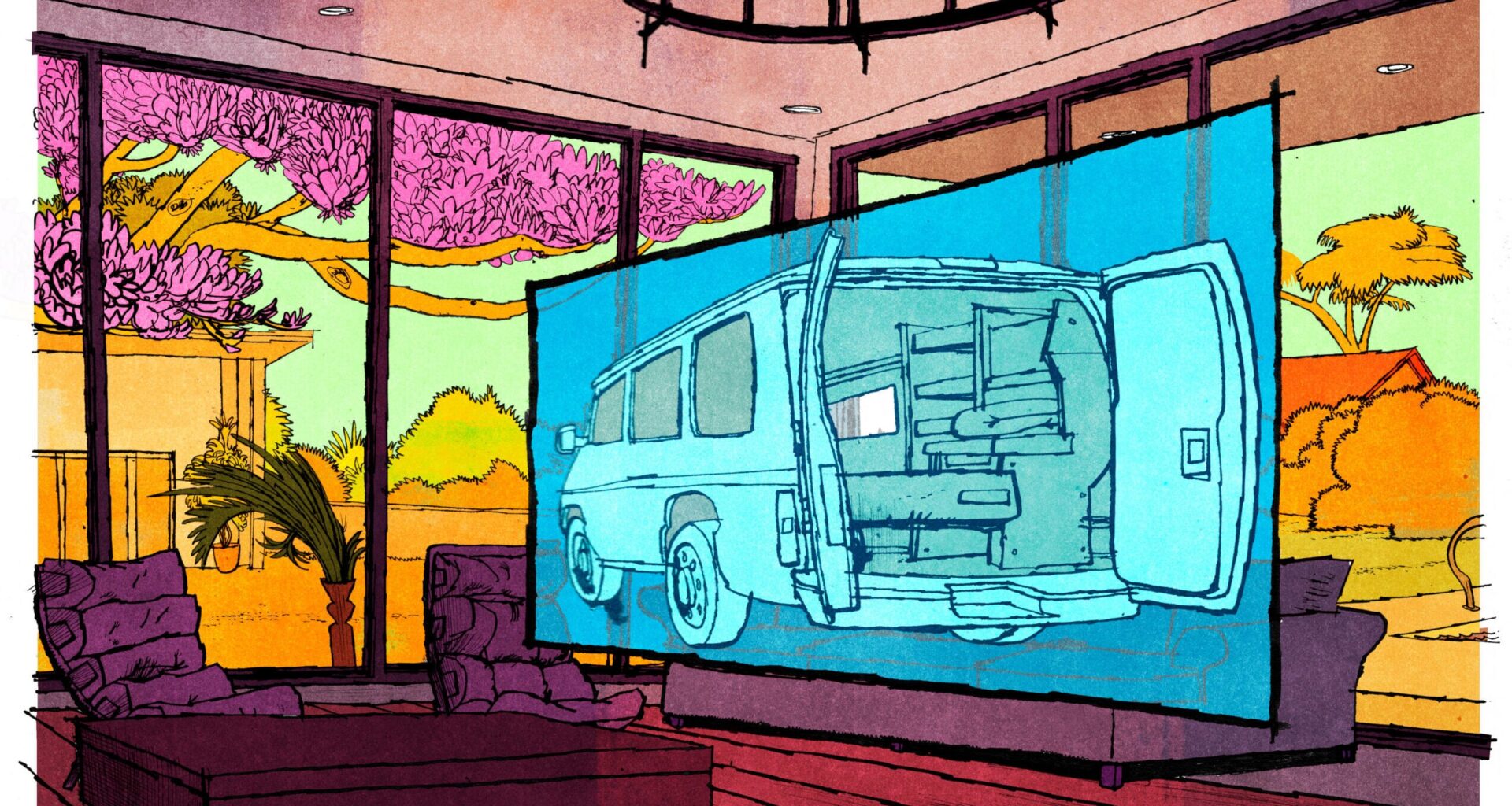
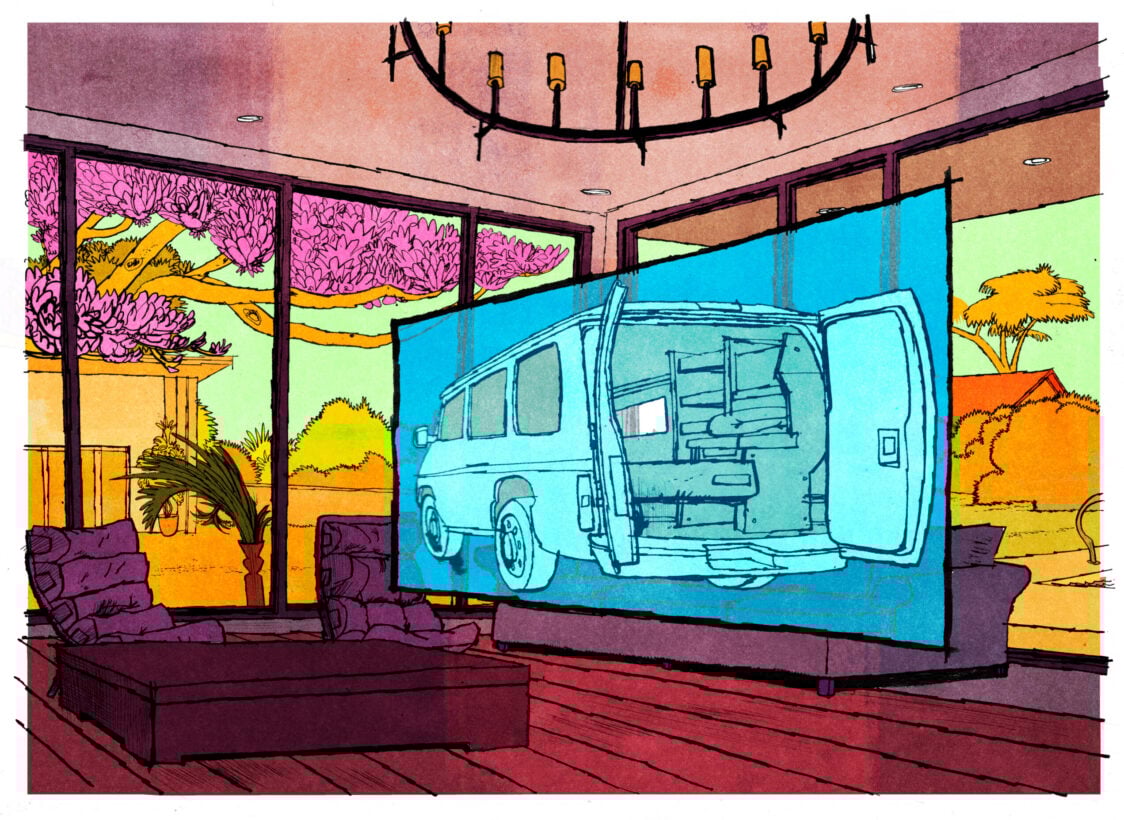
Stay as long as you like, they said, and the pool party stretched into a second day. The idea of moving into a cargo van, it turned out, had occupied the architect’s imagination since the lockdown, when the children were always home and things were hard. He wanted one. From their beautiful house he’d been googling, thinking about how to fit all the things he needed for living into a six-by fifteen-foot space, how he might cut picture windows into both walls of the van, about sink depth and water tanks, solar arrays and inverter wattage. The van had taken on a palpable presence in his mind, like his brain had grown new gray matter to hold it, the way a dream can take up space in a house that has so many rooms you could get lost in even by the third day, when he went to the drafting table in his studio, pushed aside some drawings for an office building, took a roll of vellum from a shelf, and spread it out proudly on the table—it was the design for his van build that he wanted to show us.
The whole time, the van we lived in was parked in the driveway. If no one really asked much about it, we didn’t blame them. It had been almost two years and our clothes were ragged; there was something bad in our eyes. As we drove up, we’d decided against even requesting to sleep in our van with our things and our privacy, given the stigma people can have about vehicular living, and how HOA rules can be in neighborhoods like that.
Like many people who’d found themselves living in vehicles when the pandemic came, it was an apartment or house that I wanted, so badly. But it seemed less and less attainable, the future a blank. How did people get the money? In the case of the architect and the real estate agent, from other people’s dreams of having a house. Other people’s dreams of that kind of pool, whose salted water I had been soaking in after sleeping gratefully in a cloud of a bed that rested levelly on a precisely horizontal floor, soaking and getting so clean.
Eventually, at the table under the magnolia tree, my van mate said something, or I did. Like, You might not actually need that much power. We bulk-charge the house batteries off the engine while driving, and then two hundred watts of solar paneling tops it off most seasons, if you’re not in the woods.
The architect nodded thoughtfully.
It’s surprisingly hard, the other one of us said, to get enough sun in the woods.
He considered this and asked about the inverter or something, and we went back and forth for a while, and then there was a pause. A familiar pause, by this point, when the frictionless dream made of internet comes up against a certain barrier. We let the silence be.
It was my turn to look at the magnolia tree. Its roots invisible below the upper deck. Really, it had many trunks that wove around one another like ancient arms entangled until they split into branches and glassy dark leaves above us. I kept trying to follow one part with my eyes from deck level up to where the branches began, but the pattern was too complex. What people were usually wondering, when the pause came, was what we do with our shit.
The first time I went away, when I was ten or eleven, I was sent downstate from the farm where I lived to visit my aunt and uncle and cousin. It was only a few weeks, but a lot happened. My uncle snuck me my first sips of coffee; my aunt taught me how to apply mascara. There was bike riding with a girl from their church, and horse riding, and a slumber party in an RV. By the time my aunt drove me back north to the farmhouse, I had a kind of new lease on life. I had been among happier people, I guess, and when I opened the screen door, my own house looked and smelled strange to me. My parents were sitting on the couch. No one got up. When my mother looked at me, there was hell in her eyes. And then, to my right, on a table beside the door, I saw we had a new lamp.
The lamp had a crisp, clean, pleated shade the color of parchment and an egg-shaped base that was buttery and shiny, with a swirling, raised design on it. Like from a house in a magazine. The word “porcelain” came into my head. A price tag hanging from the lampshade read $250, which I knew was the amount we paid to my grandmother every month to rent the farmhouse, and some months my mom didn’t make much more than that, giving piano lessons. The rest came from the government, because my father was disabled. I pictured my mom in the store, seeing this beautiful lamp and wanting it so much she spent a month’s rent on it, except there was nothing to spend, so I figured she must have used a credit card.
I recall this so often and I do not know why. I move around in the memory from the look in my mother’s eyes to the lamp and up the stairs to my blue bedroom, where I’m lying wide awake, staring at the ceiling in the hot cicada night feeling for the first time the most awful feeling that I did not have words for, but if I did, they would be, like, What if no one cares? What if everyone cares about stuff more than people, and how would we eat? When this great loneliness returned to me several times in adulthood, for months at a time, therapists called it depression. I don’t know if it was depression—if you have had it, if your depression is like this—or if it’s just falling through the floor into the basement of the United States of America.
When I asked my mother about the lamp the next day, she reassured me, turned over the tag. She’d bought it on clearance for $35. But I set up an office in the cellar of our farmhouse and began to figure myself as some kind of child accountant. I cut coupons and filed them into envelopes for the next grocery trip, did math and helped with the taxes. Upstairs, I read Escape to Witch Mountain and tried to move objects with my mind, flipped the pages of Choose Your Own Adventure books so fast that hyperlinks almost appeared, animated Sears-catalogue bra models from the page and into my bedroom, read A Wrinkle in Time and tried to tesser to a city on the coast.
Vans were something to fear then, especially slow-moving ones, which were kidnappers. Stranger danger. I suspect that some massive number of other children sat terrified inside their rooms like I did, squeezed their eyes shut and tried to move physical objects with their minds like Professor X, like Yoda. Tried to move Air Jordans from outside their houses to inside their houses and onto their feet, to manifest Hypercolor shirts and Guess jeans, Tamagotchis to feed. Had any generation wanted so much, or had so much to want? We played so many video games that we wanted everything to move like that; we wanted not just to watch MTV but to be inside MTV, taped posters of musicians and models to our walls until we’d made portals to where we wanted to go and who we wanted to be, and by the time I got to college, we’d wanted and wanted until we shat out the internet.
When I took a Greyhound bus to the city and then moved there, online was someplace you went to watch for the green dot of the one you wanted, but then it began to move us IRL through meatspace, to the park to catch a Pikachu by the reservoir, downtown to do the Electric Slide. At a bar, someone pushed me out of the way to catch a Poliwag on the bar top, as the music abruptly cut off mid-song. The bartender looked up to the ceiling and flipped off a camera. Her manager, watching from home, hadn’t liked the playlist and changed it. A different song came on.
After that, the internet began to speak through us, and what it said was: Wake up. All this? It’s just perception. Light is either a particle or a wave, depending on how you observe it. A dress can look blue or white, depending on how you see it. Since observation changes reality, you make the world with your mind, so what do you want?
I wanted love and a roof over my head, to rent an apartment I could afford without working every second, even to own a place of my own someday, something my parents had never been able to do. But rents were rising faster than wages. I was doing so much child accounting, looking for a loophole, when I came across a Craigslist ad for a little yellow school bus that cost two months’ rent; after that, there would be only gas and repairs to pay for. I went to a bar and showed the listing to B, a man I loved. We wanted it. But a party was starting at our friends’ apartment, so we decided to respond to the ad in the morning. I zipped my laptop into my backpack, and we walked out of the bar into the sunlight and stopped short, blinking in disbelief, because the internet had parked the little yellow school bus on the street outside.
The internet could not have really parked it there, that’s not how Craigslist worked, so had we made it appear with our minds? Inside, surrounded by the hard plywood surfaces that this tanned, fleece-jacketed Australian couple had built inside their bus, we tried to imagine this other way of living. I saw how near the man would be, all the time, and that was what I wanted most.
You don’t get signs like this every day, we told the Australians. We will probably buy your school bus. We’ll text tomorrow to confirm.
Well, the guy said, sleep on it.
At the party, we told the story, and with our friends we tried to imagine our new lives. We’d wear fleece and park outside their apartments, come in to shower. One of our hosts, S, was quiet, listening. We’d forgotten he’d lived in a car for a couple of years, but he reminded us. More people arrived. He let them in. Then he stretched his arms out and leaned on the kitchen island across from our barstools and said: It’s fun. It’s a real good time. It’s great to crawl around on the edge of town after town all derelict and stinking like a pig, wearing the same clothes day after day, wandering all over on a little adventure. Let me ask you something, though. How long is it, after you have your coffee in the morning, before you need to take a shit? Do you even know? Have you even had the opportunity to consider that? Are you interested in finding a coffee shop every time you need to? Are you always going to be in places where there’s a coffee shop to find? If not, are you interested in shitting in a bucket two feet away from each other? Is that really what you want?
The next morning, after I had my morning coffee, it was about fifteen minutes before I strolled to the bathroom and understood that he was right. It didn’t have words, the impossibility of dealing with my own shit, this aversion to shitting a few feet away from someone I loved and then figuring out how to dispose of our shit ourselves, together. It was just a wall I couldn’t scale. But if I could have put words to it, I might have said that our bodies were magic pleasure makers at the time, housing lovely, mysterious souls. If our bodies were instead shitting and therefore also dying, it could be the end of the story of love.
B had a similar experience that morning re the convenience of toilets, though mainly what we talked about was unfinished collaborations, upcoming events and obligations, our chosen family too beloved to be away from, the challenge of his writing a record and my writing a book in that small space, and anyway, we didn’t buy the school bus.
It has been the defining problem of human civilization, what to do with our shit. Timothy Morton writes that Jacques Lacan wrote that. Though Morton doesn’t agree with the human-civilization part, and neither do I. I’ve seen alpacas line up in a barn, each waiting its turn to drop pellets in a corner that they have clearly collectively designated as the shit corner. And this obsession of Western philosophy with figuring out a way to define how humans are more special than other animals; it’s exhausting. And deadly. It’s usually a trick, a way to invent a distinction that means some of us are more human than others.
The taboo has its good reasons. Human shit is hazardous for months, a constant potential plague, until it composts and becomes immensely valuable as fertilizer, in places where the stigma doesn’t prevent that—though who touches it, who moves it, is the question. For millennia it has inspired elaborate rules about which hand to wipe with, which direction to face, how far from the tent, downwind from the camp, whole styles of cleanliness and beauty, whole geographies mapped by the problem of where to hide it, as well as elegant solutions. Four millennia ago, in the ancient metropolis Mohenjo Daro, where Pakistan is now, built into the walls of homes were toilets, which emptied into sewers below. For centuries in imperial China, household shit was gathered and distributed across the fields and called night soil. Early modern Europe, arguably more barbaric. A municipal edict issued in 1539 in Paris required people to stop shitting in the street, to do it inside, and then deliver the household shit bucket to a stream or the Seine to be carried downriver by the waters, which is one way of describing a certain Western mindset: send it downstream.
I did not know about Mohenjo Daro or the night soil when I came up against the wall that shit is. If I was not thinking of the Paris edict or the millennia of taboos about shit that I had inherited, or my deep training in pretending my waste went away somewhere, if I was feeling instead like an individual and thinking about love, it was probably because I was sitting on a toilet of white porcelain. With its magic U-bend, invented so that after gallons of water flush the shit down, a palmful remains in the lower bend, sealing off the smell of the sewers where our shit joins everyone else’s below. After the U-bend, in rooms named so that we don’t even need to say the word—“el servicio,” “oterai,” “restroom,” “shauchalay,” “bathroom,” “WC”—not only the material but the smell and therefore the memory can disappear like history. The trick of the U-bend, Morton argues, creates in this way the great fiction that there is such a place as away.
After a while, at the table under the magnolia tree, I looked back at the architect and said, Compost toilet in a five-gallon bucket.
He raised his eyebrows.
Most of the time, my van mate said, we don’t use it. Finding a way to go to the bathroom is really not the hardest thing.
Or he said the first thing and I said the second, I don’t know.
It was time to leave, B to see his parents, me to park on my friend J’s street on the south side of the city. But first I had to tell her that I hadn’t been masking. I called her from a corner of the deck, across the pool from the magnolia-tree conversations, to talk through the logistics that would keep her household safe from the pool party. After two or three days’ sleep in the van’s heat, a COVID test would be accurate enough, she thought, and if I was negative, at night I could mask my way inside to sleep in an upstairs bedroom in the air-conditioning. In the meantime, we could hang out on her porch.
It’s easier for me, anyway, to stay in the van, I said, even if I’m negative.
No, she said.
I like it in there, I said. I have everything I need.
Sure, she said, but I have a luxurious new Japanese bidet in my downstairs bathroom.
A couple years after the school bus seemed to come out of the internet, we did buy a van. It happened very quickly. My mother had a stroke and needed round-the-clock care in the middle of the country, far from where I lived; B was injured and lost work; the apartment kept flooding; and for more private reasons, both of us were kind of out of our minds. In a matter of weeks, we took out a loan, bought a van, parked it inside my mother’s barn, and used a first credit card to build living quarters inside. In the house, I helped with her post-stroke rehab and planned her move off the farm to assisted living. I learned to work online, competing with people across the globe for transcription jobs that paid $8 or $10 an hour. When she was well enough, B and I began to take breaks, circling around the farm and driving out into the country like tight fists, neither of us in the mood for an all-American road trip.
Neither of us had seen the desert and then we were living there. It wasn’t beige monochrome at all but ablaze with color. There aren’t words for its sunsets. I didn’t even think I should take pictures of them. What’s monochrome is the forest. So much of the country in ruins. So much the same place, the same fluorescent bathrooms in the same superstores, where we lived in parking lots, because the internet was not just everywhere anymore. The internet was like water and sun, something I spent days trying to find so I could work. In a national forest, where parking is free, there isn’t any, so in superstore parking lots I downloaded audio files to transcribe and maps of forest roads. You can’t stay as long in a forest unless you find a clearing where the sun can shine on the solar panels, to charge the laptop so you can work. You can’t get the weather with no cell service, so you learn to watch the sky, though in the mountains, anything can happen. On the West Coast, B found work evaluating the quality of Amazon returns in a warehouse, and on the streets of an industrial park I grew into an octopus, at one with the van, reaching for the propane knob with one hand while moving the cutting board to rest on the sink with the other, pulling up the plywood plank to serve as a counter, fitting a dish towel over the cable above, listening to idling semis and the voices I was transcribing.
After four months, we broke up and agreed to take turns in the van, but with an apocalypse clause, an agreed-upon meeting place, because something was coming: we could feel it. At an artist’s residency that winter, I didn’t know what to tell people when they asked where I was from. It was neither the Instagram thing nor the other thing, neither the dream of freedom and away nor the tragedy. Then J arrived at the residency, in green lipstick and a Playboy T-shirt. When I told her I was living in a van, she said her parents had lived in a school bus. She had a picture to show me, and she pulled it out. Her father, a Black Panther, smoking next to her mother, a white hippie, pregnant and leaning against a hatchback. J was younger than me but seemed to have more information. She’d had her own years of wandering. The night before I left, we were walking in the snow and agreed that something was coming, some breakdown, and that it was good I knew how to make rudimentary plumbing and electrical systems, get energy from the sun, and that she knew hope, because she’d lived through the Storm as a teenager and had seen how people organize when the government fails and it’s up to them.
That was February 2020. Soon I was on the farm, living in the van and leaving what my immunocompromised mother needed outside her door, visiting with her on the porch, out where people lived so far apart already that the social-distancing rules could seem diabolical, the plague a matter of perception, even as the hospitals filled. I had quit the socials but lived through my phone, where my friends texted about parenting, working, sickness, rage, caretaking, protesting. The choppers overhead, the curfews, the police. One week, J texted that seven people in her neighborhood had died. Another week, that more in her family had, her father’s people in New Orleans. That the air was so filled with tear gas she wouldn’t leave the house. That she was working out like a soldier, inside. She did not text that she was out of her mind with grief and fear, but for months I knew she was out of her mind with grief and fear, putting gallons of milk on her porch for protesters to pour into their tear-gassed eyes.
Visiting porches and backyards that year was like moving between different countries, each household lonely with its own internet-fed worldview, creating its own rituals, knowing or not knowing or deciding not to know what was happening to others a few miles away, or even a few blocks away.
Between the way we think we know everything about people, and the way we don’t know anything about them, and the way we are strangers even or especially to ourselves, is the fiction of away. Unless the material that moves around and between us does do something like knowing. Unless our eardrums do vibrate with the sound of every landscape and everything that goes on here and there and even what we have tried to throw away. Unless our bodies know what’s up, and our friends know what’s up, and our enemies know best who we are, and away is actually the fakeness we lament when we’re choosing the great loneliness.
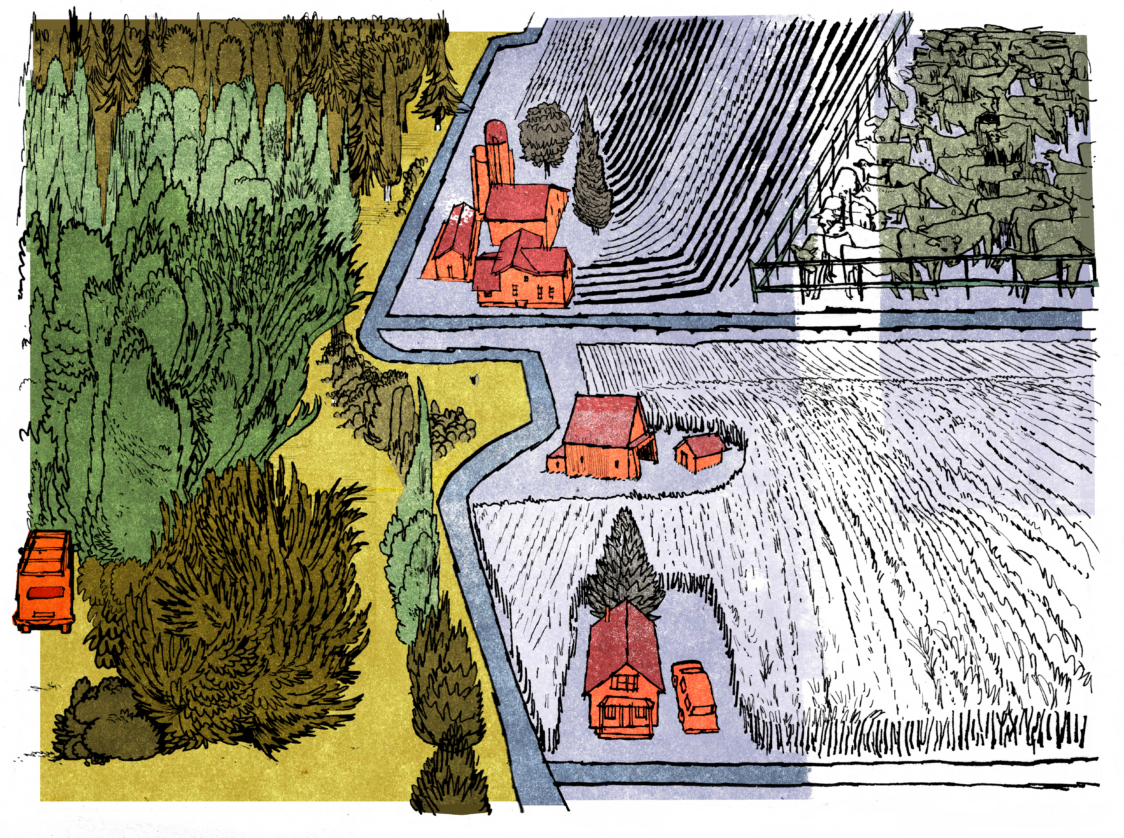
Every landscape vibrates differently. Driving north empty-minded and content, not knowing anything about where I was, I started thinking about my phone. It was listening, I knew, but I had gotten complacent. I had used it to search for the most insane things, and this anxiety overtook me. Then, on the side of the highway was a rectangular brown metal sign announcing that I was passing the NSA. Crossing Kansas, this terrible feeling came over us, before the vast lots began to appear beside the highway, feeding places for the thousands of cattle that wait each day to die, the way we’d felt the vibration of that fear before we saw them and drove crying without stopping till we hit the Missouri state line, knowing that if we wouldn’t have seen it, we wouldn’t have felt that massive pain.
You don’t even have to look up to know what part of town you’re in. In one part, the potholes have been filled, while in the other, you keep your eyes on the street to avoid them. On the side of town where you have to keep your eyes on the street, a lot of things are more expensive. A bathroom is more likely to cost twenty-five cents. Where bathrooms cost twenty-five cents, shopping carts might also require a twenty-five-cent deposit, at grocery stores where the options are fewer and, sometimes, the food more expensive. In this part of town, where credit is more expensive, rents are disproportionately high, and internet access harder to find—this is the part of town where you will be safer. On the side of town where the potholes have been fixed, the municipal regulations against “dwelling” in your vehicle are more strictly enforced and the neighbors more likely to call the police.
While I was at the architect and the real estate agent’s house, a nearby neighborhood, the wealthiest and whitest in the historically black city, was entertaining proposals to secede, to keep its tax money for itself. Like many in the United States of America, that city is laid out so that those with means live uphill and upstream. Although the U-bend brought an end to dumping the family bucket into the river, and although sewage pipes no longer empty into rivers but into wastewater-treatment plants, weather events continue to cause overflow, so when heavy rain comes to neighborhoods like that, shit floods the nearest waterway, and in the contiguous United States of America, nearly half the land drains into the same river basin. Even if the North pretends at its own exceptionality, its shit flows into the Ohio and the Mississippi and down to New Orleans, where every spring the water rises behind those levies again. Even if any of us succeeded at seceding, we would be connected with one another in this way, at least when it came to our most private efforts. That’s either impossible to ignore, if you live where the river rises, or easy to forget, if you don’t. But I think everyone who leaves their house always knows what side of town they’re on, even if we fight all day on the internet about what is real.
For six years it has always been on my mind, when getting to a place, where and how to take a shit there. But it’s not the biggest problem. The biggest problem is finding level ground, and there is hardly any of it in the entire United States of America.
A Ford E-250 pulled in and parked just ahead of us, beside a lake, on about a fifteen-degree slant, and no one got out. It was alarming, the extent to which this person never left the E-250, and impressive. So much of living in a vehicle is about learning not to seem to exist.
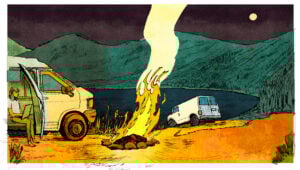
Sleeping on a slant is not really sleeping, in my view. Your muscles work all night to hold your body level. You can wake in unusual pain. It is a thin sleep at best, and after a few days a kind of psychosis can set in. It was clear to me that if the E-250 would move a few feet up and someone slid a nearby slab of rock under the back right tire, it would almost be level. But they did nothing about the slant, and for a day, or maybe even two, I never saw them outside their van.
Then I heard B’s voice and another person’s, and I climbed out to meet a pale woman in a brown bob and faded purple sweatshirt nodding nervously as she and B went through the motions of van greetings, discussing electrical systems and ways of finding free parking.
I am basically a forest gnome, she said. I just work all day in the van. I don’t come out.
But we invited her out, and the next night, over a campfire and amber ales, we sat and talked, related times we’d gotten our vans stuck in mud, and so on, until the forest gnome told us how she’d come to live in a van. After the pandemic came, things started burning—the high school she’d gone to, then a dumpster nearby, then the air itself. She came home from protesting outside the police station down the street to find tear gas filling the shitty condo she couldn’t afford with her student-loan payments, and then sewage filled her bathtub and her toilet started spewing shit. By July, she’d bought the E-250 for $2,000 and built a little home inside for her and her paddleboard.
It was a lovely and companionable night beside the campfire, and after a few hours, I asked her why a van and not some other way. And more quietly, she told us a story about a day four years before the pandemic came, the day everything changed. She was driving home after voting for the first woman president when a car slammed into hers, crumpling it. No one was hurt, but someone could have been, and she was shaken, felt knocked off course. Then, she said, her voice full of wonder, the next day she woke up to learn that 45 was elected.
It wasn’t that she thought the election and the accident were related. But for her, the events were connected forever, and reality shifted somehow. That day was a hinge in history and nothing would be as she’d expected from then on. The world was unreal, and when the pandemic came, she figured she might as well live in a van, paying off her debt and—she lit up, remembering the week before, in Florida, when she was paddleboarding with manatees. She was the managing editor of a literary magazine and what she’d been doing in there, those two days, was reading the slush pile.
Then another motor approaches the clearing in the forest. Or in the desert, we see the shimmer of a far-off vehicle bouncing toward our spot. Oh no. Who’s this? Are they vacationing (rich) or simply living (poor)? What color is their skin? Are they armed? Are they nice?
The next day, it’ll be us, motoring into the forest or the desert at ten miles an hour on a washboard road, bounce bouncy bounce, passing by, looking for a good spot while the people already there wonder about us: Are we vacationing or are we living? Are we armed? What color is our skin? In some places, in our Ford Transit cargo van, we look scary, dirty, clearly not vacationing. In others, given the high-top van with solar panels on the roof and the license plate, we’re the coastal elite, driving in slow, wondering who’ll be there. Are people just straight-out living here under those blue tarps? Looks like they’ve been here awhile. Do they have weapons, and how drunk exactly are they planning to get?
Some of the time, whoever’s there makes friends, shares food and beer, gives a hand, gets to talking, carefully, at first, given the algorithms and the politics, which everyone’s critical of, and all do find a way to bitch about the government and the media until the conversation turns toward the question of when everything changed and got so strange, and how much we hate how polarized we’ve become because of the people on the other side. Though the stories were different, they were all about the way seemingly unrelated things—the diagnosis and the president, the Democrats and the weather—felt very related, so much a part of something, some simulation.
Settled in together now, it is our turn to listen for the next motor, the next tires crunching the gravel road. Will they park too close? Will they be poor and actually living, will they be drunk and violent, will they be loud, will they be dilettantes vacationing with all the gear they’ve found online and obsessed over and gentrify the campground, will they be nervous about us because we’re not vacationing but living? Will they be kind? In this way, even out there in so-called nature, we create the United States of America again and again.
It was a handsome two-story house that J had been able to buy for cheap, before the neighborhood gentrified. She’d called a few months before to explain what she couldn’t text the summer before, the reason she wasn’t leaving the house to join the protests: she’d volunteered for the vaccine trials, and Moderna had prevented her from speaking about it. She hadn’t wanted to risk prison or death by the police until she’d done her part and the trials were done. I admired the house and asked whether she wanted to look in the van. She shook her head. For the first few days, we visited on the porch where there was a couch, and a ceiling fan that her husband, a carpenter, had installed to keep her cool in the afternoons when she passed out after a bottle of wine, and an anarchist flag hung from the porch and moved in the breeze as we drank white wine and told stories.
One afternoon, she told me a story about when she was eight and her parents had taken her to a party near a bayou. There was a bonfire, and at some point she wandered away from the grown-ups, beyond the circle of the fire’s light. She couldn’t remember how long she’d walked when the ground began to disintegrate beneath her feet. Before she could even scream, sludgy water pulled her down. The surface closed above her and she was on her way to dying. I died: that’s how she put it.
Then big hands wrapped around her little wrists and her father pulled her out of the swamp.
On the porch where she would not have been if he hadn’t pulled her out, we shook our heads. Can you imagine, we asked each other, can you imagine? We were thinking of him, but we almost couldn’t imagine the terror her father must have felt. Something in me recoils when I get near it: from his perspective, she had just gone completely away. With no idea where she was, he must have spun and shouted, and how long those seconds must have been before he heard the sludge move or bubble, or maybe he had a flashlight and saw what looked like solid ground shift just above where she was suffocating. How long those seconds must have felt as he ran and plunged his arms into the sludge to rescue her.
The horror of failing to save someone you count as kin, that they might die on your watch, is the flip side of love. How many people can we bear to care about that way?
On the porch, I was looking at her face and thinking too of how it could have gone another way. It’s wild to sit with someone you love and know there was a split second when they might not have existed, that there might have been this whole other life, in which you never met them. And I thought of how when the trials ended and she could call to tell me she’d volunteered for them, I asked why she’d done it. And she’d said it hadn’t really felt like a choice. She just had to. And I wondered if choosing to be a test subject, so early in the pandemic, had been like that, like shouting and running toward someone she cared about, except it was millions and millions of people.
In this country it’s weirdly easy to lose housing and then your way of getting enough money to get housing again. Maybe you are lower- or middle-class, even sometimes upper-middle-class but with a bad mortgage rate, and too many things happen at the same time: a medical issue (yours or that of someone you are taking care of), a rent increase, a few mortgage payments missed, an eviction, a surprise job loss. People can handle one, usually get through two, but when it gets up to three we start dropping out, thinking, Just for a few months, just for a year, and I’ll get back on my feet. If living in a vehicle is a work-around, then you’re climbing the steep learning curve of living invisibly in plain sight, which in most places is illegal, and so means moving conscious of how the police may treat you, and the neighbors, your relative risk. Then you’re dealing with cleanliness challenges, wardrobe issues, lack of internet and electricity for job searches, lack of the predictable schedule and addresses required to get through the hoops, and if the work-around is not a portal to anything but the basement, if mental-health issues weren’t there before, they might come along too.
I think a lot about the day after my mother’s stroke, when we argued about whether to get rid of everything and move into a van, and what would have happened if we didn’t, if things might have been better otherwise. In a way, it was the most consequential choice of my life but also not a choice at all—just love—moving into a van so I could be nearer and watch over her, circle around her without living in the house. Just love to get B out of the city, away from work that was breaking his back, to play his guitar. It was not even a decision, once the pandemic came, to park on that farm and bring her what she needed, when the hospitals were full and she was scared, and also not even a decision to drive toward friends who hadn’t seen a person in weeks, and park by their house and sit on their porch or in their backyard with them. But I see myself on the edge of the brown couch, bargaining, and him leaning and swiveling in an office chair across the room, and I hear myself saying, How will it work, and will you be happier, and I hear him say, I can’t promise you anything, I don’t know how things will go. I accompany myself from the apartment to the river to smoke and think and then go back inside again to bargain and argue, and I am so tempted to intervene, to say: Don’t do it. It won’t work. In four months, you’ll break up, leave him out there to travel up the Pacific Coast Highway alone with his sad story. Then the national forests will close and the campgrounds and public restrooms in cities and along the highways. People of your political persuasion will start washing their groceries, create elaborate decontamination rituals at the front door, and how will you do that, in a vehicle? You’ll keep having to quarantine for fourteen days alone, in a tiny space, living on canned food and dried noodles to avoid going into stores while mourning thousands and then millions of deaths, in places where the locals, your relatives, don’t believe that those deaths have happened and think that the plague you’re being so careful about to keep your mother and your immunocompromised friends alive and to keep visiting them is not real. You’ll go through this mostly in places that do not accept your Medicaid, pumping tanks of gas and using credit cards to pay fees at campgrounds where there is cell service so that you can work online to earn less than the cost of the spot. Then the APRs will go up, and the rents, and like millions of people you will go upside down, lose hope that you could earn enough to get a security deposit together, much less prove on paper you’d be a good tenant. I am angry at you. You have two of the most precious things in the United States of America: no credit-card debt and a roof over your head. And you are the kind of white person who thinks you can go half homeless without sliding down the steep slope toward the basement, without joining that great loneliness you’ve always feared. Don’t do it, I want to say. But you wouldn’t believe me; all this future would be as unimaginable to you as the lives of any people a few blocks or miles away whose stories your algorithms haven’t sent you. So I move around in the memory with you again and again, but I don’t say anything. You’ll run toward your mother and try to make an adventure of it with B.
I am in an apartment now, though I’m not sure for how long. At first, I was confused by how out of joint the place was with the sun, how little the temperature inside had to do with the outside. The sun would stream in and I’d plug in my gadgets to charge them, forgetting that the power would always be there. But then I sensed the crawling machinery that the place was built like a stage to disguise, the creepy root extractors that gathered water and gas and pumped them up into the building and wires stretched like IV tubes to be carried through bigger tubes strung across tall metal towers high above the ground from power plants carrying energy made from the remains of pressure-baked plankton and marine organisms that lived millions of years ago and forests cooked to coal beneath the surface of what we call the world. It took millions of years to make the oil and coal but only a century and a half for the virus of buildings to extract much of it.
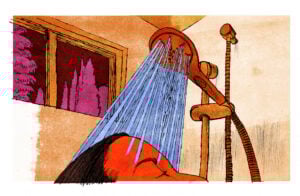
That first shower, though, with water I didn’t have to find myself. Water at a volume and speed I’d come to associate with the kind of downpour that can get the van stuck in mud. Water that came from no place I knew about, that cleaned and softened me, whispering of endlessness, and then disappearing down the drain. I was living in a structure that didn’t think it thought things, didn’t believe it believed in things, but it was thinking. It was organized to feel like care, and later, when I took a shit and pushed that lever, it disappeared down those pipes, and for a split second I could almost believe again in away.
Soon it seemed unimaginable, living in a vehicle. I could hardly remember anything about it. Though the closest grocery store was only one block away, I still couldn’t return without putting enough dry goods on a credit card to survive a plague in a mountain forest. And I kept making things the wrong way. Inside, we made nachos in the oven, or in the broiler, but I forgot this and had to really think, and then I made them in a frying pan on the stove like it was a campfire. And though the shower is right there inside the apartment, it’s hard to remember to use it more than once every week or so, though when I do get in there I stay a long time. And on a walk with friends in the woods upstate, I can smell that a bear has just passed through, but I don’t say anything to the humans about it. My allegiance is with the bear, and with the little fish in the swimming hole that used to make me nervous with their nibbling. I lost gender out there; when no one is looking at you, it goes away. But when I go out in the city, there’s the she she she again. The rest is the same, though, working to pay for the past, moving in retrograde motion, just surviving; to try to win anything here would be obscene.
It’s one small room, but there are yards of space between skull and ceiling and big old latticed windows like French doors facing the street. I put a desk before the windows, and I’m listening to the human voices of those who pass by. Strangers, I guess, but I can tell they’re not the strangers—I am. I should go out there and talk to them. If I already can’t remember anything about living in a vehicle, why can’t I shake the habit of hiding?
Outside the window, B is parked in the van. I’m on a Zoom call with a friend and she asks why I’m so disturbed. I tell her he’s texting me terrible things, thinks nobody cares about him, but he won’t come inside and take a shower. Then park somewhere else, I text him. He texts back, This neighborhood is a free country! He is about forty feet away, and I love him so much, and I get it, he’s afraid and lonely, he can’t find work, he’s tired and feeling vulnerable, and even living nearby, the difference is so great. I’d rather he come in here, no matter how bad the look in his eyes. When my friend suggests he’s being terrible, that I have to draw the line, I tell her she doesn’t understand. I get why he’s losing it. I mean, I say—and it spits out of me like a bad word—he’s homeless!
But what I meant was that there was something terrifying to lose between us. The closeness of our shared learning, how we invented new ways of coping. Now I’m in here and he’s out there.
We were in the desert once, and I had a high fever for a day or two and then all my skin broke out in an itchy rash and bubbled into blisters. All the emergency rooms were full, I didn’t have insurance, and B said, Well, we’ll have to deal with this ourselves. He pretended to be a doctor and checked me over patiently every day, implemented a protocol involving baking-soda paste, a fan, and for medicine, tiny s’mores. Even after the boils became terrible pus-filled demon eyes, hard to look at, you never would have guessed it from his eyes. Looking a little better, he always said. You’re doing a good job healing.
One day, though, it was really getting to me, the pain had become excruciating, and I wanted to tear all my skin off. We were on the rocky edge of a precipice over a great valley, and he laid me down on one of the rocks, on my back, in the sun, brought a jerrican of water from the van, poured some into a bowl, and put my head back. Focus on the water, he said. All my skin was burning, but when I shifted my attention to this cool water being wasted on me, it was all there was, this care without judgment or shame or impatience, without desire to get away from someone else’s pain, and the intimacy of inventing medicine when the system was strained.
I remember when the architect came into the van, how quickly I cleaned it so that there wouldn’t be any bad smell, how he looked around with his architect eyes, and what it meant when he said that we did a good job. And one night in upstate New York, when J crashed in the van with me, how proud I was for her to see the skills we might need, how I can build something from scraps, innovate water systems and multiuse furniture, and power appliances with the sun. When she got inside, she looked relieved, though she wouldn’t use the compost toilet. She went outside and squatted on the steps of a church and peed. Then she came back inside and lay down on the bed and smiled, and said, Okay. I get it.
She’s a writer, and I asked if it was all right if I told the story of her father pulling her out of the swamp, since it is one of the most important stories of her life and hers to tell.
The night I met Satan? she said.
What?
When I wandered away from the campfire because Satan was calling me.
You didn’t tell me that, I said. That’s not how I’ve been writing it, and frankly I do not know how to incorporate this. It’s about your dad’s love, how when you love someone you just run toward them.
That is correct, and you can write whatever you want, J said, but it was Satan calling me out there, and I am pretty sure, trying to drag me down to hell.
So maybe you will read another version of this story in the literature of the United States of America.
The plastic is still in the ocean, and the prisoners know who we are. The massacred haunt us, I hope, and the whales are attacking the yachts. I am freaking out about the water AI drinks and where the server farms are placed, but not about the two thousand gallons I probably used flushing an old toilet while writing this. To paraphrase Morton: What ethical calculation is not a hallucination, in the time after the fiction of away?
These days, though, I’m thinking a lot about evil and what it is. And still of J’s father running to save her. How it’s not even a choice to move your feet and reach for someone in danger when you consider them kin. It’s a kind of care that goes without saying. It has a responsibility in it that is an action, preceding thoughts or beliefs, before you know what to do, or if what you are doing will work. And this goes without saying, but to live lonely, in inaction, without the responsibility of care, to avoid the grief that caring always risks, is to live in the absence of love.
But in this infinite apartment internet, I’ve been watching Chicago teenagers drive around before school, tracking slow-moving vans, recording license plates, texting locations so that other people can arrive to witness, film, document names and phone numbers, state the facts in public before people are dragged away. I’ve watched the woman in the polka-dot dress flip off ICE officers in New York. The fruit carts and food trucks lined up as barricades. Human chains around vans.
You can see in them the love that runs toward instead. In the one fifth of adults in the United States of America who do unpaid caretaking, some of whom take on debt, miss bills, borrow just to keep going, you can see the running toward. In J’s drives to the vaccine-trial site and cartons of milk on the porch and the care of those who made maps of bathrooms that were still unlocked, of safe places to park during the lockdown, and of M, who organized her entire apartment building so that no elder or shut-in would be left without what they couldn’t go out to get: the running toward. And B, who just the other day ran recklessly into four lanes of traffic toward a pedestrian who’d been struck down, while others took out their phones to film the accident. He just ran toward her laid out on the ground and stopped traffic to protect her. And those biking in slow circles around the industrial park, watching for when the vans turn the corner, or filming from third-floor walk-ups, whispering, They’re here, those reciting rights in Spanish, recording, tracking, running toward instead of away. So many standing against the fiction of away, speaking of a way out of the great loneliness.
So when seven million people take to the streets across the United States of America to protest an administration that would send undocumented people away, non-white people away, trans people away, unhoused people away, people with student loans away, people who need Medicaid and food stamps away, what does the president do but retweet an AI video, set to “Danger Zone,” from the Top Gun soundtrack, of himself wearing a crown and flight suit, in a fighter jet, flying over the protesters, and covering them in long, brown, slimy streams of shit?
Well, I couldn’t remember much about living out here, when I was in there, but here in the parking lot I do.
You can shit less. You can choose not to shit for many hours, or even a couple of days, if you don’t have a place to do it or you want to wait until morning to cross the parking lot into the fluorescent lights of a superstore bathroom. We call that combining, and the eventual act, culminating. And it isn’t the end of the story of love, to deal with our shit together.
Crack a window, have the other put a pillow over their head.
We developed a way to dig a hole to take a shit and called it fracking. Desert ground can be tough as the floor of a house. Pour some water over it and hit it with a shovel, pour more water, hit, and dig. It’s hard work and time-consuming, but you really appreciate it when you are done.
In the forest, walk seventy paces from any water source and dig a cathole in softer dirt at least six inches deep, with an eye out for bears and human hikers. Use wipes and bag them to throw away later. Shitting in a squat, watching plants move at eye level in the wind, feels just right.
On my mother’s farm, I shit in the compost toilet we built inside the van, using a cover made of peat moss and wood shavings. Every few weeks, I dig a hole several feet deep to bury it not far from her garden, but not too close, where, in six months, it will be rich soil. Anyway, that’s what we do with our shit. What do you do with yours?