
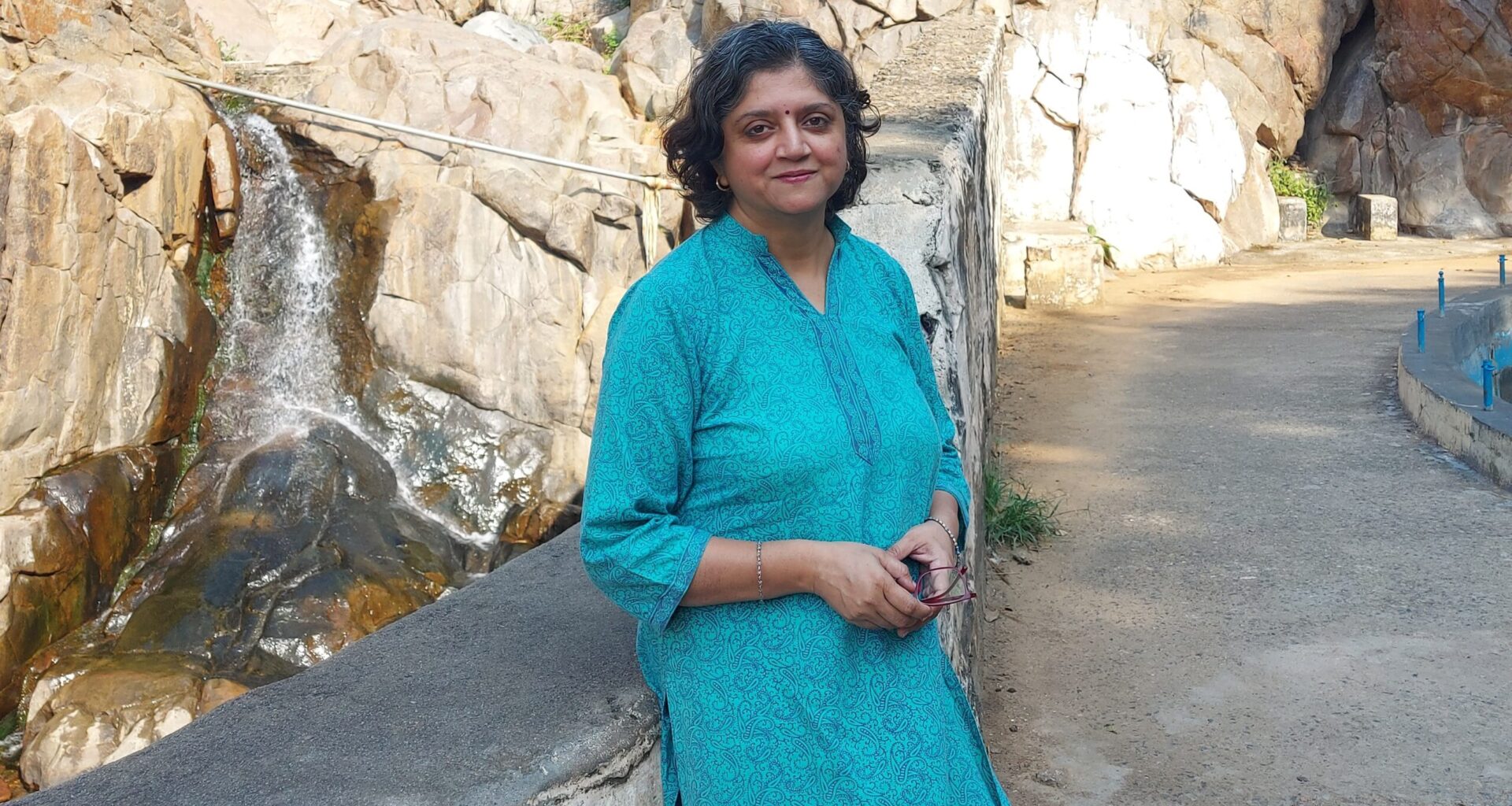
Psychosis and conditions like Schizophrenia have been tainted with pessimism right from the beginning. Doctors often don’t know that recovery is possible and can convey this fatalism to their patients. Prateeksha Sharma’s lived experience and research work challenge this pessimism. Prateeksha is a musician, researcher, composer, counselor, and writer. However, for the longest time, she was only thought of as a patient.
She is a distinguished research fellow at the National Academy of Legal Studies and Research in Hyderabad and the founder of Brightside Family Counseling Center. She received a diagnosis of bipolar disorder as a college student and has managed these achievements while navigating the horrors and the gifts of psychosis. Prateeksha’s writings critically examine psychiatric systems and foreground survivor perspectives. She brings intellectual depth and personal clarity to what it means to move from being labeled a patient to being recognized as a person.
In this interview, we discuss psychiatric subjectivation, medical zombification, the silencing effects of diagnosis, and how lived experience completely reshapes the conversation about mental health.
The transcript below has been edited for length and clarity. Listen to the audio of the interview here.
Ayurdhi Dhar: Can you tell us a little about your background, your personal lived experience?
Prateeksha Sharma: I was given a diagnosis of bipolar disorder in 1992, in the final year of college. I was put on psychiatric drugs, antipsychotics, for a long time after that, notwithstanding the fact that whatever upheaval happened in the first few days was contained very quickly.
In fact, my mom told the psychiatrist that my daughter is all right now, she’s sleeping and not running helter-skelter, so why don’t you just taper it off? But he said, “No, no, no, this has to go on for a long time”. He, in fact, upped the dosage. For the next 18 years, I remained on psychiatric medication, which means life was totally compromised. The foremost identity I had was a patient.
At that time, I was studying economics and had received musical training since childhood. 18 years went by like that with the medication. Many things happened—the music kept unraveling, and there were very difficult periods when I was absolutely frozen. You have long bouts of depression—you’re absolutely immobilized, you cannot do anything for months.
Like, I remember looking at my tanpuras and thinking, “Oh my god, did I really ever tune and play this instrument?” There was no question of singing; not a sound would come out of my throat. I was so frozen in my mind that I had no words. I could sit with somebody for hours and not articulate a single idea. There were no ideas. That was zombification, how the medication, it just takes over your life completely. It’s like becoming a stone. Your mind is frozen. I couldn’t believe that it was me.
I was one of the most compliant patients you would ever encounter, so disciplined, I wouldn’t miss a dose of medicine. 18 years is not a small amount of time. All these neuroleptics, like lithium, are given to us, saying that these keep you stable, but I saw that despite lithium and whatever else you got, you did have breakdowns. So, what is happening here? I’ve seen repeatedly that whenever the stressors in life were humongous and beyond my capacity to handle, I still had breakdowns, “psychotic breakdowns”.
Then I encountered a homeopath who was recommended to me by my family. I said, “No, I don’t think homeopathy can do anything”. But out of curiosity, I spoke with him. He asked me some very strange questions, like, “Do you have any sensitivity to sound?” I said, “Yeah, if I hear loud sounds, I have a lot of heart palpitations”. When I finally went to see him, he actually sat with me for two and a half hours.
Dhar: Unlike most psychiatrists who probably spend 5 to 10 minutes, right?
Sharma: Yes. The psychiatrist will talk to you for 5 to 10 minutes. He sat with me for two and a half hours, asking every single detail, including how cold or hot I feel, my hair, skin, everything. He said in homeopathy, you must have a capacity for observation. He told me right on the phone that you’ll recover. I thought this man didn’t know how serious bipolar disorder is. I’ve been a patient for 18 years. How can I recover?
Dhar: Had you ever heard that before?
Sharma: Never, never, never. Nobody ever said I could recover.
Dhar: If you were to look back on the 18 years and think about what the psychiatric and mental health treatment stole from you, what would come to your mind?
Sharma: Ayurdhi, I think it’s a very tough question because actually it stole my life away.
Dhar: I’m sorry to hear that.
Sharma: With the knowledge that I have today, had I had this knowledge those 18 years ago that are gone now… I can’t enter into any professional field to take up a job. I could have done something in music; I could have created a life for myself.
By the time I did my PhD, my work was outside the realm of comprehension of the average person—here the world is talking about mental illness, and I’m saying that there is no mental illness, that everybody can recover. What a claim! What a direction I’m taking, opposed to the whole world. I refuse to budge from that, no matter who’s listening. The fact that people are not recovering is not because they cannot. It’s because they have no enablement in the system. It suits everybody that people remain mentally suffering to maintain the status quo in society.
Dhar: I study corruption in the pharmaceutical industry; I study bad science. It is rampant. I completely understand what you mean about it serving the status quo when people do not recover.
Sharma: How will they legitimize their power otherwise? What is the claim to saying that I’m an expert and I have the capacity to understand your suffering and ameliorate it? They don’t. They can’t. Yet they have that claim, and because they seem to be men of science, they have the legal and the social power behind them.
Dhar: Science at its heart is supposed to be open and humble. There is little openness or humility that exists in many of the Psy-disciplines.
In the foreword to your book, Amita Dhanda says that she gleaned from it that the diagnosis itself was the greatest barrier to recovery. How can diagnosis foreclose recovery in the first place?
Sharma: You walk into a clinic, and you explain you’re suffering, your pain. You didn’t go with the intention of getting a mad label. You want to have some respite from your pain. They say you have schizophrenia. Now you think, “Wow, this is something legitimate because the doctor has a name for it”, okay?
People will quickly go and check what schizophrenia is sitting there in the office itself. They go, “Oh my God, it’s such a huge thing.” Now they enter into the portals of mental illness, and the whole world tumbles upon them. You read stories, watch films. The discourse tells you how dire your situation is. You don’t want to tell somebody, “I have schizophrenia”. It silences you. That’s the first thing that happens.
This is the beginning of how you become a subject of psychiatry. You walked in as a free individual, thinking, “I will go to this man who’s an expert at understanding pain, and possibly they’ll understand mine as well”. You come out with a diagnosis so dire and damning that you’re silenced.
You can’t tell anybody about this part of you, which is so salient—identity is transformed immediately, from a person you become the patient and a patient who has also a very powerful diagnosis. The more you investigate online, the more damning it becomes. Your family will also investigate. The doctor will say, “Please be sure that your child, your spouse, or whoever remains within the bounds of medication.” Then they’ll be manageable. The family is going to become the arm of psychiatry.
Then there is shame. I’m talking of the year ’92—my behavior was considered problematic because it was too extroverted—I was going around talking to people I ordinarily wouldn’t talk to or saying things I wouldn’t have said. After coming down with your suppressing medication, your neuroleptic, you feel the shame of what you’ve done. The loss of the social face is such a huge thing.
That is the start of the stigma, the self-stigma. This disables you because anybody who cuts themselves off from the social world is going to progressively become disabled. They’re going to keep shutting themselves inside their four walls, and that’s exactly the case with every psychiatric patient.
Dhar: So, a person is given an identity that they might find temporary relief in, but it also cuts them off from the rest of the world.
Sharma: Ayurdhi, the relief is very momentary. In fact, the word I would use instead of “relief” is “recognition” of their pain.
Dhar: There is a meaning to the pain. The relief comes from the recognition that there are others like me.
Sharma: You feel it’s legitimate. Maybe my family or my loved ones cannot understand me, but this educated man, who’s a doctor, gets me.
Dhar: This process of psychiatric subjectivation starts. For example, I noticed that for you and the people you interviewed for your book, even when they were doing really badly on all their medications, they were still good patients. They didn’t seem to realize it wasn’t working. What is it about my discipline that stops people from seeing that I am much worse than how I was when I first entered a psychiatrist’s or a psychologist’s office?
When did you start suspecting that something was off with the treatment or the system itself? What don’t many others not notice?
Sharma: The average person, who includes me, is not going to question psychiatry. Why would I be compliant if I didn’t agree with it? I did have faith. I believed that this was science and that it was working in my interest. Doctors are trying to do the best they can.
In fact, in the first year of taking the medication, I had a thyroid flare-up. I had a very bad case. When we went to the doctor, he said, “Oh, well, thyroid issue is a very natural outcome of lithium, so please get your thyroid checked”. But when you gave me the medication, you never warned me of that. They stopped that lithium, and then I was given Valproate, which damaged my liver. But I thought, “I’m stable, I’m able to function in the world. I can write an article”.
This is how most people think—“Now I’m functional, and I’m able to do day-to-day life. Even if I’m getting up late, I’m still getting up. I’m going to college. I’m going to work.” They compare that basic functionality to where I had totally broken down. They’re not seeing the effects it is having on the rest of the body, the iatrogenic harm.
By the way, I never said I’m quitting medication. It was my mother’s insistence. She said, “Beta, you better—this is a good homeopath you found”. I said, I don’t need to. I was very stable in my conceptualization of who I am as a stable patient. I had that stability narrative—this is good, this is me being functional, my whole life can go like this. But my family insisted on my seeing the homeopath. She paid for the ticket! I met the doctor, and he said, “You will be okay”. I said, he doesn’t understand how serious this game is.
I was in a state of inertia, believing that now I’ve achieved stability. This is exactly what I’ve seen in many other peer clients. Some say, “No, I’m quite stable with my medication”. I totally get that they would not like to upset their apple cart. People never question what harm they are coming to.
The outside force bringing about change has to be the family or someone who’s concerned about that person and says, “No, look elsewhere or do something else because this is causing you harm.” That was my mother and my sister. They pushed me to the homeopathic doctor, who said, ” You can quit. I said, “How should I stop the medicine, taper it off”? He said, no, you stop it today. I looked at that elderly man and said, “Listen, I’ve been on this for 18 years. I haven’t missed a dose. How can you say this to me?” It was blind faith in a way. I just believed him, and I quit cold turkey.
Dhar: I mean, given how much we know about withdrawal symptoms and tapering, this is quite something.
Sharma: There was a little tapering down in the sense that I had emotional flares up, but that didn’t last very long.
Dhar: How long did it last?
Sharma: Maybe six months. But that was also a time in my life with a lot of upheaval – breaking a house, a whole family moving in together; there were three packs of dogs. I handled that turmoil and came out unscathed; everybody was unscathed. We all came out alive.
Dhar: You had support. Families can be annoying and create mayhem, but if they are doing it right, they’re also that force that provides you with grounding when everything is shaking.
Sharma: That’s why I say the role of the family is so important, especially in India. My family is very educated, which is a blessing because we are skeptical of everything, every form of knowledge that seems dominant. We have critical perspectives on everything in the world. Otherwise, if you believe that doctors know best, then there’s no questioning.
Dhar: You call psychosis a misrecognition of distress. What do you mean? And what are the consequences when we define distress as psychosis? What happens to a person?
Sharma: I have been trying to unravel my own so-called psychosis time and again. I’ve had more than one episode; the last one was in 2024, after my dad’s passing, after a lot of stress had accumulated.
When you cross a certain level of suffering, when you can’t take it anymore, there’s some kind of rupture that happens—a separation of the individual from the universal. I also think the personal and collective unconscious are connected; there is some kind of gateway that opens.
Psych professionals are not there when that psychosis is building. It’s not one problem; it’s going to be multiple things. You failed one exam, and the next thing is you have a psychotic breakdown—nobody breaks down like that. It takes a lot. They might start crying, might even attempt suicide. But the psychotic breakdown is something much more protracted.
The stressors come from multiple domains. There may be a lack of nutrition, some social component, a personal setback of a deeper nature, say a divorce or death of a loved one. These things add up slowly. The distress gets more and more congealed and burdensome for the person to handle, and there is no redress. Nobody talks about it. At no point does this person get any help.
In my case, one of the triggers was my aunt’s demise in the second year of college. I was the person who took her to the hospital in her last journey. It had a deeper personal connection for me because I saw her frothing at the mouth, and it affected me as a 19-year-old. Nobody thought that my pain was even legitimate or that it merited recognition because she was an aunt.
Dhar: You write of recovery as nonlinear, and in a Mad in America article, you talked about your father’s death and the breakdown you had after. Could you tell us a little bit about that? People often get scared that they have relapsed, that it’s over, and expect recovery to be linear.
Sharma: This house where I live used to be a beehive of activity, people coming to meet my dad, and there was so much going on. Then, when he passed away, everybody left. It’s a four-storied house, and the whole house became empty. I had come back to this place after a decade and a half, so I had no connections except for my mom and my sister. I didn’t know anyone in the community. What do we need? Meaningful connection, recognition that we matter.
This time, I did not go out and have the reactions like when I had my earlier breakdown, but I was absolutely malnourished, living alone, not eating or sleeping properly. I went deep into music. I had all kinds of ragas and musical connections going on in my head, and tanpuras playing all over the house. It was very fascinating, and it opened my mind into new realms of music. I don’t feel bad about it. It’s like the gateway of consciousness opens, and then you have to gather what you can, but that gathering happens later on.
My sister and mother said I have had a breakdown, and let’s go to see a psychiatrist. I said, “No way, I’m not a psychiatric patient. I’ve done a PhD!” This neighborhood was very noisy at that time. The noise was the one that had triggered me off so badly. I did not take the psychiatric path. I made sure that I ate properly. My sister works with cannabis oils; it grows everywhere in North India. I had cannabis oils and some homeopathic medicine. Recovery is not so straightforward that, once it is accomplished, it stays stable for the rest of your life, because life will keep unsettling you time and again. It will keep bringing those meltdowns.
Dhar: I especially appreciate you sharing how you emerged out of this breakdown through a non-psychiatric path because people need to hear that there are these options.
You mentioned you were living alone with your dogs, and we had someone write this beautiful piece for Mad in South Asia about the presence of street animals in India and the healing power of touching a cat or petting a dog. Tell me about the importance of your dogs in your recovery.
Sharma: From the beginning of my life, there have been dogs. When I lived alone, I had dogs. They didn’t let me feel lonely. I had company, like children of my own. It was very active and lively having three dogs running around. My dogs have been my biggest rehabilitation, or may I say they are the real therapists in my life. They’re so central to everything, including the fact that I cook for my dogs at home.
If I had been living alone, I would have suffered from a lack of food and nutrition, but because food was being cooked for three dogs, one human automatically got something in the process. Not that I was eating dog food, but I had to ensure that there was food in the house and a functional kitchen, that they were well fed, taken care of, and taken for walks. It brought a certain discipline.
I was responsible for somebody. They were the ones who were actually there for me, not saying anything, not asking for anything, and yet they were simply there, and that was transformative.
Dhar: To be needed and responsible is a beautiful thing. You dedicated your book to your parents and wrote that a life worth living is lived for others and peers. This counters our current cultural obsession with self-care and self-preservation alone.
You wrote that music gave expression to the anguish in you, but it also gave you an identity as a musician and an artist, not just a patient. Tell us about your journey with music and how music has helped you.
Sharma: For me, music is a form of communication. In deep mental distress, communication breaks down. If a person finds the means to communicate their pain, whether it is music, theatre, painting, sports, walks in nature, knitting or crochet, serving the elderly, anything, it’s a form of communication. It’s the self, connecting with itself. When you practice music a lot, it also becomes silent somewhere. In that silence, you’ll find yourself. The essential thing is communication.
The rupture that has happened in the psychic fabric in psychosis is the rupture in the ability to communicate meaningfully to the world outside. That rupture can be mended when someone communicates in a language in which they can express themselves without threat. That communication is meaningful to you personally, and it will become your path of recovery as long as you keep doing it.
I felt that—I am not just a patient, I’m a singer, I’m a composer, a writer, a thinker, a researcher.
Dhar: That was beautiful. I will link our audience to a beautiful performance by you. Thank you for doing this with us, for this lovely conversation, and for teaching us so much about pain and recovery, dogs and music.
***
MIA Reports are supported by a grant from Open Excellence and by donations from MIA readers. To donate, visit: https://www.madinamerica.com/donate/