
Similar to the wide receivers class, this year’s safeties class isn’t top-heavy, but it’s deep with players who fit specific roles. Caleb Downs is a blue-chip talent in my eyes and for many evaluators, but I’ve talked to coaches who didn’t think he was a top-10 pick because of the lack of splash plays and high-end athleticism. So, he’s not a consensus top-10 prospect. There is a group of raw safeties who need development but offer high ceilings.
In this era of two-deep defenses influenced by Vic Fangio and Mike Macdonald, I’m moving away from the terms “post safeties” and “strong safeties” and categorizing safeties as “deep safeties,” “big nickels,” and “do-it-all” safeties who can do both and more. Deep safeties are safeties you trust to play deep. They are less viable than the rangy post safety such as Earl Thomas, but defensive coordinators need to have two who won’t give up explosives.
Big nickels are safeties who play in the slot but have a multitude of responsibilities. Playing deep, things unfold more slowly, and they have more time to react. But playing closer to the line of scrimmage, they have to react quicker, so the skills are much different. Also, nickels have to be able to cover different body types but can play the run like a linebacker at times. The value of the nickel is as great as ever, and some coaches believe finding a truly impactful one is as valuable as an outside corner.
Big nickelA.J. Haulcy
Haulcy has one of the most fun tapes to watch because he’s trying to destroy guys on every play. He’s extremely active, but to his own detriment at times. He tries to pounce on every play. Though he mostly played deep at LSU in 2025, he should play in the box early on as he learns a system in the NFL. His reactivity might be better in the slot, where he won’t leave a receiver wide open because he nailed down on an underneath route too quickly. He has the size, physicality and burst to thrive in the box.
Keionte Scott
Scott isn’t a “big” nickel in size, but he plays much bigger than his size. He weighed in at only 193 pounds, but he has heavy hands and attacks blockers like he’s trying to take their lunch money. He was used as a blitzer a lot. He times up the blitz well and has edge-like bend around the corner. His ability to rush the passer will be a legitimate tool. What makes him unique is he has the man skills to match up with slot receivers and strong click-and-close ability, playing underneath zones. He’s an older prospect (25 years old), but his unique set of skills could be impactful in the right system.
Jalon Kilgore
Kilgore was Nick Emmanwori’s successor at South Carolina, and he can be accurately described as Emmanwori lite from a traits perspective. He’s not as big and fast as Emmanwori but is still a freak in his own right. However, he’s not nearly as natural in man coverage as Emmanwori was. He’s too impatient and often bites on the first move. He has the traits worth developing, but he’s not a Day 1 starter and much more of a project at nickel. It’ll take a lot of refinement, but the hope is he can develop into 75 percent of what Emmanwori is for the Seattle Seahawks.
Wild card: Kyle Louis
Louis played a hybrid role at Pitt. He played “star” linebacker — a term usually reserved for nickels. He was essentially a nickel and played on the wide side of the field. Louis’ sideline-to-sideline burst pops on film. He’s too light (220 pounds), nor does he have the physicality to play full-time linebacker, but his movement skills are elite. He has a great understanding of zone and how to play passing lanes. He showed his man coverage chops at the Senior Bowl, locking up running backs and tight ends, according to The Athletic’s Dane Brugler. In this new era of light box defenses, Louis can be an interesting fit as a big nickel.
Deep safetyBud Clark
Clark’s 4.4 speed shows up on tape. He has enough range to play effectively as a middle-of-the-field safety in an old-school one-high system. He’s twitched up and effortlessly flips his hips to cover ground. He’s thinner, but doesn’t mind getting in the mix against the run, though it isn’t his specialty. He has strong ball skills and can attack the ball in the air. On a team with a designated nickel, where he can stay deep on most snaps, Clark can be a rangy playmaker.
Jakobe Thomas
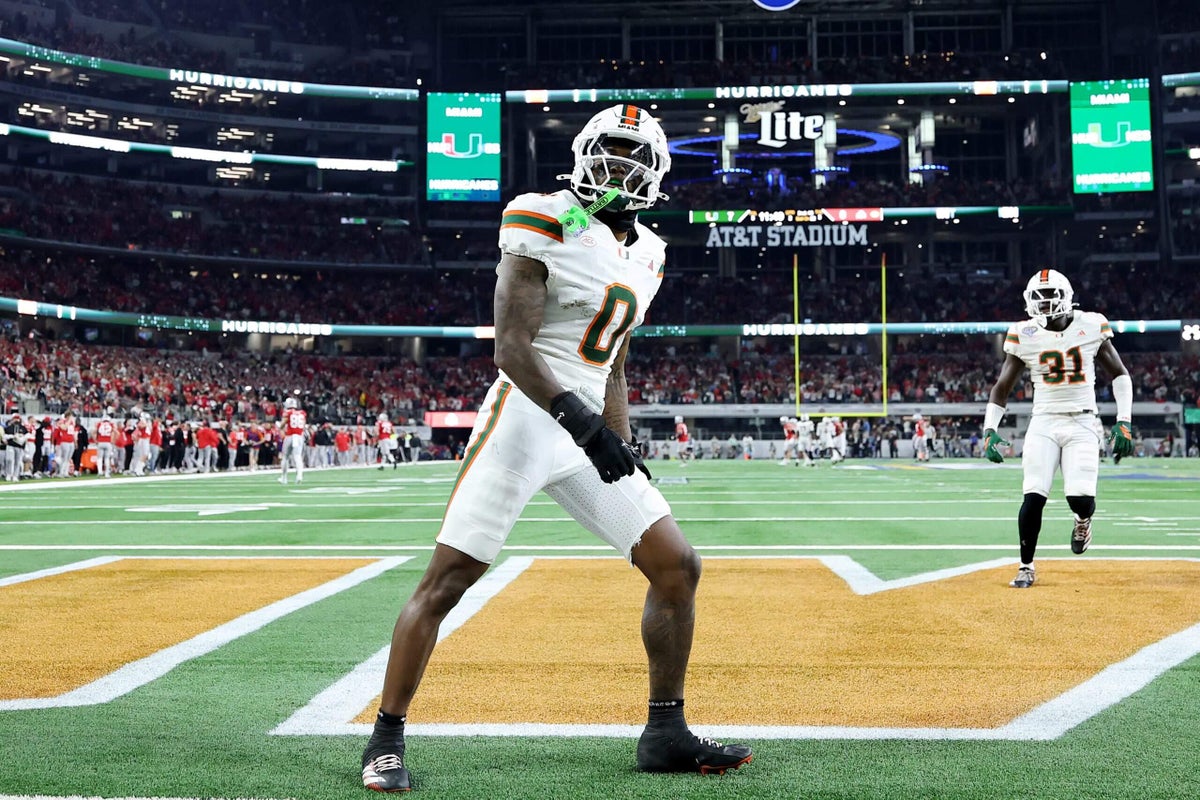
Thomas mainly played as one of the deep safeties in Miami’s quarter-based system. Thomas plays with reckless abandon and little worry for self-preservation with the way he throws his body around. Though he’s physical coming down and playing the run from the alley for driving on underneath passes, he’s rarely out of position. He can miss tackles because of his aggressiveness, but he doesn’t bust coverages often. There are times I want him to trigger a little faster against passes, and his movement skills are average, but he’s a player you can trust to play deep and come up against the run with physicality.
Kamari Ramsey
Ramsey was a deep safety until last season, when he had to move to the nickel because of injuries. Though he wasn’t a natural fit in the slot, he selflessly moved and learned it on the fly. The experience helped him become a better overall player. Ramsey is better playing deep, where he can showcase some of his natural movement skills and range. He wore the green dot, meaning he was the one getting the calls from his defensive coordinator — a role typically reserved for linebackers. Ramsey isn’t a “splashy” pick, but he’s the prototype for credible deep safety in a two-high system.
True do-it-allCaleb Downs
In the draft cycle, Downs is blowing away coaches with his ability to break down defenses on the chalkboard. He will be the cliche extension of a coach for any system he’s put in. At Ohio State, defensive coordinator Matt Patricia changed his role from game plan to game plan. He was the “hole” player in a Cover 2 in some games. He was a slot in some games. He was a blitzer in others. Though Downs is smaller (6 feet, 206 pounds), he’s an extremely physical run defender and can knock back pulling offensive linemen better than some linebackers. He will be a nuisance for NFL offenses because of his anticipation from film study.
Dillon Thieneman
Thieneman played a unique role for Oregon. It played a three-safety defense with a 4-1 front in which he was essentially the weakside linebacker. He showcased the ability to quickly diagnose runs and was an incredible run fitter on inside gaps, a rare ability for a safety. Though he’s smaller, he does an exceptional job of avoiding blocks. He takes excellent angles and is always around the ball. Thineneman’s not a huge hitter, but he can play at a high level deep or in the box. His best fit would be with a creative defensive coordinator who will move him around.
Emmanuel McNeil-Warren
Some coaches are very high on McNeil-Warren, and he will very likely get drafted in the first round. Though I can see his potential as a 6-3 safety who covers ground and comes against the run with nastiness, he’s very raw. He can take bad angles, miss his run fit, miss tackles and blow coverages that lead to big plays. Some see him as the next Emmanwori, but Emmanwori had excellent man-to-man coverage film, and I struggle to find that with McNeil-Warren. He is a thumper in the alley, does a good job of navigating through traffic, is terrific at forcing fumbles (nine career forced fumbles) and has excellent range closing in on passes, but the up-and-down nature of his game is concerning for a first-round pick.