
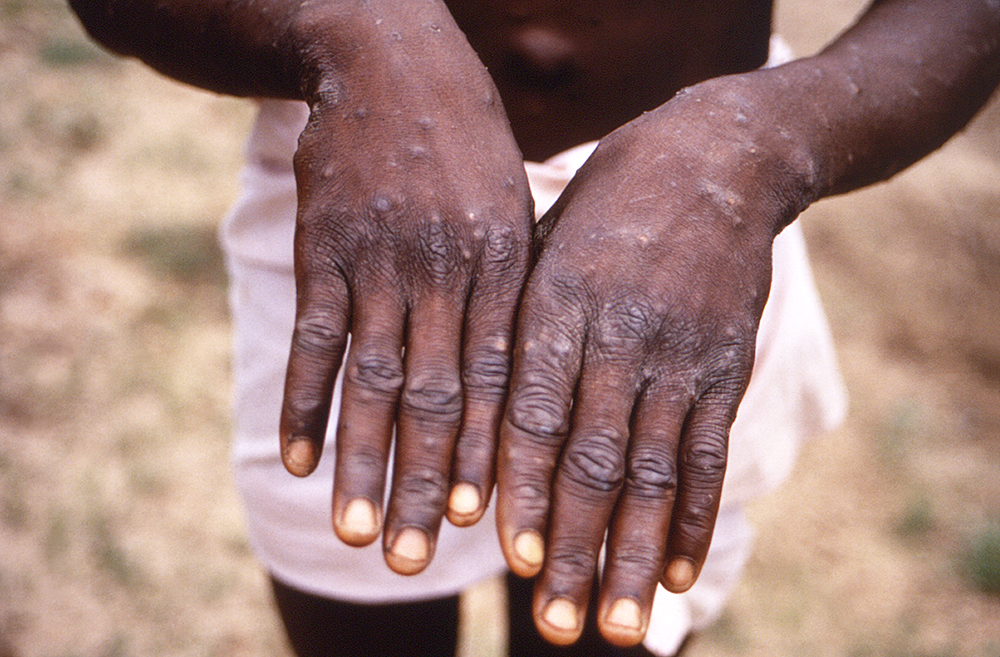
This CDC image shows the characteristic mpox rash on a patient’s skin during the recovery stage. San Francisco has confirmed its first case of clade I mpox in an unvaccinated adult who had contact with an international traveler.
Centers for Disease Control and Prevention
San Francisco public health officials on Wednesday confirmed the city’s first case of clade I mpox, a strain of the virus that officials say may cause more severe illness than the type behind the outbreak in 2022.
The case was identified in an unvaccinated San Francisco adult who was hospitalized and is now improving, according to the San Francisco Department of Public Health. The person reported close contact with someone who had traveled internationally, the agency said.
Health officials stressed that the risk to the general public remains low. But they urged people at higher risk of exposure to get fully vaccinated with the two-dose mpox vaccine.
Article continues below this ad
“SFDPH is closely monitoring mpox. While clade I mpox cases remain rare in the United States, clade II mpox cases continue to occur in San Francisco and throughout California,” Dr. Susan Philip, the city’s health officer, said in a statement. “This development reminds us just how important it is to be fully vaccinated against mpox if you are at risk. With summer travel and events quickly approaching, now is a great time to seek the mpox vaccine.”
The announcement puts San Francisco on a short list of U.S. jurisdictions to report clade I infections, which federal officials have been tracking as outbreaks continue in parts of Africa and occasional cases surface in the United States and Europe.
San Francisco Chronicle Logo
Make us a Preferred Source to get more of our news when you search.
Add Preferred Source
According to the Centers for Disease Control and Prevention, 15 clade I mpox cases had been reported in the United States as of March, including four reported that month. All of those patients were recovering, the agency said.
The CDC has said the risk to most Americans remains low, though it describes the risk to men who have sex with men as low to moderate.
Article continues below this ad
There are two main types of mpox virus: clade I and clade II. The 2022 outbreak in the United States was driven by clade II, which is still circulating at low levels, including in California.
Both forms of the virus can cause fever, swollen lymph nodes, fatigue and a rash that can look like pimples or blisters. In the United States, mpox spreads mainly through close skin-to-skin contact, including sexual contact, according to local and federal health officials.
Clade I has historically been associated with more severe illness than clade II. But federal health officials have also said they are still monitoring cases to better understand how severe clade I infections are in the United States, where reported cases remain rare.
San Francisco officials said the vaccine offers protection against both clade I and clade II. They urged people at risk to get both doses, especially ahead of summer travel and large events.
The city said people can get the vaccine through health care providers and local pharmacies. People without insurance, or those having trouble getting care, can find vaccination sites through the city’s mpox resources page.
Article continues below this ad
Officials said anyone with a rash that could be mpox should contact a health care provider for testing and notify partners so they can take steps to reduce the risk of spreading the virus.
While anyone can get mpox, health officials say most reported cases in the United States have been among gay and bisexual men and other men who have sex with men, as well as transgender people who have sex with men.
The San Francisco case follows earlier clade I cases reported elsewhere in California. In October, Los Angeles County public health officials confirmed a clade I infection in an adult with no recent travel to a region where the strain is typically found. That patient was hospitalized and later recovered at home, officials said.
Public health agencies have leaned heavily on vaccination as their main message. The two-dose Jynneos vaccine remains the best protection against mpox, officials say, and can reduce the risk of severe illness, hospitalization and death.
Article continues below this ad
People who got the first dose but never got the second do not need to restart the series, even if more than 28 days have passed, San Francisco health officials said.
Booster doses are not recommended at this time for people who have already completed the two-dose series, the department said.